
Distribute time to industrial equipment with a clock selected for the required reference sources, output protocols and timing performance. Compare the complete antenna and network arrangement, holdover behavior and monitoring so timestamp requirements become a verifiable installation scope. Prioritize requirement, references, outputs. Use the checkpoints to build a consistent equipment scope and confirm the intended trial or installation evidence. The official image is a product reference; it does not establish availability or an authorized supplier relationship. Submit OEM/ODM changes for application-specific feasibility review.
Distribute time to industrial equipment with a clock selected for the required reference sources, output protocols and timing performance. Compare the complete antenna and network arrangement, holdover behavior and monitoring so timestamp requirements become a verifiable installation scope.
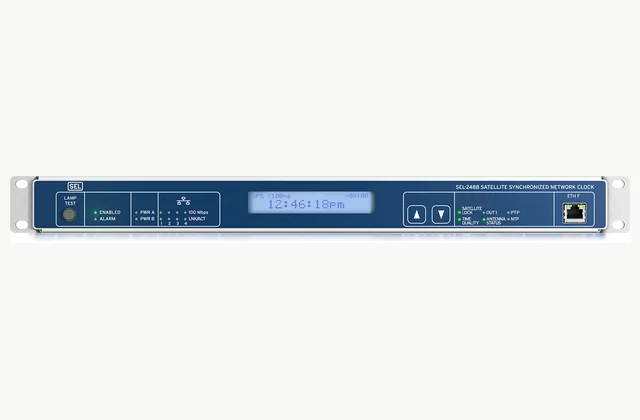
Shown as a configuration reference. Availability and the equipment offered for your project are confirmed separately.
Define why the installation needs synchronized time
Time synchronization can support event records, measurement correlation and other industrial applications, but these tasks have different accuracy and interface needs. List the devices and the timing relationship required between them. Distinguish absolute time from relative synchronization and identify where timestamps are generated. A clock’s headline accuracy does not establish the accuracy of records produced by every connected device across an unspecified network or cable arrangement.
Select reference sources and outage behavior
Identify the primary time reference and any alternatives the design requires. Satellite reception needs an appropriate antenna installation, while network references have their own dependencies. Discuss what the system must do when the selected reference is unavailable. Holdover depends on the exact oscillator, configuration and conditions; it should not be treated as a universal duration or accuracy promise. Request evidence matching the proposed unit and intended outage case.
Match output protocols and receiver requirements
List NTP, PTP, IRIG-B, pulse or frequency outputs only where required by the actual endpoint equipment. Protocol name, electrical format and profile can all matter. The SEL-2488 reference supports several timing arrangements with configuration-dependent options. Confirm the supplied outputs and any upgrade or license needs. A device receiving one timing format may need an appropriate interface or converter rather than a simple connector adapter.
| Selection issue | Information to specify |
|---|---|
| Requirement | Absolute or relative timing and the endpoint measurement point. |
| References | Primary source, alternative sources and required outage behavior. |
| Outputs | Protocols, profiles, electrical formats and supplied options. |
| Installation | Antenna, cables, network topology and relevant delay conditions. |
| Operations | Alarms, redundancy architecture and configuration support. |
| Evidence | Agreed timing method and complete-chain acceptance records. |
Engineer antennas, cables and network paths
Provide antenna position, cable route, grounding or protection requirements and installation environment. Include permitted cable types and any delay compensation relevant to the design. For network-distributed time, identify the topology and participating infrastructure and review how it supports the intended timing protocol. A capable clock cannot remove unknown delays introduced elsewhere. Assign responsibility for the complete path from reference reception to the endpoint that uses the time.
Plan redundancy, alarms and maintenance
Specify the desired response to reference loss, power loss or a device fault. Identify required alarms, monitoring interfaces and who receives them. Redundant supplies or reference inputs support a defined architecture but do not automatically create end-to-end redundancy. Check firmware support, access control and configuration backup. Retain oscillator and option identification because a replacement with a different configuration may have different holdover or output behavior even within the same product family.
Accept timing at the relevant point
Agree a measurement method and conditions appropriate to the timing requirement, including the endpoints or interfaces where performance matters. Verify configured outputs, reference status, alarms and the agreed loss-of-reference behavior. Retain the installation details and measurement records with the final configuration. Do not treat a front-panel indication of synchronization as proof that all application timestamps meet their requirement. The acceptance needs to address the complete installed timing chain.
Scope OEM/ODM without losing traceability
Rack integration, labels, output organization and configuration can be reviewed. Changes to reference receivers, oscillators, outputs or timing software need validation and lifecycle support. Provide endpoint requirements and the complete distribution design with the brief. Any customized assembly should preserve component identity and its own timing evidence. A reference manufacturer’s photograph does not establish certification, private-label authorization or the performance of an altered timing chain.
What should your industrial time synchronization device RFQ include?
- Requirement: Absolute or relative timing and the endpoint measurement point.
- References: Primary source, alternative sources and required outage behavior.
- Outputs: Protocols, profiles, electrical formats and supplied options.
- Installation: Antenna, cables, network topology and relevant delay conditions.
- Operations: Alarms, redundancy architecture and configuration support.
- Evidence: Agreed timing method and complete-chain acceptance records.
- Destination, site conditions and delivery access
- Installation boundary, utilities and connection drawings
- Acceptance procedure, documentation and training scope
- OEM/ODM changes: interface, material, branding or new design; written engineering feasibility required
Need OEM / ODM customization?
Submit branding, packaging, configuration or engineering requirements for this equipment. Include the target market, initial and annual quantities, required changes and acceptance criteria.
Customization feasibility, permitted branding, development responsibilities, minimum quantity, cost and lead time are reviewed for the proposed supplier and configuration before a quotation is confirmed.
Frequently asked questions
Does clock accuracy equal timestamp accuracy at every device?
No. Distribution paths, endpoint behavior and where timestamps are generated affect the result. Define the application requirement and verify performance at the relevant point. A precise source clock alone does not establish the accuracy of records across an unspecified industrial network or cable arrangement.
Are NTP, PTP and IRIG-B interchangeable?
They are different timing interfaces and need compatible endpoint and infrastructure arrangements. Specify the required protocol, profile and electrical format where relevant. A product supporting several outputs still needs the correct configured option and installation; a connector adapter does not translate an unsupported timing method.
What does holdover mean in procurement?
It describes timing behavior after the reference is lost, under specified conditions. Performance depends on oscillator and configuration. State the outage case and required result and ask for applicable evidence, rather than treating a family-level description as a universal accuracy or duration guarantee.
Why must antenna installation be included?
Satellite-reference operation depends on an appropriate receiving arrangement and cable path. Specify position, routing, protection and relevant cable-delay conditions. A clock-only quotation can omit components and installation work needed for reliable reference reception, making the complete timing scope unclear.
How should a synchronization device be accepted?
Verify the intended outputs, reference status, alarms and agreed interruption behavior using an appropriate measurement method. Include the points relevant to application timing. Retain configuration and installation records; a synchronized indicator does not by itself prove that every connected endpoint meets its timestamp requirement.
Can industrial clocks be customized for an OEM rack?
Rack organization, labels and configuration may be reviewed. Changes to receivers, oscillators, outputs or software require timing validation and lifecycle commitments. Provide the distribution design and endpoint requirements so the customized package retains traceability and evidence for its own installed timing chain.
Reference information
- SEL-2488 Satellite-Synchronized Network Clock | Schweitzer Engineering Laboratories
- SEL-2488 Satellite-Synchronized Network Clock - Documentation | Schweitzer Engineering Laboratories
Reference data and images explain equipment configurations. IndustryApex engineers confirm the offered model, specification and commercial scope in your project quotation.