
Specify a two-hand control station as part of a complete machine protective function. Review the actuation devices, compatible safety logic, stopping behavior and workstation geometry together, with a competent machinery safety specialist responsible for the application and validation. Validate normal operation, simultaneous actuation, release and re-initiation, held-input attempts and specified faults using the approved machine test plan. Confirm stopping behavior and station placement on the actual installation. Keep the configuration, circuit and validation record; a standalone station demonstration cannot establish the complete machine's protective performance. Submit the intended configuration and any OEM/ODM changes for project-specific feasibility review.
Specify a two-hand control station as part of a complete machine protective function. Review the actuation devices, compatible safety logic, stopping behavior and workstation geometry together, with a competent machinery safety specialist responsible for the application and validation.
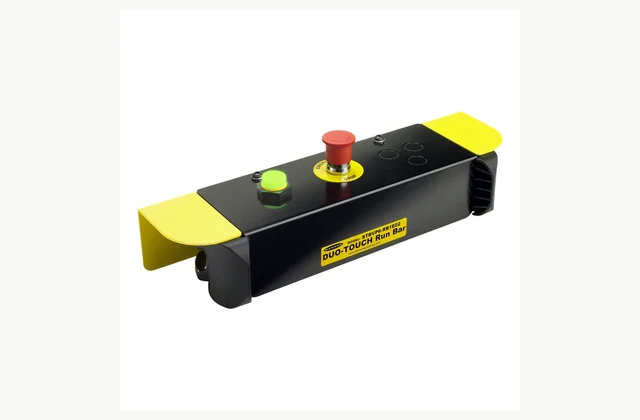
Shown as a configuration reference. Availability and the equipment offered for your project are confirmed separately.
Define the hazardous operation and users
Describe the machine movement, operator tasks and every person who could reach the danger area. A two-hand station occupies its user during an intended operation; it does not by itself protect another person, stop access from another side or address hazards outside the assessed machine function.
Match actuators with safety logic
Identify the exact station, self-checking actuation devices and compatible safety controller or module using official documentation. Define the complete circuit and monitored outputs. Two ordinary buttons connected to normal control logic cannot be assumed to provide the intended protective behavior just because both are pressed during a demonstration.
Verify simultaneity and anti-tie-down behavior
Document the required simultaneous actuation, release and re-initiation behavior with the responsible safety designer. Test attempted held inputs, interrupted operation and relevant faults. An ergonomic pair of touch devices does not establish these logic functions without a correctly designed and validated station-to-machine control system.
Calculate placement from stopping performance
Provide measured machine stopping time, approach paths and the proposed station position for the applicable safety assessment. Mounting distance must follow that assessment and the device instructions. A convenient distance seen in a reference photo cannot establish adequate separation for another machine, stopping system or operator approach.
Consider posture and unintended actuation
Review hand spacing, reach, visibility, clothing and the possibility of operating both actuators with one hand or another body part. Assess the final mounting, not just the standalone bar. Operator comfort supports correct use, but ergonomic preference cannot override the protective function's verified layout and anti-defeat requirements.
Retain validation and service records
Define who validates the complete circuit and which inspection and proof-test procedures are required. Identify approved replacement devices and settings. Replacing a touch button or relocating the station can change the protective function, so document modification control and repeat the appropriate validation before returning the machine to service.
Compare a complete two-hand control station scope
| Decision | Information to compare |
|---|---|
| Define the hazardous operation and users | Hazardous movement, operator tasks, personnel exposure and other access routes |
| Match actuators with safety logic | Station/device models, compatible safety logic and complete monitored circuit |
| Verify simultaneity and anti-tie-down behavior | Simultaneity, release/restart rules, held-input tests and fault behavior |
| Calculate placement from stopping performance | Stopping measurement, approach geometry, placement calculation and mounting constraints |
| Consider posture and unintended actuation | Workstation reach, spacing, visibility, mounting and unintended-actuation assessment |
| Retain validation and service records | Validation responsibility, inspection tests, approved spares and modification control |
Plan installation and access
A competent machinery safety integrator should coordinate risk assessment, circuit design, station mounting and control validation. Follow the exact station and logic-device instructions, including wiring and fault monitoring. Confirm protection of other access routes and retain the stopping-time evidence, placement calculation, final drawings and operator training for the installed machine.
Agree acceptance evidence before ordering
Validate normal operation, simultaneous actuation, release and re-initiation, held-input attempts and specified faults using the approved machine test plan. Confirm stopping behavior and station placement on the actual installation. Keep the configuration, circuit and validation record; a standalone station demonstration cannot establish the complete machine's protective performance.
Define OEM/ODM engineering boundaries
OEM mounting, approved actuators and cable arrangements can be reviewed. ODM station geometry, safety logic or protective-function changes require specialist engineering and revalidation. Reference imagery establishes neither agency nor a transferable safety approval for another machine, layout or incompatible control module.
What should your two-hand control station RFQ include?
- Hazardous movement, operator tasks, personnel exposure and other access routes
- Station/device models, compatible safety logic and complete monitored circuit
- Simultaneity, release/restart rules, held-input tests and fault behavior
- Stopping measurement, approach geometry, placement calculation and mounting constraints
- Workstation reach, spacing, visibility, mounting and unintended-actuation assessment
- Validation responsibility, inspection tests, approved spares and modification control
- Destination, working environment, access and delivery constraints
- Installation responsibility, utilities and connection drawings
- Acceptance samples, documented test method, operator training and maintenance scope
- OEM/ODM changes requested: identification, tooling, interfaces or new design; engineering feasibility to be confirmed
Need OEM / ODM customization?
Submit branding, packaging, configuration or engineering requirements for this equipment. Include the target market, initial and annual quantities, required changes and acceptance criteria.
Customization feasibility, permitted branding, development responsibilities, minimum quantity, cost and lead time are reviewed for the proposed supplier and configuration before a quotation is confirmed.
Frequently asked questions
How do I define the hazardous operation and users?
Describe the machine movement, operator tasks and every person who could reach the danger area. A two-hand station occupies its user during an intended operation; it does not by itself protect another person, stop access from another side or address hazards outside the assessed machine function.
How do I match actuators with safety logic?
Identify the exact station, self-checking actuation devices and compatible safety controller or module using official documentation. Define the complete circuit and monitored outputs. Two ordinary buttons connected to normal control logic cannot be assumed to provide the intended protective behavior just because both are pressed during a demonstration.
How do I verify simultaneity and anti-tie-down behavior?
Document the required simultaneous actuation, release and re-initiation behavior with the responsible safety designer. Test attempted held inputs, interrupted operation and relevant faults. An ergonomic pair of touch devices does not establish these logic functions without a correctly designed and validated station-to-machine control system.
How do I calculate placement from stopping performance?
Provide measured machine stopping time, approach paths and the proposed station position for the applicable safety assessment. Mounting distance must follow that assessment and the device instructions. A convenient distance seen in a reference photo cannot establish adequate separation for another machine, stopping system or operator approach.
How do I consider posture and unintended actuation?
Review hand spacing, reach, visibility, clothing and the possibility of operating both actuators with one hand or another body part. Assess the final mounting, not just the standalone bar. Operator comfort supports correct use, but ergonomic preference cannot override the protective function's verified layout and anti-defeat requirements.
How do I retain validation and service records?
Define who validates the complete circuit and which inspection and proof-test procedures are required. Identify approved replacement devices and settings. Replacing a touch button or relocating the station can change the protective function, so document modification control and repeat the appropriate validation before returning the machine to service.
Reference information
- Banner Engineering DUO-TOUCH Run Bar official product reference
- Banner Engineering two-hand control station official family or technical reference
Reference data and images explain equipment configurations. IndustryApex engineers confirm the offered model, specification and commercial scope in your project quotation.