
Specify a safety light curtain from the access hazard, required detection capability and complete machine stopping time. Match protected height, placement, interfaces and restart logic through a qualified risk assessment, then validate the installed protective system using the prescribed test procedure. Validate all intended access paths using the prescribed test piece and an approved safe procedure. Verify stopping, fault response, muting where applicable and reset/restart behavior with final machine elements included. Record installed device codes, geometry, stopping evidence and responsible sign-off, retaining the configuration for future service checks. Submit the intended configuration and any OEM/ODM changes for project-specific feasibility review.
Specify a safety light curtain from the access hazard, required detection capability and complete machine stopping time. Match protected height, placement, interfaces and restart logic through a qualified risk assessment, then validate the installed protective system using the prescribed test procedure.
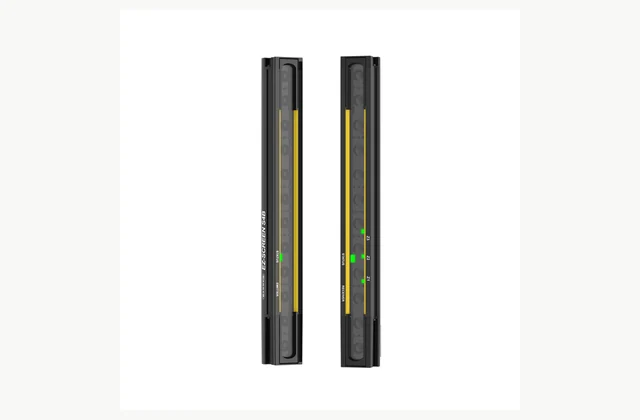
Shown as a configuration reference. Availability and the equipment offered for your project are confirmed separately.
Define what access must be detected
Determine whether the function addresses fingers, hands, body access or another defined approach. Select the required detection capability and safety performance from the risk assessment and exact device instructions. A tall light curtain does not automatically detect a smaller object or protect every path into the machine.
Calculate placement from stopping behavior
Include sensor, controller and final-element response and the machine's measured stopping time. Qualified design must establish separation and prevent reach-over, reach-under or access around the beams. Placing the curtain close to the tool because it fits the frame is not an adequate engineering basis.
Match emitter and receiver geometry
Check span, alignment, mounting stiffness and any mirrors or cascaded units. Reflections and obstructions can affect the installed arrangement. Confirm the exact compatible emitter/receiver pair and accessories, avoiding a quotation that mixes family-level parts without an approved configuration.
Specify muting and blanking deliberately
Material passage or fixed obstructions can prompt requests for muting or blanking. These functions change the protective arrangement and need qualified assessment, monitored logic and validation. They should not be used as informal ways to suppress nuisance stops or allow an operator to bypass the detection zone.
Integrate OSSD and restart functions
Match safety outputs, test behavior and external monitoring with the controller or relay. Define manual reset location and restart interlock as required by the application. Ordinary diagnostic indications are useful for troubleshooting but do not replace the safety output path and the machine's validated stop response.
Plan regular checks and replacement
Keep optical surfaces clean and brackets accessible without allowing casual repositioning. Obtain test-piece instructions, inspection frequency and replacement part identification. Changing beam height, brackets or receiver wiring requires the relevant verification because a working status light does not establish that the original protective geometry remains intact.
Compare a complete safety light curtain scope
| Decision | Information to compare |
|---|---|
| Define what access must be detected | Hazard/access assessment, detection capability and required protected height |
| Calculate placement from stopping behavior | Stopping-time evidence, response chain, separation and bypass routes |
| Match emitter and receiver geometry | Span, alignment, brackets, mirrors/cascades and matched device codes |
| Specify muting and blanking deliberately | Muting/blanking purpose, conditions, monitored sequence and validation boundary |
| Integrate OSSD and restart functions | OSSD/interface compatibility, feedback, reset location and restart interlock |
| Plan regular checks and replacement | Optics cleaning, test pieces, inspection, bracket datum and replacements |
Plan installation and access
Qualified installers should follow the approved mechanical and electrical drawings and the selected light curtain instructions. Secure alignment, protect cables and control access during commissioning. Where mirrors or auxiliary sensors are included, verify the complete arrangement rather than each device in isolation.
Agree acceptance evidence before ordering
Validate all intended access paths using the prescribed test piece and an approved safe procedure. Verify stopping, fault response, muting where applicable and reset/restart behavior with final machine elements included. Record installed device codes, geometry, stopping evidence and responsible sign-off, retaining the configuration for future service checks.
Define OEM/ODM engineering boundaries
OEM mounting and approved integration can be reviewed. ODM optics, firmware or safety-function changes require specialist engineering and system validation. Reference photos do not certify a guarded machine or establish stock, authorized agency or permission to reproduce a manufacturer's protective device.
What should your safety light curtain RFQ include?
- Hazard/access assessment, detection capability and required protected height
- Stopping-time evidence, response chain, separation and bypass routes
- Span, alignment, brackets, mirrors/cascades and matched device codes
- Muting/blanking purpose, conditions, monitored sequence and validation boundary
- OSSD/interface compatibility, feedback, reset location and restart interlock
- Optics cleaning, test pieces, inspection, bracket datum and replacements
- Destination, working environment, access and delivery constraints
- Installation responsibility, utilities and connection drawings
- Acceptance samples, documented test method, operator training and maintenance scope
- OEM/ODM changes requested: identification, tooling, interfaces or new design; engineering feasibility to be confirmed
Need OEM / ODM customization?
Submit branding, packaging, configuration or engineering requirements for this equipment. Include the target market, initial and annual quantities, required changes and acceptance criteria.
Customization feasibility, permitted branding, development responsibilities, minimum quantity, cost and lead time are reviewed for the proposed supplier and configuration before a quotation is confirmed.
Frequently asked questions
How do I define what access must be detected?
Determine whether the function addresses fingers, hands, body access or another defined approach. Select the required detection capability and safety performance from the risk assessment and exact device instructions. A tall light curtain does not automatically detect a smaller object or protect every path into the machine.
How do I calculate placement from stopping behavior?
Include sensor, controller and final-element response and the machine's measured stopping time. Qualified design must establish separation and prevent reach-over, reach-under or access around the beams. Placing the curtain close to the tool because it fits the frame is not an adequate engineering basis.
How do I match emitter and receiver geometry?
Check span, alignment, mounting stiffness and any mirrors or cascaded units. Reflections and obstructions can affect the installed arrangement. Confirm the exact compatible emitter/receiver pair and accessories, avoiding a quotation that mixes family-level parts without an approved configuration.
How do I specify muting and blanking deliberately?
Material passage or fixed obstructions can prompt requests for muting or blanking. These functions change the protective arrangement and need qualified assessment, monitored logic and validation. They should not be used as informal ways to suppress nuisance stops or allow an operator to bypass the detection zone.
How do I integrate OSSD and restart functions?
Match safety outputs, test behavior and external monitoring with the controller or relay. Define manual reset location and restart interlock as required by the application. Ordinary diagnostic indications are useful for troubleshooting but do not replace the safety output path and the machine's validated stop response.
How do I plan regular checks and replacement?
Keep optical surfaces clean and brackets accessible without allowing casual repositioning. Obtain test-piece instructions, inspection frequency and replacement part identification. Changing beam height, brackets or receiver wiring requires the relevant verification because a working status light does not establish that the original protective geometry remains intact.
Reference information
- Banner Engineering S4B official product reference
- Banner Engineering safety light curtain official family or technical reference
Reference data and images explain equipment configurations. IndustryApex engineers confirm the offered model, specification and commercial scope in your project quotation.