
Size a rotary screw air compressor from delivered airflow at the required pressure and the factory’s measured demand profile. Compare air treatment, controls, package power and support as one system. Motor kW or tank size alone cannot establish the capacity you need.
What does delivered airflow mean when buying a screw compressor?
A rotary screw air compressor uses rotating screw elements to supply compressed air. The purchase decision is about usable air reaching your process at the required pressure, quality and operating pattern. Specify those requirements before choosing a motor size or package arrangement.
Keep the flow value, pressure and reference conditions together. Free air delivery (FAD) is not a substitute name for theoretical displacement. State whether a supplier’s figure is FAD and retain its test basis. Ask for m³/min or cfm with the operating pressure and inlet or reference conditions clearly identified.
CAGI’s performance-verification information identifies ISO 1217 for displacement-compressor performance comparison and standardized data sheets. Check the offered model’s actual documentation and verification status; brand participation is not proof that every configuration has been independently verified.
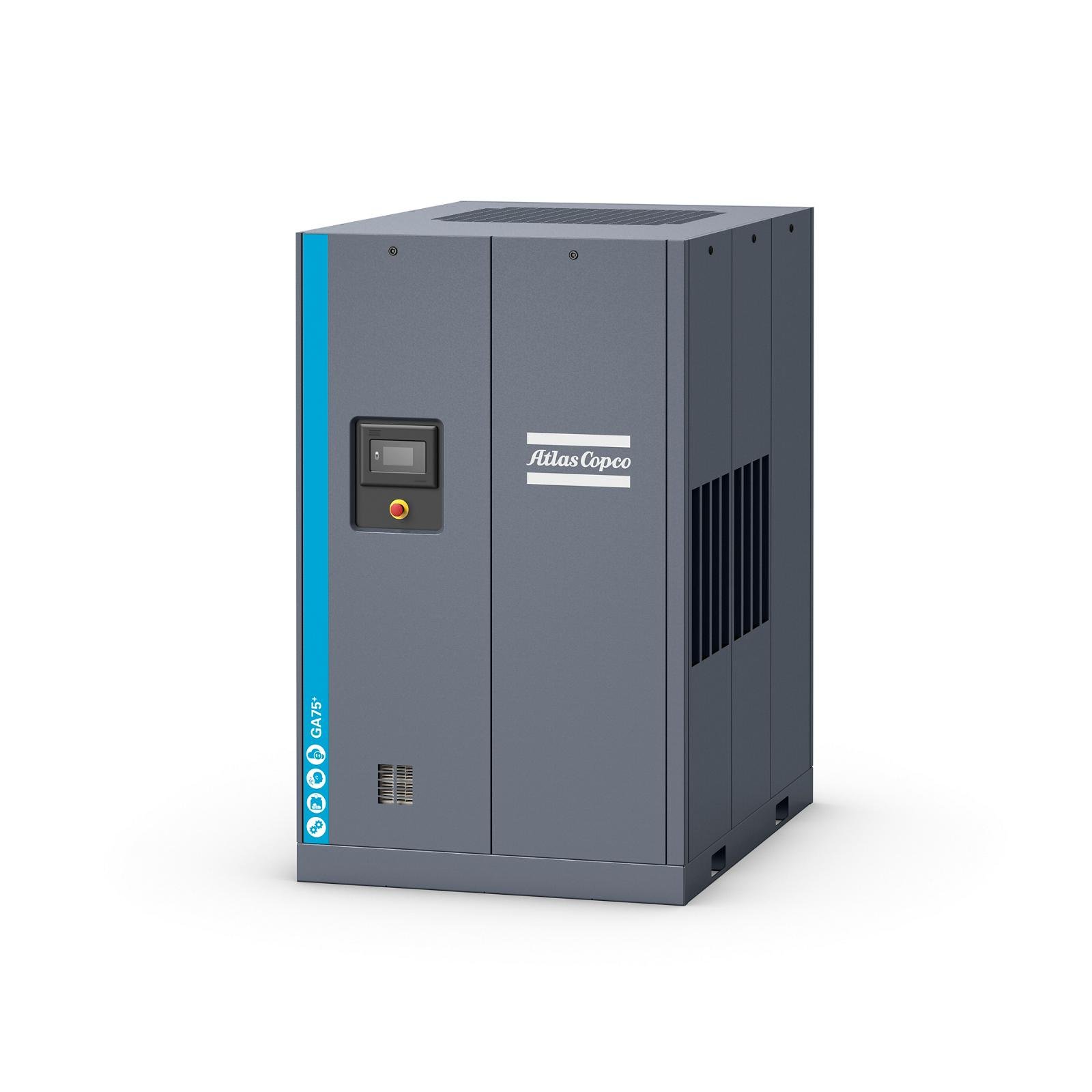
Shown as a configuration reference. Availability and the equipment offered for your project are confirmed separately.
Which factory requirements determine compressor size?
| Requirement | What to record | Why it affects the comparison |
|---|---|---|
| Pressure | Minimum required at the point of use; distribution losses | A package rating does not prove adequate pressure at the equipment |
| Airflow | Useful demand, units and stated reference basis | Allows a consistent capacity comparison |
| Demand profile | Minimum, typical and peak demand; duration and simultaneity | Shows the workload the controls must handle |
| Duty and resilience | Shifts, annual hours, planned standby and existing machines | Defines system operation and production risk |
| Air quality | Moisture and contaminant requirements; verification point | Defines drying, filtration and monitoring |
| Site conditions | Power supply, ambient temperature, altitude, ventilation and destination | Determines whether the proposed package fits the installation |
Build the demand list from tools and processes that run together, rather than adding every nameplate maximum. Where measurements are incomplete, ask for a demand assessment and document the uncertainty. Storage can help with some short peaks, but a receiver does not create additional compressor capacity.
Use the small-factory compressor sizing checklist to prepare measurements and identify missing information before selecting a package.
Should you choose VSD or fixed-speed control?
Choose controls from demand, not from a savings headline. Variable-speed drive (VSD) changes compressor speed to respond to demand within the machine’s operating range. Fixed-speed packages can be considered for steady-duty applications or coordinated systems. Compare both against your measured operating pattern.
CAGI’s technical resources discuss operating ranges and part-load performance. Request package input power at relevant loads, minimum operating flow, control behavior and interaction with existing compressors. The useful decision is annual system cost at your workload, not the largest percentage quoted from an unrelated installation.
A factory running one shift might have low demand during setup, stable demand during production and short peaks when several tools operate together. Record the airflow and duration of each period. These observations form a comparison brief; they are not a compressor size or guaranteed savings estimate.
Read the VSD vs fixed-speed buying guide for the evidence to request from each supplier.
What belongs in the complete compressed-air system?
Review the compressor, receiver, drying, filtration, drains, piping, controls and ventilation together. State where your process’s air quality will be verified and under which operating conditions. Ask for air-treatment capacity and pressure losses at the proposed flow.
Specify moisture and contaminant requirements in process terms before discussing a dryer type or filter combination. Oil-free and oil-injected package choices require an application-specific assessment; neither removes the need to check the full downstream system. Include condensate handling and maintenance access in the installation plan.
Confirm the commissioning scope, service intervals, consumables, parts availability, warranty responsibilities and support route in your destination. Request current documents for the exact configuration rather than relying on a general catalogue.
How do you compare annual compressor electricity cost?
Estimated annual kWh = average package input kW × annual operating hours. Multiply by the local cost per kWh. Use measured or properly supported average input at the expected duty, and list auxiliary equipment that sits outside that measurement.
An average package input of 22 kW for 8 hours/day and 250 days/year gives 44,000 kWh/year. At USD 0.12/kWh, electricity is USD 5,280/year. These are illustrative inputs, not a machine quotation, measured factory result or savings guarantee.
The Australian Government’s compressed-air guide treats the air system as an efficiency opportunity. For your project, include demand, leakage, pressure and system operation in the assessment, alongside the compressor purchase.
Change the assumptions in the compressor electricity calculator, then add purchase, installation, treatment, maintenance and downtime allowances to the project budget. Identify any costs still awaiting supplier or local confirmation.
What should you send with a screw compressor RFQ?
Send the pressure and delivered-air requirements together with the demand profile, air quality, operating hours and site conditions. Include the existing system and the expected installation and service scope. Ask suppliers to return a consistent performance sheet and an itemized proposal.
IndustryApex supplies industrial equipment with professional engineering support. Final sizing and air-system design need confirmation using project-specific evidence. Sources checked: 13 October 2026.
Explore your application and buying questions
For a small factory sourcing a rotary screw compressor from China, define simultaneous air demand, point-of-use pressure and treatment needs. Use the guides below to compare a complete system and prepare the quotation scope.
Need OEM / ODM customization?
Submit branding, packaging, configuration or engineering requirements for this equipment. Include the target market, initial and annual quantities, required changes and acceptance criteria.
Customization feasibility, permitted branding, development responsibilities, minimum quantity, cost and lead time are reviewed for the proposed supplier and configuration before a quotation is confirmed.
Frequently asked questions
How do I size a rotary screw air compressor for a factory?
Establish required pressure at the point of use and the airflow consumed by equipment operating together. Record minimum, typical and peak demand, peak duration, operating hours, air quality and pressure losses. Use these requirements to compare delivered airflow and the complete air-treatment system.
What does FAD mean on a compressor data sheet?
Free air delivery describes delivered air stated on a defined reference basis. Keep the test conditions, operating pressure and units with the value. Do not compare FAD directly with theoretical displacement or an airflow number whose measurement basis is unspecified.
Is a VSD screw compressor always more economical than fixed speed?
No. The result depends on demand variation, efficient operating range, controls, system arrangement and electricity cost. Compare performance at your expected loads and include maintenance and capital costs. A percentage saving from another application is not evidence for your factory.
How much electricity will a screw compressor use?
Multiply measured average package input power in kW by annual operating hours to estimate kWh, then multiply by your electricity tariff. Include relevant auxiliary equipment separately if it is outside the measured package. Rated motor power may differ from average package input.
Does an oil-free compressor guarantee the air quality my process needs?
No single label defines the entire delivered air condition. State your process requirements for contaminants and moisture, along with the test method and verification point. Assess drying, filtration, distribution and operating conditions as part of the full system.
What should I include in a compressor request for quotation?
Include destination, point-of-use pressure, required airflow with units and reference basis, demand profile, operating hours, air quality, existing equipment, power supply, ambient conditions and installation needs. Request package power and performance data for the exact proposed model and pressure.
Reference information
- CAGI — Performance verification and standardized data sheets
- CAGI — Resource library and compressor guidance
- Australian Government — Compressed air equipment guide
Reference data and images explain equipment configurations. IndustryApex engineers confirm the offered model, specification and commercial scope in your project quotation.