
Connect copper Ethernet equipment to an optical fiber link where distance, electrical isolation or installation conditions require a media converter. The buying process should establish ethernet link rate, fiber type, optical link budget, and duplex arrangement. Use the comparison checkpoints to prepare a consistent quotation request, define installation and acceptance responsibilities, and identify missing accessories or evidence. OEM/ODM is a project-specific feasibility question; request written confirmation of any proposed change and the supporting documentation.
Connect copper Ethernet equipment to an optical fiber link where distance, electrical isolation or installation conditions require a media converter. Compare configuration, interfaces and acceptance evidence before requesting an application-specific quotation or OEM/ODM feasibility review.
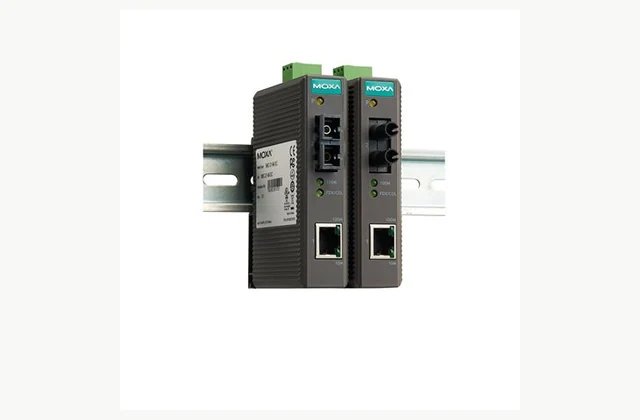
Shown as a configuration reference. Availability and the equipment offered for your project are confirmed separately.
Connect copper Ethernet equipment to an optical fiber link where distance, electrical isolation or installation conditions require a media converter.
Use a media converter for the right network job
An industrial Ethernet media converter bridges compatible copper Ethernet and optical interfaces. It is useful when a fiber run provides the needed reach or electrical isolation between locations. It does not automatically provide routing, protocol conversion or the management features of a managed switch. Show the two endpoint devices and the complete link in the inquiry so the proposed converter has a clearly defined role.
Match Ethernet rate and optical hardware
Check the supported Ethernet rate on both copper and fiber sides. A converter described as industrial is not necessarily gigabit-capable or compatible with every optical transceiver. Specify fixed optics or a pluggable optical interface, the connector type and any required module. The Moxa IMC-21 reference illustrates a compact converter family; its exact variant must be selected from the applicable model information rather than inferred from the photograph.
Build a fiber link budget
Distance is only one part of optical selection. Fiber type, wavelength, transmitter output, receiver limits and losses through connectors and splices determine whether the link can operate reliably. Confirm single-mode or multimode fiber at both ends. For single-fiber links, the paired units need complementary optical arrangements. Ask for a documented link assessment instead of assuming that two products with the same connector will communicate.
| Buying checkpoint | Project information |
|---|---|
| Ethernet link rate | Match the converter and peer device rather than assuming automatic gigabit support. |
| Fiber type | Identify multimode or single-mode fiber and connector polishing compatibility. |
| Optical link budget | Account for distance, connectors, splices and receiver limits. |
| Duplex arrangement | Check two-fiber or single-fiber wavelength pairing at both ends. |
| Cabinet environment | Document DC supply, mounting, temperature and condensation exposure. |
| Link diagnostics | Confirm fault propagation, status indication and commissioning tests. |
Plan cabinet power and installation
Provide the available DC supply, earthing arrangement, mounting space and site environment. Inspect the permitted input range, terminal arrangement and actual power demand of the selected variant. Outdoor cabinets can experience condensation and temperature swings even where the nominal ambient temperature seems acceptable. Maintain the manufacturer’s clearances and cable bend requirements. Electrical isolation across a fiber span does not remove local cabinet wiring and bonding obligations.
Decide which diagnostics matter
Simple status LEDs may be sufficient for a short, accessible link; a remote installation can need a clearer method of identifying loss of signal or a failed endpoint. Check whether link-fault pass-through is supported and how it behaves with connected equipment. Define commissioning checks for copper negotiation, optical reception, data transfer and interruption recovery. Record endpoint model numbers and fiber routes so a later replacement uses compatible optics.
Handle OEM/ODM requests at the interface level
Useful requests include enclosure labeling, connector accessibility, mounting adapters or a pretested converter-and-fiber package. Changes to optical components, power circuitry or environmental design require engineering validation. A private-label request should identify expected quantities and documentation responsibilities without assuming access to another manufacturer’s branding. For a cabinet project, an accurately specified standard converter can be a better fit than a modified device with unclear replacement compatibility.
Keep replacement optics identifiable
Label both ends of the optical link with the installed model and fiber assignment. Retain module details where pluggable optics are used. Maintenance staff need this information to avoid introducing an incompatible wavelength or fiber type during replacement.
What should your industrial ethernet media converter RFQ include?
- Ethernet link rate: Match the converter and peer device rather than assuming automatic gigabit support.
- Fiber type: Identify multimode or single-mode fiber and connector polishing compatibility.
- Optical link budget: Account for distance, connectors, splices and receiver limits.
- Duplex arrangement: Check two-fiber or single-fiber wavelength pairing at both ends.
- Cabinet environment: Document DC supply, mounting, temperature and condensation exposure.
- Link diagnostics: Confirm fault propagation, status indication and commissioning tests.
- Project location, destination requirements and intended operating environment
- Required drawings, connection information and site responsibility boundaries
- Representative acceptance case, documentation, training and spare-parts scope
- OEM/ODM: proposed branding, interface or design changes; engineering feasibility and evidence required
Need OEM / ODM customization?
Submit branding, packaging, configuration or engineering requirements for this equipment. Include the target market, initial and annual quantities, required changes and acceptance criteria.
Customization feasibility, permitted branding, development responsibilities, minimum quantity, cost and lead time are reviewed for the proposed supplier and configuration before a quotation is confirmed.
Frequently asked questions
Does a media converter change industrial communication protocols?
A standard Ethernet media converter changes the transmission medium between compatible Ethernet interfaces. It does not translate application protocols such as serial Modbus into Ethernet protocols. If the task requires protocol translation, specify a suitable gateway and its supported device mappings instead.
Can single-mode and multimode fiber be connected interchangeably?
The optical interfaces must match the installed fiber and the peer equipment. Connector appearance alone is insufficient. Identify fiber type, wavelength, link length and relevant losses, then select a compatible pair or converter and endpoint optic with a documented optical link budget.
What is special about a single-fiber converter pair?
A single-fiber bidirectional link generally uses complementary transmit and receive wavelengths at its two ends. Ordering identical units can therefore be wrong. State the installed fiber arrangement and require the supplier to identify the correct paired optical variants in the quotation.
Should a converter have link-fault pass-through?
That depends on how connected devices detect a failed path. Link-fault pass-through can help propagate an optical-side failure to the copper endpoint, but behavior must be checked for the selected model. Include an interruption-and-recovery test with the actual endpoint equipment.
What power information belongs in the inquiry?
State nominal DC voltage, available tolerance, power-source arrangement and cabinet conditions. Ask for terminal details and consumption for the selected converter and optics. Include mounting and grounding information so installation accessories and wiring can be assessed before the unit reaches the site.
Can a media converter be supplied as an OEM assembly?
A project may request a prewired cabinet module, special labels or mounting accessories. Optical, power and environmental changes require separate assessment. Confirm interface specifications, replacement-part identification and who maintains the assembly documentation, rather than assuming a reference-brand device can be relabeled.
Reference information
- IMC-21 Series - Ethernet-to-Fiber Media Converters | Moxa
- Industrial Network Infrastructure | Moxa
Reference data and images explain equipment configurations. IndustryApex engineers confirm the offered model, specification and commercial scope in your project quotation.