
An electric stacker fits a project where pallet placement at height is needed and the load, route and access match its design. Specify the required capacity at the highest storage point rather than only the nominal rating. Provide pallet drawings showing lower boards, entry openings and the direction in which the truck approaches. Support-leg stackers, straddle layouts and counterbalanced stackers solve different access problems. State whether work is occasional storage, repeated line feeding or long travel between racks.
Identify the stacking task and pallet entry
An electric stacker fits a project where pallet placement at height is needed and the load, route and access match its design. Specify the required capacity at the highest storage point rather than only the nominal rating. Provide pallet drawings showing lower boards, entry openings and the direction in which the truck approaches. Support-leg stackers, straddle layouts and counterbalanced stackers solve different access problems. State whether work is occasional storage, repeated line feeding or long travel between racks. A low-lift pallet truck transports pallets but does not replace a stacker for raised rack placement.
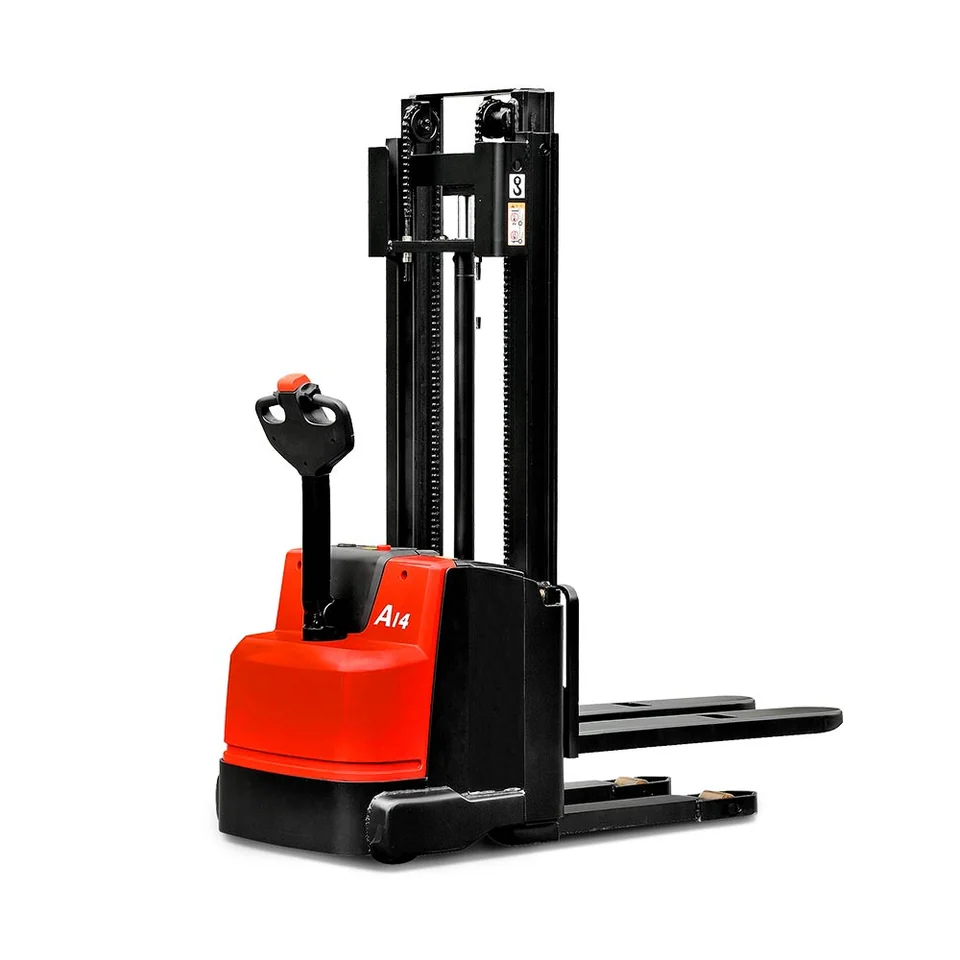
Shown as a configuration reference. Availability and the equipment offered for your project are confirmed separately.
Match legs, forks and mast to the load
Support legs must clear the pallet and rack arrangement through the whole approach and placement sequence. Closed-bottom pallets may need a different leg or fork layout from open-bottom pallets. Request fork dimensions, support-leg spacing, mast height and a capacity chart at the actual load center and lift height. Include free lift and overhead clearance if pallets pass under doors or a mezzanine. Longer forks and attachments should be assessed as part of the capacity configuration. The smallest turning space should be checked with the loaded truck, because a catalogue body width alone does not establish aisle suitability.
Review the route, operator position and charging
Show floor joints, thresholds, slopes and rack access on a site plan. Ask the supplier to confirm allowed surfaces and gradients for the exact stacker and load. Choose walking or rider operation from travel distance and the site’s traffic rules, then reserve space for operator positioning during placement. Define operating cycles, shifts, temperature and charging windows with the battery/charger proposal. Include the local electrical supply and battery-handling access. Cold or wet locations need a reviewed option. Assign operator training and local maintenance before operation, including safe procedures for fault recovery at an elevated storage location.
Compare a complete stacking package
Include mast, forks, legs, battery, charger and any initial-lift or positioning option in the quotation. Budget for delivery, site commissioning, electrical preparation and operator training. Request spare wheels, chains and other wear items by identifier, with an agreed service arrangement. Check whether the offered battery warranty matches shifts and temperature, and whether charger cables are included. A low purchase price can be misleading if the proposed pallet geometry requires rack changes or new pallets. Compare the whole handling process, including storage access and charging, rather than assuming every stacker with a similar capacity works on the same route.
Verify loaded placement and repeatable operation
Use actual pallets and representative loads to check approach, leg clearance, fork entry, lifting and withdrawal at the required height. Confirm residual capacity through the manufacturer’s documents for the delivered configuration. Test access under the lowest doorway and movement through the narrowest reviewed aisle. Record representative stacking cycles and charging behavior, and inspect mast, battery and charger identifiers. Protective functions and recovery should be verified by competent personnel. An unloaded lift test is useful for basic commissioning, but should not replace the reviewed capacity evidence and a practical loaded-placement trial.
Describe custom pallets and approved changes
The inquiry should include pallet files, rack dimensions, load distribution and floor photographs. OEM requests can cover branding, manuals and interface language. ODM work involving wider legs, special forks, different mast arrangements or unusual loads requires engineered dimensions and revised capacity evidence. Agree who owns special parts and how replacements are ordered. Identify which future pallet or attachment changes require a new manufacturer review. The shown family is a configuration reference; it does not imply every pallet design is compatible or that capacity remains unchanged after modifications to legs, forks or attachments.
Manufacturer configuration references
Review the linked manufacturer information as configuration references. Request the current sheet, included scope and relevant evidence for the exact proposed equipment; these references do not establish an IndustryApex supply relationship.
What should you include in your RFQ?
- Pallet dimensions bottom boards and entry
- Maximum load and load center
- Required lift and residual capacity
- Support leg or counterbalance geometry
- Rack and aisle dimensions
- Lowered mast doorway clearance
- Floor ramps thresholds and exposure
- Walking rider and travel duty
- Battery charger and charging windows
- Attachments and fork dimensions
- Local training maintenance and spares
- OEM scope and destination
For OEM / ODM requests, include the branding, packaging, configuration or engineering changes you need, initial and annual quantities, target market, sample approval and acceptance requirements. Feasibility and commercial scope are confirmed for the specific project.
Need OEM / ODM customization?
Submit branding, packaging, configuration or engineering requirements for this equipment. Include the target market, initial and annual quantities, required changes and acceptance criteria.
Customization feasibility, permitted branding, development responsibilities, minimum quantity, cost and lead time are reviewed for the proposed supplier and configuration before a quotation is confirmed.
Frequently asked questions
When should I consider an electric stacker?
Consider a stacker when pallets must be placed at height and its load, leg geometry and travel limits fit the job. Define residual capacity at the highest placement and distinguish occasional stacking from long-distance or intensive handling.
How do support legs affect pallet compatibility?
Legs must clear pallet bottom boards and the rack approach throughout placement and withdrawal. Closed-bottom pallets may need straddle or counterbalanced arrangements. Submit drawings and verify forks, leg spacing and capacity at the actual load center.
Which floor and charging details need review?
Review joints, thresholds, slopes, rack access, operator position and environmental exposure. Provide shift cycles and charging windows with electrical supply, then match the battery and charger to duty and reserve maintenance and battery-handling access.
What should an electric stacker quotation include?
Include mast, forks, legs, battery, charger and approved options, plus commissioning, training and wear parts. Identify capacity documentation and local service, and include pallet or rack changes if the offered geometry cannot use the existing carriers.
How do I verify rack access and residual capacity?
Use approved loaded pallets to check approach, leg clearance, entry, lifting and withdrawal at rack height. Verify the exact capacity chart and doorway dimensions, then representative cycles, charging and protective functions under competent supervision.
Can stackers be customized for special pallets?
Yes. Submit pallet and rack drawings for special forks, legs, mast or controls, and include OEM presentation requirements. Engineering changes need revised capacity evidence and trials; agree replacement-part ownership and which later changes require another review.
Reference information
- HANGCHA: A Series Basic Range pallet stacker
- HANGCHA: Warehouse product families
Reference data and images explain equipment configurations. IndustryApex engineers confirm the offered model, specification and commercial scope in your project quotation.