
Closed-bottom pallets require leg or fork geometry that clears lower boards and approaches from the correct direction. Compare straddle stackers, counterbalanced models and support-leg arrangements. Verify fork entry, leg spacing and residual capacity at working height with actual pallet drawings and the manufacturer's configuration-specific capacity chart.
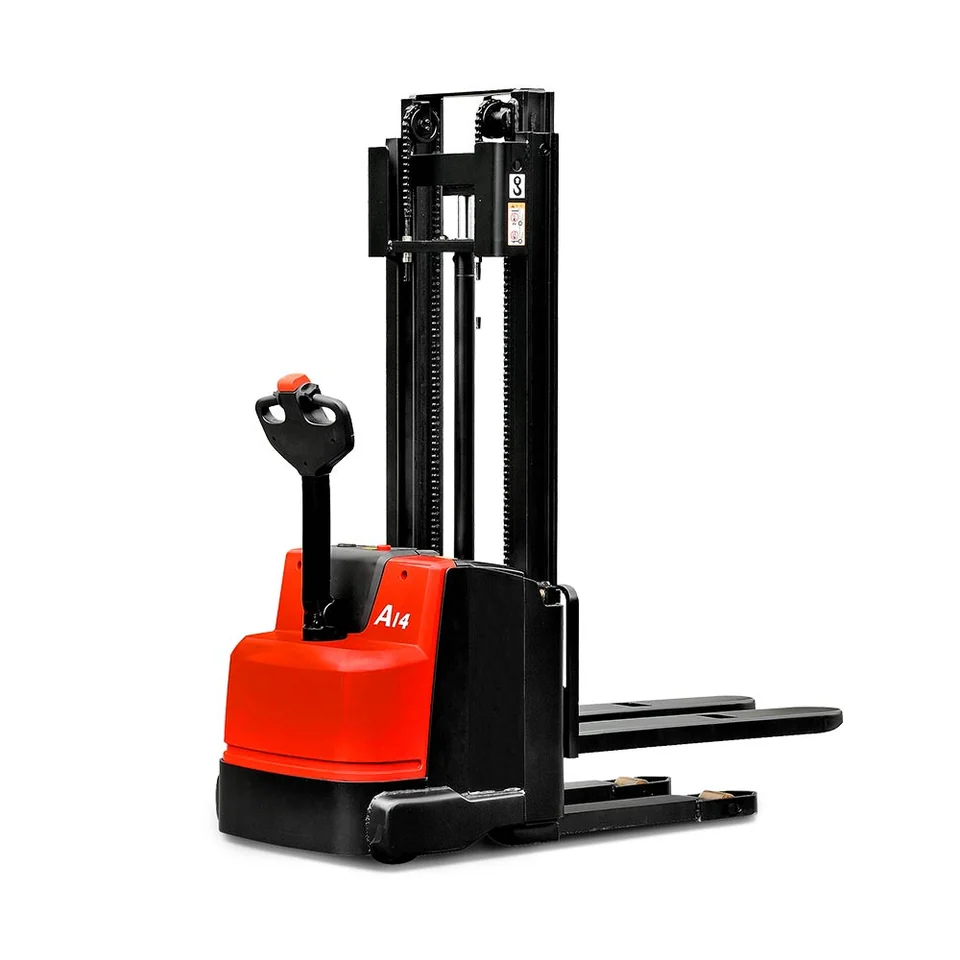
Shown as a configuration reference. Availability and the equipment offered for your project are confirmed separately.
Why closed-bottom pallets change stacker selection
Closed-bottom pallets have continuous lower boards or panels that prevent fork or support-leg entry from beneath. This geometry eliminates many standard walkie stackers designed for open-bottom or four-way entry pallets. The stacker must approach from the pallet’s open side, use legs that straddle the pallet rather than pass under it, or operate as a counterbalanced design without forward support legs. Choose the arrangement based on your pallet construction, rack approach direction and aisle width.
A standard support-leg stacker with legs extending under the pallet will not work. Attempting to lift a closed-bottom pallet with incompatible legs damages the pallet lower boards, prevents stable placement and creates an unsafe condition. Request pallet drawings showing bottom-board locations, entry openings and load distribution before selecting a stacker configuration.
Compare straddle, counterbalance and modified support arrangements
A straddle stacker has adjustable or fixed legs that span outward around the pallet rather than passing beneath it. This design suits closed-bottom pallets that present two open sides for fork entry. The legs must clear the pallet width and any rack uprights during approach and placement. Measure the pallet’s outer dimensions, the distance between rack posts and the stacker’s leg opening at minimum and maximum adjustment. Straddle stackers typically require wider aisles than support-leg models because the legs extend beyond the pallet footprint.
A counterbalanced walkie stacker operates without forward support legs, using rear weight to balance the load. This arrangement allows fork entry from one open pallet side without leg interference. Counterbalanced designs are heavier, require more turning space and cost more than straddle or support-leg stackers, but they handle closed-bottom pallets in narrower aisles when approach direction is controlled. Verify the manufacturer’s turning radius and aisle width requirement with your actual loaded pallet and the longest travel route.
Some manufacturers offer modified support-leg configurations with narrow or retractable legs that fit specific closed-bottom pallet designs. These are engineering changes rather than standard catalogue products. Submit pallet drawings and request a capacity chart for the modified leg arrangement. Any leg or fork change affects the stacker’s residual capacity and may require mast or chassis reinforcement.
Decision table: stacker arrangement for closed-bottom pallets
| Stacker Type | Pallet Entry Requirement | Leg Clearance | Aisle Width Impact | Capacity and Cost | Request from Supplier |
|---|---|---|---|---|---|
| Straddle legs | Two open sides for fork entry | Legs span pallet width; must clear rack uprights | Wider than support-leg models | Standard capacity for leg opening; moderate cost | Leg opening range, fork length, capacity chart at load center and lift height, turning radius with load |
| Counterbalanced | One open side for fork entry | No forward legs; rear weight balances load | Larger turning circle; can work in controlled-direction aisles | Higher capacity; higher cost and weight | Turning radius, aisle width, floor load, capacity chart, brake and slope rating |
| Modified support legs | Specific to pallet board layout | Custom leg spacing or retractable design | Depends on modification | Engineering change; capacity may be reduced | Pallet compatibility drawing, revised capacity chart, modification cost, lead time, spare parts |
Verify fork entry, leg positioning and residual capacity
Fork entry must be confirmed with actual pallet samples. Measure the distance from the pallet’s open edge to the first obstruction, the height of any bottom reinforcement and the available fork insertion depth. The forks must fully support the load without catching on internal boards or leaving the pallet unstable. Request fork length, thickness and width from the supplier, and compare these dimensions to your pallet’s internal openings and load overhang.
Leg positioning affects stability and rack access. For straddle stackers, measure your pallet’s outer width and add clearance for rack post spacing. The supplier’s leg-opening specification must accommodate this dimension at the required lift height. HANGCHA’s A Series Basic Range pallet stacker includes “three braking types: releasing brake, reversing brake and emergency brake” [S2], an example of the safety features integrated into standard walkie stackers, though brake configuration does not change pallet compatibility. Confirm leg adjustment limits, locking method and whether the legs remain parallel or taper during travel.
Residual capacity is the load the stacker can safely lift at the actual load center and lift height after accounting for fork length, mast configuration and attachments. Request the manufacturer’s capacity chart showing load center, lift height and fork length as variables. Do not assume the nameplate capacity applies at every height or with every pallet design.
Include aisle geometry, floor condition and charging access
Aisle width must accommodate the loaded stacker during approach, placement and withdrawal. Measure the narrowest point including rack overhang, floor obstructions and door frames. Add the loaded pallet width, stacker body or leg width and operator clearance if walking. For straddle stackers, include the full leg span. Request the supplier’s aisle width recommendation for your exact pallet, load and lift height rather than using a catalogue body dimension.
Floor condition affects travel safety and battery life. Closed-bottom pallets are often heavier than equivalent open designs because of additional lower boards. Review floor joints, expansion gaps, slopes and surface hardness with the supplier. Provide photographs and gradient measurements. The stacker’s wheels, motor and brake must suit the reviewed route. If the floor requires repair or leveling, include that cost in the project rather than assuming the stacker will compensate for poor surfaces.
Charging access and battery handling depend on shift length, cycle intensity and temperature. Define operating hours, average cycles per shift and the longest period between charging opportunities. Closed-bottom pallet handling may involve longer approach paths or more precise rack placement, increasing energy consumption compared to simple open-pallet stacking. Request battery capacity, charger type, charging duration and whether the battery can be exchanged or must charge in the stacker. Include electrical supply preparation and a safe battery-handling procedure.
Practical inquiry inputs for closed-bottom pallet stackers
| Inquiry Input | Why It Matters | What to Provide |
|---|---|---|
| Pallet construction drawing | Defines bottom-board layout, entry direction and obstruction points | CAD file or dimensioned sketch showing lower boards, openings, thickness and load-bearing surfaces |
| Maximum load and center | Determines required stacker capacity at working height | Load mass, distribution and distance from fork face to load center; include packaging and overhang |
| Lift height and free lift | Affects mast selection and residual capacity | Highest rack position, door or mezzanine clearance and whether load must rise before mast extends |
| Rack and aisle layout | Establishes leg clearance, turning space and approach direction | Rack post spacing, beam height, aisle width at narrowest point and pallet orientation in rack |
| Stacker arrangement preference | Narrows configuration options and cost range | Straddle, counterbalance or modified support legs; state constraints such as aisle width or budget |
| Shift and cycle duty | Sizes battery, charger and cooling requirements | Operating hours per day, cycles per hour, travel distance and charging windows |
| Floor and environment | Confirms wheel type, brake and enclosure rating | Surface type, slope, temperature range and exposure to moisture or dust |
Request configuration-specific capacity evidence and trials
The supplier must provide a capacity chart for the exact stacker configuration including mast type, fork length and leg or counterbalance arrangement. This chart shows how capacity decreases as lift height and load center increase. Do not rely on a single nominal rating. If the quoted stacker includes a modified leg design or extended forks, request updated capacity documentation signed by the manufacturer’s engineering department.
Conduct placement trials with representative loaded pallets before final acceptance. Check fork entry from the pallet’s open side, leg clearance during approach, stable lifting to the highest rack position and smooth withdrawal. Verify that the load remains centered and the mast does not obstruct the operator’s view. Record battery state, motor temperature and any fault indications during repeated cycles. These trials confirm that the chosen stacker arrangement works with your actual closed-bottom pallets and rack geometry, not only on paper.
If trials reveal interference, instability or capacity shortfall, the options are to modify the stacker (engineering change with new capacity evidence), change the pallet design (cost and lead time for new molds or suppliers) or revise the rack layout (aisle width, post spacing or beam height). Agree on responsibility and cost for each change before proceeding. A stacker that cannot reliably place your closed-bottom pallets at the required height is not a successful procurement outcome regardless of its purchase price.
Compare complete proposals including modifications and pallet changes
Request quotations that include the stacker, mast, forks, legs, battery, charger and any pallet or rack modifications needed for safe operation. A low stacker price is misleading if it requires new pallets, wider aisles or reduced lift height. Compare the total project cost including equipment, commissioning, operator training and any facility changes. Identify spare parts by part number, lead time and whether they are standard or custom components.
For OEM or ODM projects involving branding, custom leg spacing or special controls, include initial and annual volumes, target market, sample approval and spare-part ownership. Customization feasibility and cost depend on the proposed supplier’s engineering capability and production constraints. Discuss these requirements with IndustryApex engineers to build a project-specific proposal. State delivery location, installation scope, local service and warranty coverage in the agreed quotation.
Closed-bottom pallet handling is a defined application, not a universal stacker capability. Success depends on matching the stacker’s leg or fork arrangement to your pallet’s entry geometry, verifying residual capacity at working height and confirming practical placement in the actual aisles andracks. Provide complete pallet drawings, load data and site dimensions, then request configuration-specific evidence and conduct loaded trials before accepting the equipment.
Define your equipment requirements
Review the Electric stacker buying guide for the complete equipment scope.
Discuss this equipment project ↗ · OEM requirements · ODM requirements. Configuration and feasibility are reviewed for your application.
Explore the Electric stacker buying guide and RFQ checklist ↗
Frequently asked questions
Why do closed-bottom pallets require a different stacker?
Closed-bottom pallets have continuous lower boards that prevent standard support legs from passing underneath. The stacker must use straddle legs that span the pallet, a counterbalanced design without forward legs, or custom leg spacing. Submit pallet drawings showing bottom-board layout and entry direction to identify compatible configurations.
How do I choose between straddle and counterbalanced stackers?
Straddle stackers suit pallets with two open sides and require wider aisles because legs extend beyond the pallet. Counterbalanced stackers need one open side, have larger turning circles but work in controlled-direction aisles. Compare leg clearance, turning radius, aisle width and cost with your actual rack layout and approach paths.
What pallet and load information must I provide?
Provide dimensioned pallet drawings showing lower boards, entry openings and load-bearing surfaces. Include maximum load mass, distribution and load center distance from the fork face. State required lift height, rack post spacing, aisle width and approach direction. Request a capacity chart for the exact configuration and load center.
How do I verify the stacker will work with my pallets?
Request fork dimensions, leg opening or counterbalance specifications and a capacity chart for your load center and lift height. Conduct placement trials with loaded pallets, checking fork entry, leg clearance, stable lifting to rack height and smooth withdrawal. Record battery state and any faults during repeated cycles.
What if trials show the stacker cannot handle my pallets?
Options include modifying the stacker with revised capacity evidence, changing pallet design with new tooling cost and lead time, or adjusting rack layout for aisle width or post spacing. Agree on responsibility and cost for each change before proceeding. Do not accept equipment that cannot reliably place pallets at the required height.
What should a complete closed-bottom pallet stacker quotation include?
Include stacker with specified leg or counterbalance arrangement, mast type, fork length, battery, charger and any pallet or rack modifications. State capacity chart, commissioning scope, operator training, spare parts by identifier, delivery location, local service and warranty. Compare total project cost rather than equipment price alone.
Reference information
- A series Basic range pallet stacker
Reference data and images explain equipment configurations. IndustryApex engineers confirm the offered model, specification and commercial scope in your project quotation.