
A thermoforming machine should be selected from the finished geometry and the sheet or roll material to be formed. Roll-fed packaging and sheet-fed large parts involve different handling and tooling arrangements, so establish that route before comparison. Provide draw depth, corner details, surface requirements, thickness distribution and dimensional tolerances. State resin, sheet thickness, width and any recycled content for the trial. The output target should describe accepted trays, cups or formed parts, including trimming and stacking.
Fix the formed part and material route
A thermoforming machine should be selected from the finished geometry and the sheet or roll material to be formed. Roll-fed packaging and sheet-fed large parts involve different handling and tooling arrangements, so establish that route before comparison. Provide draw depth, corner details, surface requirements, thickness distribution and dimensional tolerances. State resin, sheet thickness, width and any recycled content for the trial. The output target should describe accepted trays, cups or formed parts, including trimming and stacking. A nominal forming area alone cannot prove that the product can be formed, cut and removed with the required wall distribution and finish.
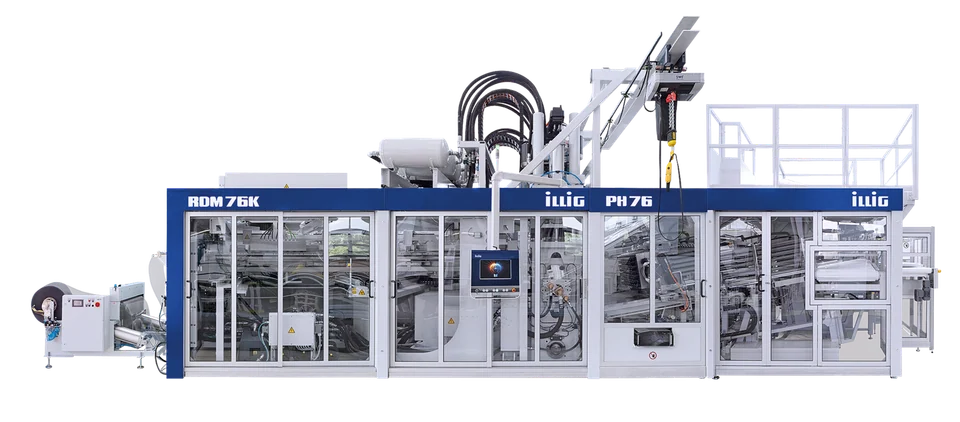
Shown as a configuration reference. Availability and the equipment offered for your project are confirmed separately.
Review forming, cutting and tool interfaces
Vacuum forming, pressure assistance and plug-assist features should be matched to the material and draw geometry rather than selected by a general preference. Ask the tool designer to review venting, cooling, draft and the transfer of parts from the mold. Combined forming/cutting and separate forming/cutting arrangements can have different tooling and production implications. Include the approved mold interface and tool-change method in the specification. Product nesting, stack separation and trim quality may constrain the usable output. Request a product-specific process proposal and sample plan instead of assuming every tool within a machine’s forming envelope will run efficiently.
Coordinate material loading and utilities
Show reel handling or sheet loading, heating, forming, trimming, stacking and scrap removal in one layout. Define compressed air, vacuum and cooling-water conditions at the process, with electrical supply and heat removal assigned to responsible parties. Reserve tool-change access and appropriate lifting arrangements. If an inline extruder is proposed, establish the sheet delivery and shared control behavior. Describe restart and downstream blockage handling so hot material is managed through interruptions. The main machine outline alone is not an installation plan where large reels, scrap skeletons and packaged stacks also require space and controlled material flow.
Compare the accepted-product production system
Include thermoformer, tools, material handling, trimming, stacking, scrap collection and downstream packing in every quote. Budget trial sheet, startup waste, tool changes and spare heaters or mechanical wear items. Compare material usage and accepted output for the approved layout rather than the highest cycle rate in isolation. Clarify whether a new part needs another tool set or changes to trim and stacking fixtures. Local tooling and technical support should be part of the ownership comparison. Freight, utilities, installation and process training belong in installed cost, particularly where the buyer is introducing a new forming material or geometry.
Validate wall distribution and final handling
Acceptance should use approved material and tooling and inspect wall distribution, dimensions, surface, trim and stacking against the agreed criteria. Record good output and waste after stabilization over a representative run. Test startup, a planned tool or format change and restart after an interruption. Where barrier, seal or other functional properties are part of the application, define the appropriate finished-product test rather than inferring them from machine performance. Retain material identifiers, sample parts and settings. A visually attractive first-off part does not prove sustained production or that thin corners remain acceptable across normal material variation.
Make custom packaging development reviewable
Send part files, material specifications, sample requirements and site drawings with the inquiry. OEM requests can cover branding, languages and documents. ODM work may include product development, forming tools, plug designs, trim and stack fixtures or full downstream integration, with sample approval and design milestones. Agree ownership of tooling and validated recipes and define what happens when sheet thickness or recycled content changes. Name local installation and maintenance responsibilities. The manufacturer family illustrates thermoforming equipment; the actual offered system should be validated for your material, tool and finished-product tests.
Manufacturer configuration references
Review the linked manufacturer information as configuration references. Request the current sheet, included scope and relevant evidence for the exact proposed equipment; these references do not establish an IndustryApex supply relationship.
What should you include in your RFQ?
- Part CAD and formed sample
- Material resin sheet or roll specification
- Thickness width and recycled content
- Forming area draw depth and tolerances
- Mold temperature venting and plug assist
- Forming cutting trimming and stacking
- Accepted output and SKU changes
- Roll handling or sheet loading
- Air vacuum cooling power and extraction
- Scrap collection and downstream packing
- Tool ownership replacement parts and service
- OEM design and acceptance criteria
For OEM / ODM requests, include the branding, packaging, configuration or engineering changes you need, initial and annual quantities, target market, sample approval and acceptance requirements. Feasibility and commercial scope are confirmed for the specific project.
Need OEM / ODM customization?
Submit branding, packaging, configuration or engineering requirements for this equipment. Include the target market, initial and annual quantities, required changes and acceptance criteria.
Customization feasibility, permitted branding, development responsibilities, minimum quantity, cost and lead time are reviewed for the proposed supplier and configuration before a quotation is confirmed.
Frequently asked questions
What should determine a thermoforming machine?
Define formed geometry, draw depth, wall distribution, resin and sheet/roll specification, with accepted output including trimming and stacking. Establish sheet-fed or roll-fed handling early; forming area alone does not confirm the tool and product can run successfully.
How should tooling and forming method be compared?
Compare vacuum, pressure assistance, plug, cooling, venting and forming/cutting arrangement using the material and tool. Review trim, nesting and removal as well as mold fit; tooling inside the envelope does not automatically establish efficient accepted output.
What downstream and utility interfaces are needed?
Integrate reel or sheet loading, heating, air/vacuum, cooling, trimming, stacking and scrap handling. Reserve tool-change and lifting access and define downstream stop/restart behavior, assigning utilities and any inline extrusion interface to responsible parties.
What belongs in the complete thermoforming-line cost?
Include machine, tools, loading, trimming, stacking, scrap handling and packing, plus utilities and commissioning. Model accepted material use, waste, changeover and local tooling support; compare the complete product cycle rather than the highest forming-cycle rate alone.
How should formed-product quality be accepted?
Inspect thickness distribution, dimensions, surface, trim, stacking and specified functional properties using approved material and tooling. Record sustained good output, waste and startup/restart, retaining samples and material settings rather than relying on an attractive first-off part.
Can thermoforming lines support custom packaging designs?
Yes. ODM can cover product development, plugs, molds, trim/stack fixtures and downstream controls, with OEM branding and languages added separately. Agree ownership and sample milestones and revalidate important changes to material, thickness or recycled content.
Reference information
- ILLIG: RDM 76K 4G roll-fed thermoformer
- ILLIG: Thermoforming system modules
Reference data and images explain equipment configurations. IndustryApex engineers confirm the offered model, specification and commercial scope in your project quotation.