
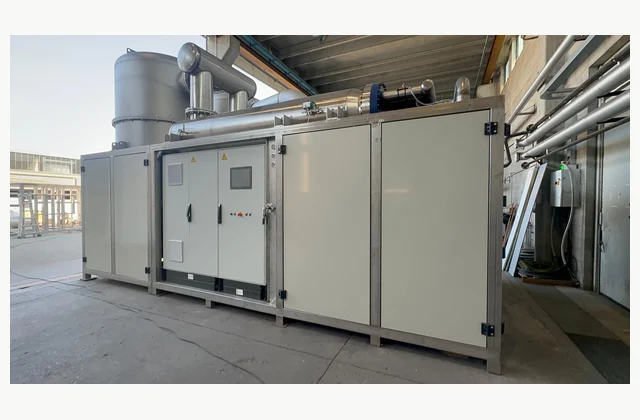
Shown as a configuration reference. Availability and the equipment offered for your project are confirmed separately.
A wastewater evaporator RFQ needs representative feed analysis, its variation and a defined destination for condensate and concentrated residue. Mechanical vapor recompression is a process option to evaluate against that feed and the available utilities. Do not compare an evaporation rate or an energy figure without the operating conditions and the complete treatment boundary.
Reviewed 2026-10-22 · IndustryApex editorial and engineering procurement resources. Reference equipment images illustrate the relevant process; they do not establish a completed IndustryApex project or the offered configuration.
Wastewater evaporator feed analysis and the intended result
Record where the wastewater originates, how production changes it and the basis of the laboratory samples. Describe average, peak and batch flows and the required concentration or volume-reduction objective. Identify the intended use or disposal route for every output. Concentrating a stream changes the disposal task; it does not by itself establish that the recovered water is suitable for any particular reuse.
Wastewater evaporator pilot testing: resolve process unknowns
Ask which parts of the feed require laboratory or pilot evaluation before the final equipment is selected. Agree the sample, test objective and report contents with the process engineer. Review observed concentration behavior, fouling, cleaning and the characteristics of condensate and residue. A trial on another wastewater stream is background information, not a substitute for evidence on the proposed feed and operating window.
MVR energy consumption: compare the complete utility boundary
For a mechanical vapor recompression proposal, identify compressor duty, startup heat, pumps, cooling, controls and the conditions behind the quoted utility figures. Compare alternative process routes using the same feed and product target. A claimed saving against an undefined baseline is not a useful quotation comparison. Electrical supply, available heat and the operating schedule need project-specific review before an equipment route is confirmed.
Wastewater evaporator cleaning and residual handling
List feed storage, required pretreatment, dosing, evaporation, condensate treatment, cleaning and residue handling. Assign responsibility for off-spec streams and cleaning waste. Include the expected consumables, planned cleaning method and maintenance access in the proposal. A skid price can exclude tanks, connections or further treatment that the factory still needs. Confirm each inclusion and exclusion before comparing total investment.
Wastewater evaporation acceptance: close the material balance
Define sampling points and the operating test, then account for feed, recovered water, concentrate, cleaning losses and any other relevant stream. Agree quality measurements and the conditions for accepted output. Specify which checks can occur before shipment and which depend on the real site. Any recovery or utility commitment should state the agreed feed envelope, measurement method and exception handling.
MVR wastewater treatment cost: include accepted residual routes
Include power, heat, chemicals, cleaning, service, testing, consumables and residual handling alongside capital cost. Use only confirmed water-reuse value and disposal charges. Review sensitivity to feed changes and shorter operation between cleaning. Zero liquid discharge is a complete process objective requiring treatment of all residual streams and a site-specific engineering review; it is not established by installing one evaporator.
Your project brief
- Feed source, sampling dates, analysis and production variation
- Flow / batch schedule and required concentration objective
- Condensate quality, reuse destination and off-spec handling
- MVR / heat / power assumptions and full utility boundary
- Trial plan, cleaning, residual disposition and acceptance evidence
Buyer questions
Is MVR suitable for every industrial wastewater?
Suitability depends on the actual feed, concentration behavior, utility conditions and process objectives. Request engineering review and trials where needed.
Does an evaporator automatically produce reusable water?
No. Define the receiving-process quality requirements and verify condensate treatment, monitoring and off-spec handling against them.
What should a pilot-test report include?
Agree feed identification, test conditions, outputs, relevant quality and utility observations, fouling or cleaning behavior and limits of the test before the trial.
Does a wastewater concentrator guarantee zero liquid discharge?
A concentrator is only one possible stage. The complete treatment and residual-handling boundary must be engineered and verified for the site.
Continue your project review
Reference basis
Selection questions were checked against the following public technical material. Source names identify the reference basis and do not establish a supply relationship or performance promise.
- GEA evaporation plant and pilot-test reference
- Alfa Laval wastewater concentration and pilot-test discussion
Request the technical evidence for your proposed configuration. Prices, supply, OEM / ODM feasibility and project commitments are confirmed in the actual proposal.
Explore the Wastewater evaporation concentrator buying guide and RFQ checklist ↗