
Specify a pneumatic feed separator around the queued workpiece, feed pressure and downstream pickup sequence. Coordinate the retaining and releasing fingers, guides and sensors so one part is presented predictably, including jams, empty queues and machine restart. Run representative part tolerances at full and nearly empty queues, using the intended upstream feeder and downstream pickup. Count double feeds, missed releases and jams over an agreed trial. Demonstrate restart and finger replacement, recording guide gaps, pressures and timing with the approved part revision. Submit the intended configuration and any OEM/ODM changes for project-specific feasibility review.
Specify a pneumatic feed separator around the queued workpiece, feed pressure and downstream pickup sequence. Coordinate the retaining and releasing fingers, guides and sensors so one part is presented predictably, including jams, empty queues and machine restart.
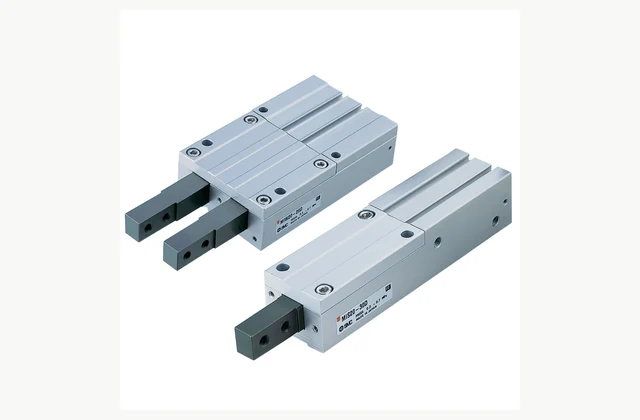
Shown as a configuration reference. Availability and the equipment offered for your project are confirmed separately.
Define the queued workpiece geometry
Provide drawings, orientation, mass and dimensional variation of the parts arriving in the rail or chute. Include surface friction and fragile features. A separator selected for a nominal part width may fail when tolerances, nesting or changing contact positions affect how the queue loads its fingers.
Assess queue force at the fingers
Gravity, vibration or an upstream feeder can press the queued parts against the mechanism. Specify the maximum queue and applied force. Finger capacity and stroke must be reviewed under this load, rather than judged only by the mass of the single part being released.
Coordinate retention and release timing
An escapement must retain following parts while releasing the intended one. Document the finger sequence and any mechanically linked action in the selected family. Check overlap and clearances on the actual parts; two independently moving stops are not automatically equivalent to a purpose-designed separator.
Match presentation to downstream pickup
Define where the released part must stop and how the robot, slide or operator confirms its presence. Include guides and support after release. Reliable singulation alone does not establish a repeatable pickup position if the part can bounce, roll or change orientation in the transfer zone.
Define jam and restart behavior
Trial a missing part, double presentation and a blocked finger with a safe method. Decide how the controller recognizes the fault and restarts without releasing an extra workpiece. Include residual air behavior and manual-clearing responsibilities rather than relying on an operator to infer mechanism position.
Keep wear points and guides serviceable
Contact fingers and rail surfaces can wear differently with abrasive or oily workpieces. Specify replaceable tips and access for cleaning. Obtain the correct seal, finger and switch identification and a setup record so replacing a tip restores the accepted separation gap.
Compare a complete pneumatic feed separator scope
| Decision | Information to compare |
|---|---|
| Define the queued workpiece geometry | Part drawings, orientation, tolerances, nesting and contact surfaces |
| Assess queue force at the fingers | Queue length, chute angle, feeder force and finger contact load |
| Coordinate retention and release timing | Finger strokes, retention overlap, release order and timing diagram |
| Match presentation to downstream pickup | Pickup datum, downstream support, bounce control and presence sensing |
| Define jam and restart behavior | Jam detection, empty queue, double-feed test and reset sequence |
| Keep wear points and guides serviceable | Finger tips, rail wear, contamination, switches and gap-reset procedure |
Plan installation and access
Mount the separator square to the feed rail on a rigid support and align both retaining positions to the approved part datum. Confirm tubing, flow control and sensor routing. Guard access to the queue and isolate stored pneumatic or gravitational energy before clearing a jam.
Agree acceptance evidence before ordering
Run representative part tolerances at full and nearly empty queues, using the intended upstream feeder and downstream pickup. Count double feeds, missed releases and jams over an agreed trial. Demonstrate restart and finger replacement, recording guide gaps, pressures and timing with the approved part revision.
Define OEM/ODM engineering boundaries
OEM contact tips, rail interfaces and sensor integration can be reviewed. ODM changes to linked finger motion, stroke or load capacity require engineering and endurance trials. The official reference depicts an existing separator family and establishes neither stock nor permission to copy its internal mechanism.
What should your pneumatic feed separator RFQ include?
- Part drawings, orientation, tolerances, nesting and contact surfaces
- Queue length, chute angle, feeder force and finger contact load
- Finger strokes, retention overlap, release order and timing diagram
- Pickup datum, downstream support, bounce control and presence sensing
- Jam detection, empty queue, double-feed test and reset sequence
- Finger tips, rail wear, contamination, switches and gap-reset procedure
- Destination, working environment, access and delivery constraints
- Installation responsibility, utilities and connection drawings
- Acceptance samples, documented test method, operator training and maintenance scope
- OEM/ODM changes requested: identification, tooling, interfaces or new design; engineering feasibility to be confirmed
Need OEM / ODM customization?
Submit branding, packaging, configuration or engineering requirements for this equipment. Include the target market, initial and annual quantities, required changes and acceptance criteria.
Customization feasibility, permitted branding, development responsibilities, minimum quantity, cost and lead time are reviewed for the proposed supplier and configuration before a quotation is confirmed.
Frequently asked questions
How do I define the queued workpiece geometry?
Provide drawings, orientation, mass and dimensional variation of the parts arriving in the rail or chute. Include surface friction and fragile features. A separator selected for a nominal part width may fail when tolerances, nesting or changing contact positions affect how the queue loads its fingers.
How do I assess queue force at the fingers?
Gravity, vibration or an upstream feeder can press the queued parts against the mechanism. Specify the maximum queue and applied force. Finger capacity and stroke must be reviewed under this load, rather than judged only by the mass of the single part being released.
How do I coordinate retention and release timing?
An escapement must retain following parts while releasing the intended one. Document the finger sequence and any mechanically linked action in the selected family. Check overlap and clearances on the actual parts; two independently moving stops are not automatically equivalent to a purpose-designed separator.
How do I match presentation to downstream pickup?
Define where the released part must stop and how the robot, slide or operator confirms its presence. Include guides and support after release. Reliable singulation alone does not establish a repeatable pickup position if the part can bounce, roll or change orientation in the transfer zone.
How do I define jam and restart behavior?
Trial a missing part, double presentation and a blocked finger with a safe method. Decide how the controller recognizes the fault and restarts without releasing an extra workpiece. Include residual air behavior and manual-clearing responsibilities rather than relying on an operator to infer mechanism position.
How do I keep wear points and guides serviceable?
Contact fingers and rail surfaces can wear differently with abrasive or oily workpieces. Specify replaceable tips and access for cleaning. Obtain the correct seal, finger and switch identification and a setup record so replacing a tip restores the accepted separation gap.
Reference information
- SMC MIW/MIS official product reference
- SMC pneumatic feed separator official family or technical reference
Reference data and images explain equipment configurations. IndustryApex engineers confirm the offered model, specification and commercial scope in your project quotation.