
Choose a lithium electric forklift by its rated capacity at your actual load center, lift height and attachment configuration. Match the battery and charger to the working shifts and site supply, then verify clearances, operating conditions and local support.
When this equipment fits your project
Lithium electric forklifts are worth evaluating for pallet handling in warehouses, factories and loading areas where charging can be planned around the work. Start with the heaviest and most awkward loads, not an average pallet. Include rack heights, doorways, dock access and ramps in a dimensioned site sketch. Compare trucks on the same attachment and mast configuration.
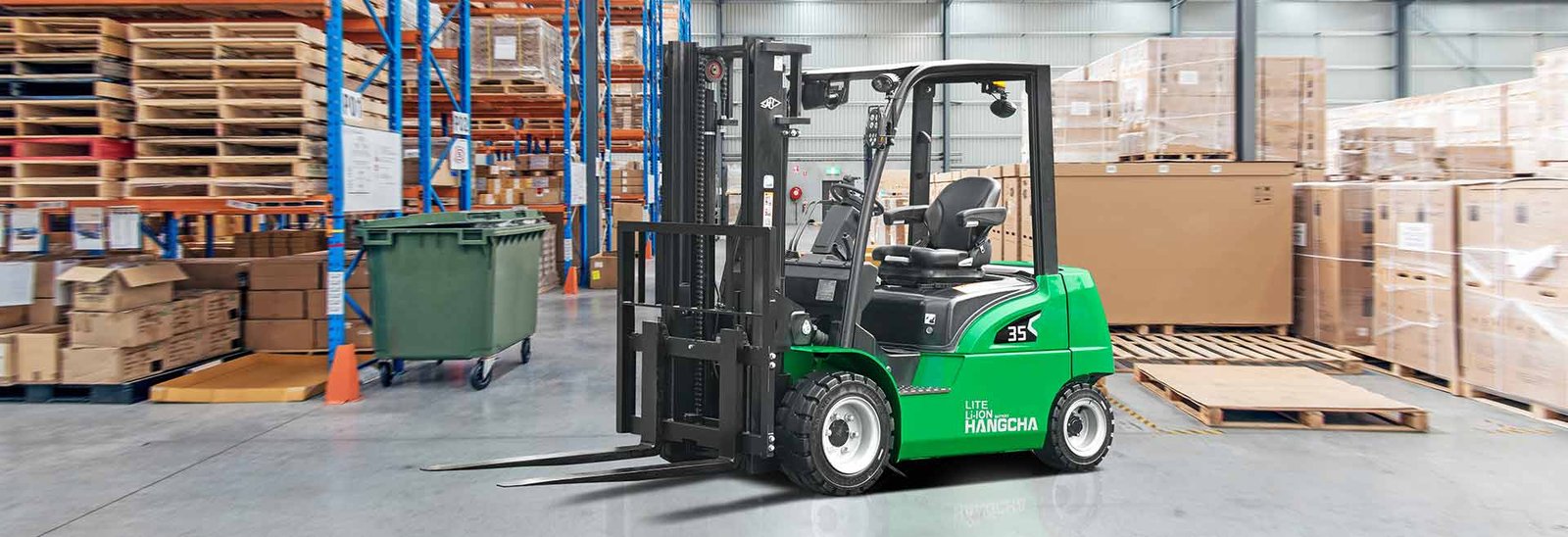
Shown as a configuration reference. Availability and the equipment offered for your project are confirmed separately.
Specify the complete configuration
| Decision | Include in your request | Evidence to compare |
|---|---|---|
| Capacity | Load dimensions, center of gravity, height and attachment | Capacity plate/chart for the quoted truck and attachment |
| Mast and access | Lift height, lowered mast, doorway and container clearance | Dimensioned truck drawing and site clearance review |
| Battery and duty | Shifts, peak travel, temperature and charging windows | Battery/charger sheets and a representative duty plan |
| Work area | Aisles, turning, floor, ramps and outdoor exposure | Site layout and manufacturer operating limits |
| Support | Maintenance provider, parts and training | Named responsibilities, spare list and warranty exclusions |
As a family reference, HANGCHA XC Li-ion light-duty models cover nominal 2–3.5 t capacities; the exact mast and capacity chart still control the choice. OSHA explains load-center effects on stability and capacity. Its US training reference does not establish destination approval.
Compare installed cost and support
Separate the truck, mast, attachments, battery, charger and installation costs. Confirm whether charger cables, electrical work, battery diagnostics, operator training and spare wear parts are included. For shift comparisons, record charging availability and expected downtime as well as energy cost. A battery warranty should specify its capacity-retention conditions, operating limits and claim process.
Keep the delivery term, currency, quote validity and included scope consistent. Use the complete project budget tool to organize assumptions, then replace estimates with dated quotations and destination-specific charges. Discuss supplier checks through our sourcing process.
Agree an acceptance test before ordering
Use the proposed load and attachment to verify required rack access and capacity documentation. Check doorway clearance, steering space and visibility, then record a supervised representative shift and recharge plan. Agree who checks the capacity plate, battery/charger identifiers and delivered accessories. Training and site operating rules must be resolved for the destination before use.
What to include in your RFQ
- Destination country and operating site; purchase window and budget range
- Maximum load mass, dimensions, center of gravity and pallet type
- Required lift height and residual capacity at that height
- Mast configuration, lowered height, doorway and container clearances
- Attachments, fork dimensions and whether their mass is included in the capacity chart
- Aisle layout, floor condition, ramps and indoor/outdoor duty
- Daily operating hours, shifts, travel distances and peak handling demand
- Battery chemistry, voltage, rated energy/capacity and temperature conditions
- Charging opportunities, charger rating and available electrical supply
- Local maintenance, spare parts, training and warranty responsibilities
Need OEM / ODM customization?
Submit branding, packaging, configuration or engineering requirements for this equipment. Include the target market, initial and annual quantities, required changes and acceptance criteria.
Customization feasibility, permitted branding, development responsibilities, minimum quantity, cost and lead time are reviewed for the proposed supplier and configuration before a quotation is confirmed.
Frequently asked questions
Does a 3-tonne forklift carry 3 tonnes at every lift height?
No. The capacity plate and manufacturer chart apply to a stated load center and configuration. Lift height, mast and attachments can change residual capacity. Request the rating at your actual working height and load conditions.
How does load center affect the truck capacity I should request?
Provide the load dimensions and center of gravity as well as mass. A long or unevenly loaded pallet can place its center farther from the fork face. Ask the manufacturer for the correct rating; do not replace its chart with a simple field estimate.
Which mast height and aisle dimensions should I include in an inquiry?
Include the highest handling point, required residual capacity, lowered mast height, doorway height, pallet dimensions and narrowest aisle. Show rack legs, obstructions and turning areas on the layout used for the supplier review.
How should I compare battery and charger configurations for my shifts?
Describe travel, lifting frequency, shifts, temperature and every available charging window. Compare the exact battery and charger combination against that duty. Published battery capacity alone does not prove a full shift or a recharge time.
Can the same lithium forklift work indoors, outdoors and on ramps?
Only within the proposed truck configuration and manufacturer limits. Specify rain exposure, floor condition, ramps, surface transitions and gradients. Have the supplier review traction, protection and operating restrictions for that site.
What capacity, battery, charger and service documents should accompany a quote?
Request the exact capacity plate/chart, mast and attachment drawing, battery and charger sheets, operating manual, warranty conditions and a service/spare-parts plan. Verify that all identifiers match the delivered configuration.
Reference information
- HANGCHA: XC Series Electric Forklift with Li-Ion Power 2.0–3.5 t (Light Duty)
- OSHA Forklift eTool: Load Handling—Load Composition
Reference data and images explain equipment configurations. IndustryApex engineers confirm the offered model, specification and commercial scope in your project quotation.