
Residual capacity is the safe lifting capacity after accounting for attachments, lift height and load position. Request the manufacturer capacity chart for the exact mast, attachment and lift height. Verify load center, chart approval and acceptance conditions before ordering.
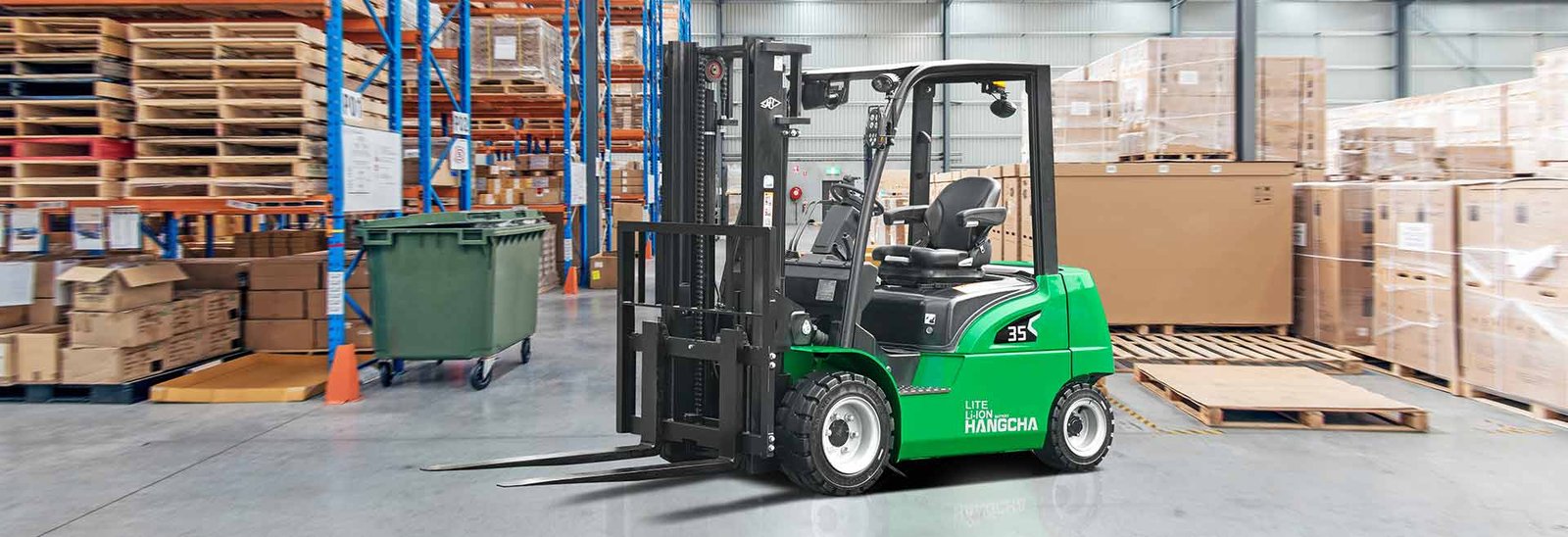
Shown as a configuration reference. Availability and the equipment offered for your project are confirmed separately.
Why residual capacity controls forklift selection
The nominal capacity marked on a forklift applies to a reference configuration: usually a stated load center, minimum lift height and standard forks. When you add attachments, increase lift height or change the load position, the safe lifting capacity changes. This adjusted figure is residual capacity. Choosing a forklift without verifying residual capacity at your actual working conditions can result in a machine that cannot safely handle the intended loads.
The stated capacity of a forklift only applies to the load center indicated on the data plate, and if the load is not centered at the specified position, the forklift’s capacity will be reduced [S2]. Request the manufacturer capacity chart for the exact mast, attachment and lift height combination you will use.
Attachments reduce available capacity
Attachments such as clamps, rotators, side shifters and extended forks add mass ahead of the truck’s front axle. This extra weight and the forward shift in the combined center of gravity reduce the load the truck can safely lift. The reduction is not a simple subtraction of attachment mass; it depends on the attachment weight, its mounting position and the resulting load moment.
Request the manufacturer capacity chart for the complete configuration: the base truck model, mast type, attachment model and your required lift height. The chart should show residual capacity at the planned load center for every lift height you will use. Do not estimate residual capacity by subtracting attachment weight from nominal capacity or applying a generic derating percentage.
Lift height affects stability and capacity
As the mast extends and the load rises, the center of gravity of the truck-and-load system moves upward and forward. This shift increases the overturning moment and reduces stability. Manufacturers provide capacity charts that show how much load can be safely lifted at each mast height. Residual capacity typically decreases as lift height increases, especially with tall masts and heavy attachments.
Include the highest handling point in your request. Verify that the quoted truck delivers the required residual capacity at that height, not just at the reference height printed on the data plate. If your application includes varying lift heights, check residual capacity at the maximum working height and confirm adequate margin for the loads you will handle there.
Load center distance and load shape
Load center is the horizontal distance from the vertical face of the forks to the center of gravity of the load. Standard load center for many forklifts is measured at a reference distance from the fork face. If your load is deeper, unevenly distributed or projects beyond a standard pallet footprint, the effective load center increases and the safe lifting capacity decreases.
Measure the load dimensions and estimate the center of gravity position. For irregular loads, mark the approximate balance point. Provide these dimensions to the supplier and request the residual capacity at the actual load center. The manufacturer may supply a family of capacity curves for different load centers, or calculate a specific rating for your load geometry. Do not apply field estimates or rules of thumb as a substitute for manufacturer-approved capacity information.
Decision table: residual capacity verification
| Buyer input | Alternative | Document to request | Rejection condition |
|---|---|---|---|
| Attachment type and model | Standard forks / clamp / rotator / side shifter / extended forks | Attachment specification sheet with mass, mounting dimensions and approved truck models | Attachment not listed on manufacturer compatibility table; no approved capacity chart available |
| Maximum lift height | Low / medium / high mast configuration | Capacity chart showing residual capacity at stated lift height for the selected mast and attachment | Residual capacity at maximum lift height is less than required load mass; chart does not cover the requested height |
| Load center distance from fork face | Standard distance / custom distance | Manufacturer capacity chart or engineering calculation for the stated load center | No capacity rating provided for the actual load center; supplier offers only standard-distance ratings |
| Load mass, dimensions and shape | Standard pallet / long load / irregular shape / unbalanced load | Drawing or description of load; confirmation that load center and capacity are compatible | Load dimensions or balance point exceed the truck’s capacity envelope; load shape requires attachment not covered by capacity chart |
| Capacity plate and chart approval | Manufacturer-issued plate and chart / third-party certification / site-specific approval | Delivered capacity plate matching the quoted configuration; capacity chart signed or stamped by manufacturer | Capacity plate does not match the delivered mast or attachment; chart is a generic reference not approved for the supplied configuration |
Evidence to request before ordering
Ask the supplier for the complete capacity documentation package for the quoted forklift. This should include the capacity plate that will be installed on the delivered truck, showing the exact model, mast, attachment and capacity ratings. Request the full capacity chart covering all lift heights and load centers relevant to your operation. Verify that the chart is issued or approved by the truck manufacturer, not a generic reference copied from a catalogue.
Obtain the attachment specification sheet showing mass, dimensions and the list of approved truck models. Confirm that your selected truck and mast appear on the compatibility list. If the supplier proposes a different attachment or mast to achieve the required residual capacity, request updated capacity documentation for that alternative configuration.
Prepare a dimensioned load profile showing mass, overall dimensions and the estimated center of gravity. Submit this to the supplier and ask for written confirmation that the proposed truck configuration can handle the load at the required lift height. If your loads vary significantly in size or weight distribution, provide the range and ask the supplier to verify residual capacity for the most demanding case.
Acceptance verification scope
Before the truck enters service, verify that the delivered capacity plate matches the quotation and approved capacity chart. Check the attachment model and mounting hardware against the specification sheet. Confirm that the plate shows residual capacity at the working lift height, or that a separate chart is provided and accessible to operators.
Conduct a supervised load test using representative loads at the intended lift heights. Do not attempt to test the truck to its maximum stated capacity or deliberately approach stability limits; this must be designed and supervised by qualified personnel under manufacturer instructions and site-specific safety arrangements. The purpose of acceptance verification is to confirm that the truck handles the planned loads safely and that documentation is correct, not to validate the manufacturer’s capacity ratings.
Record the test loads, lift heights and any observed behavior. Agree the acceptance criteria with the supplier before the test. Confirm who will be present, what loads will be used, and what constitutes a pass or rejection. Document the results and retain the capacity plate image, chart and test log with the project records.
Configuration and quotation boundaries
Residual capacity depends on the complete delivered configuration. A quotation that states only nominal capacity without specifying mast height, attachment and load center does not give you enough information to verify that the truck meets your needs. Request a detailed configuration description and the corresponding capacity documentation.
If you plan to use multiple attachments, ask whether the capacity chart covers all of them or whether separate charts are required. Confirm whether the quoted price includes the attachment, mounting hardware and updated capacity plate. Clarify who is responsible for verifying compatibility and providing the final capacity documentation.
Delivery, installation, operator training and maintenance responsibilities should be stated separately in the quotation. Residual capacity affects how the truck is loaded and operated; training must cover the specific capacity limitations of the delivered configuration. Ensure that operators have access to the capacity chart and understand how lift height, attachment and load position affect safe operation.
Discuss your forklift application with IndustryApex engineers to confirm the required residual capacity, mast and attachment configuration, and request a detailed equipment quotation with complete capacity documentation.
Define your equipment requirements
Review the Lithium electric forklift buying guide for the complete equipment scope.
Discuss this equipment project ↗ · OEM requirements · ODM requirements. Configuration and feasibility are reviewed for your application.
Explore the Lithium electric forklift buying guide and RFQ checklist ↗
Frequently asked questions
What is the difference between nominal capacity and residual capacity?
Nominal capacity is the maximum load at a reference configuration, usually minimum lift height, standard forks and a stated load center. Residual capacity is the safe load after adjusting for the actual attachment, lift height and load position. Always verify residual capacity at your working conditions rather than relying on the nominal rating.
Which documents prove residual capacity for my forklift and attachment?
Request the manufacturer capacity chart for the exact truck model, mast type and attachment. The chart should show residual capacity at every lift height you will use, for your stated load center. Verify that the delivered capacity plate matches this chart and lists the installed attachment.
How does lift height reduce the safe lifting capacity?
As the mast extends, the combined center of gravity moves upward and forward, increasing the overturning moment. Manufacturers provide capacity charts showing reduced capacity at greater lift heights. Always check residual capacity at your maximum working height, not just at the reference height.
Why does load center distance matter when choosing a forklift?
Load center is the horizontal distance from the fork face to the load's center of gravity. If your load is deeper or unbalanced compared to the standard load center, the effective moment increases and safe capacity decreases. Provide actual load dimensions and request capacity ratings for that load center.
Can I estimate residual capacity by subtracting the attachment weight from nominal capacity?
No. Residual capacity depends on the attachment mass, its mounting position and the resulting load moment, not a simple subtraction. Request the manufacturer capacity chart for the complete configuration rather than applying field estimates.
What should I verify during forklift acceptance for residual capacity?
Confirm that the delivered capacity plate matches the quotation and approved chart. Check the attachment model and verify the plate shows capacity at your working lift height. Conduct a supervised load test with representative loads and document the results. Follow manufacturer instructions and site safety rules.
Reference information
- eTool : Powered Industrial Trucks (Forklift) - Load Handling - Load Composition | Occupational Safety and Health Administration
Reference data and images explain equipment configurations. IndustryApex engineers confirm the offered model, specification and commercial scope in your project quotation.