
Specify a leather splitting machine around the usable piece width, target thickness and material compressibility. Match the feed and band-knife arrangement to the actual leather, then verify thickness after relaxation and downstream use rather than accept a thickness display alone. Split representative pieces across the agreed width, incoming thickness and firmness range. Measure the defined grid after conditioning or relaxation and inspect surface marks, tearing and edge behavior. Demonstrate thickness changeover, sharpening and restart, retaining good-piece yield and the exact feed and knife configuration used. Submit the intended configuration and any OEM/ODM changes for project-specific feasibility review.
Specify a leather splitting machine around the usable piece width, target thickness and material compressibility. Match the feed and band-knife arrangement to the actual leather, then verify thickness after relaxation and downstream use rather than accept a thickness display alone.
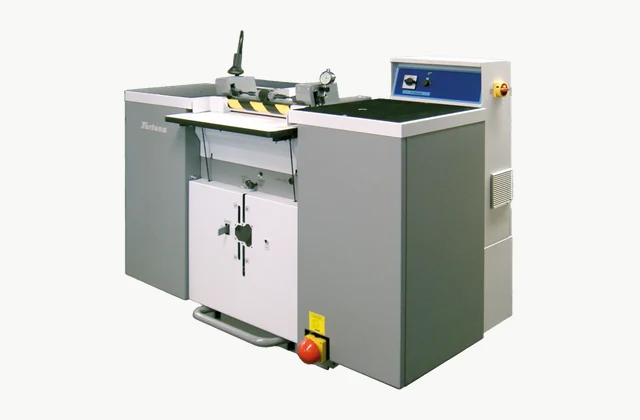
Shown as a configuration reference. Availability and the equipment offered for your project are confirmed separately.
Define piece width and thickness targets
Provide part dimensions, incoming thickness variation and the required final thickness across the entire piece. Include whether a retained split layer has value. Full-width splitting differs from an edge bevel; the acceptable variation should relate to sewing, folding or bonding requirements rather than a nominal machine setting.
Characterize compressibility and surface finish
Supply soft, firm and coated samples from the actual purchase range. Define which face must be protected and how leather is conditioned before measurement. Compressible material may appear correct while held in the machine yet recover differently afterward, so the inspection method needs a stated relaxation and measuring procedure.
Select feeding and pressure elements
Review feed roller and presser-bar or roller arrangements for the offered model and material. Check traction, marking and support for small or irregular pieces. A large working-width specification does not establish reliable feeding of every narrow part or prevent surface impressions on soft finished leather.
Manage band knife and grinding
Itemize the band knife, tracking, sharpening and waste-removal equipment included. Obtain setup and service instructions for qualified operators. Thickness consistency depends on cutting condition and correct adjustment, so compare the ability to maintain that condition over a representative run rather than evaluating a newly sharpened knife only.
Inspect split quality across the piece
Define measurement positions across width and along feed direction, plus allowable holes, ridges or torn fibers. Trial difficult material orientations and part boundaries. A single center-point measurement can conceal an edge or trailing-end defect that becomes costly after lamination or assembly.
Record changeovers and consumable support
List leather grades and target-thickness changes, with approved settings and trial coupons for setup. Identify knives, grinding consumables and feed-component spares. Include safe waste removal and cleaning, because accumulation or worn contact parts can affect feed quality even while the thickness readout remains unchanged.
Compare a complete leather splitting machine scope
| Decision | Information to compare |
|---|---|
| Define piece width and thickness targets | Piece width, incoming/final thickness, tolerance and retained-split requirements |
| Characterize compressibility and surface finish | Leather firmness, coating, protected face and relaxed measurement procedure |
| Select feeding and pressure elements | Feed/presser arrangement, narrow-part support, traction and surface-mark limits |
| Manage band knife and grinding | Band knife specification, tracking/grinding, extraction and maintenance instructions |
| Inspect split quality across the piece | Measurement grid, holes/ridges, edge/end quality and downstream sample tests |
| Record changeovers and consumable support | Grade/thickness changeovers, setup coupons, knives, feed spares and cleaning |
Plan installation and access
Arrange flat leather staging, safe feed access and waste collection according to the supplied machine's instructions. Qualified installers should confirm electrical and extraction services and guards around the knife system. Retain calibration references, knife-service training and a controlled method for checking thickness without exposing personnel to moving parts.
Agree acceptance evidence before ordering
Split representative pieces across the agreed width, incoming thickness and firmness range. Measure the defined grid after conditioning or relaxation and inspect surface marks, tearing and edge behavior. Demonstrate thickness changeover, sharpening and restart, retaining good-piece yield and the exact feed and knife configuration used.
Define OEM/ODM engineering boundaries
OEM feed elements, guides and piece-handling interfaces can be reviewed. ODM knife paths, control systems or pressure elements require engineering and material trials. Reference imagery does not establish authorization or promise the same thickness result for another leather condition, measuring method or machine variant.
What should your leather splitting machine RFQ include?
- Piece width, incoming/final thickness, tolerance and retained-split requirements
- Leather firmness, coating, protected face and relaxed measurement procedure
- Feed/presser arrangement, narrow-part support, traction and surface-mark limits
- Band knife specification, tracking/grinding, extraction and maintenance instructions
- Measurement grid, holes/ridges, edge/end quality and downstream sample tests
- Grade/thickness changeovers, setup coupons, knives, feed spares and cleaning
- Destination, working environment, access and delivery constraints
- Installation responsibility, utilities and connection drawings
- Acceptance samples, documented test method, operator training and maintenance scope
- OEM/ODM changes requested: identification, tooling, interfaces or new design; engineering feasibility to be confirmed
Need OEM / ODM customization?
Submit branding, packaging, configuration or engineering requirements for this equipment. Include the target market, initial and annual quantities, required changes and acceptance criteria.
Customization feasibility, permitted branding, development responsibilities, minimum quantity, cost and lead time are reviewed for the proposed supplier and configuration before a quotation is confirmed.
Frequently asked questions
How do I define piece width and thickness targets?
Provide part dimensions, incoming thickness variation and the required final thickness across the entire piece. Include whether a retained split layer has value. Full-width splitting differs from an edge bevel; the acceptable variation should relate to sewing, folding or bonding requirements rather than a nominal machine setting.
How do I characterize compressibility and surface finish?
Supply soft, firm and coated samples from the actual purchase range. Define which face must be protected and how leather is conditioned before measurement. Compressible material may appear correct while held in the machine yet recover differently afterward, so the inspection method needs a stated relaxation and measuring procedure.
How do I select feeding and pressure elements?
Review feed roller and presser-bar or roller arrangements for the offered model and material. Check traction, marking and support for small or irregular pieces. A large working-width specification does not establish reliable feeding of every narrow part or prevent surface impressions on soft finished leather.
How do I manage band knife and grinding?
Itemize the band knife, tracking, sharpening and waste-removal equipment included. Obtain setup and service instructions for qualified operators. Thickness consistency depends on cutting condition and correct adjustment, so compare the ability to maintain that condition over a representative run rather than evaluating a newly sharpened knife only.
How do I inspect split quality across the piece?
Define measurement positions across width and along feed direction, plus allowable holes, ridges or torn fibers. Trial difficult material orientations and part boundaries. A single center-point measurement can conceal an edge or trailing-end defect that becomes costly after lamination or assembly.
How do I record changeovers and consumable support?
List leather grades and target-thickness changes, with approved settings and trial coupons for setup. Identify knives, grinding consumables and feed-component spares. Include safe waste removal and cleaning, because accumulation or worn contact parts can affect feed quality even while the thickness readout remains unchanged.
Reference information
- FORTUNA AN 400 official product reference
- FORTUNA leather splitting machine official family or technical reference
Reference data and images explain equipment configurations. IndustryApex engineers confirm the offered model, specification and commercial scope in your project quotation.