
Industrial platform trucks carry loads on a deck rather than lifting them on forks or towing them on separate trailers. Powered heavy-duty platforms are one configuration within this family; deck geometry, load transfer and route conditions define the useful procurement specification. Provide load dimensions, mass, center of gravity and support or contact requirements, including any transport rack. Describe how the load gets onto and off the platform. A large deck alone does not establish that the transfer method or concentrated support loads are acceptable.
Industrial platform trucks carry loads on a deck rather than lifting them on forks or towing them on separate trailers. Powered heavy-duty platforms are one configuration within this family; deck geometry, load transfer and route conditions define the useful procurement specification. Compare application fit, configuration and OEM/ODM scope through the buyer checklist below.
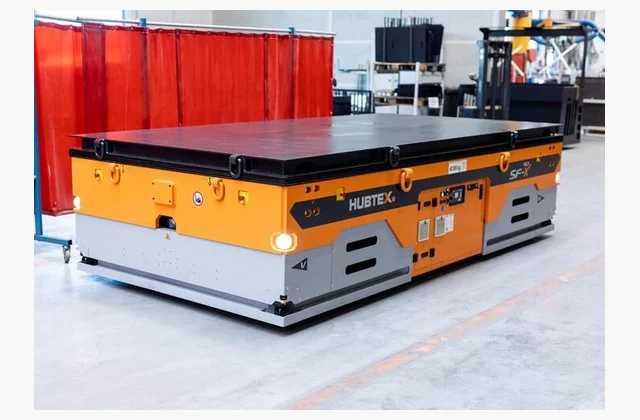
Shown as a configuration reference. Availability and the equipment offered for your project are confirmed separately.
Deck loading: application and input specification
Industrial platform trucks carry loads on a deck rather than lifting them on forks or towing them on separate trailers. Powered heavy-duty platforms are one configuration within this family; deck geometry, load transfer and route conditions define the useful procurement specification.
Provide load dimensions, mass, center of gravity and support or contact requirements, including any transport rack. Describe how the load gets onto and off the platform. A large deck alone does not establish that the transfer method or concentrated support loads are acceptable.
Support loads may be concentrated even when the total mass fits the rating. A die, coil cradle or transport frame can bear on a small area of the deck. Supply the support layout and ask the manufacturer to review the platform structure and load distribution explicitly.
Transfer: configuration tradeoffs
Compare fixed-deck and lifting concepts, steering modes, operating position and any docking aids against the move. Remote, onboard or automated operation creates different interface requirements. Select the configuration around pickup and placement rather than treating travel capacity as the whole task.
Transfer height needs an installed reference. Floor variation, load deflection and fixture tolerances can affect whether a stand or crane can exchange the load reliably. Include the complete loaded interface in a drawing and demonstrate it with the intended locating and restraint arrangement.
| Decision | What to resolve | Useful evidence |
|---|---|---|
| Deck loading | Concentrated supports and distribution | Load-support drawing review |
| Transfer | Height, location and restraint | Actual loaded-station trial |
| Travel control | Visibility and route envelope | Full-route operating demonstration |
Process integration and handover points
Coordinate cranes, transfer stands, production fixtures and destination supports with the platform height and clearances. Define communication and interlocks where equipment exchanges loads. Show which party supplies locating features, restraints and any automatic handover mechanism at each station.
Multidirectional travel can reduce repositioning but still needs a swept-path assessment. Check the load's corners and projections at bends, doors and workstations. A compact platform footprint does not describe the moving envelope of a large tool or aircraft component placed on top.
Installation and maintainable operating arrangements
Survey floors, gradients, joints, turning spaces and indoor-outdoor transitions. Review concentrated wheel loads with the responsible site specialist. Confirm energy replenishment, service access and operating visibility, with traffic separation appropriate to the loaded platform and its chosen control method.
Control selection follows visibility and workflow. An onboard operator, remote user and automated system each need a defined observation and response method. Evaluate the actual operating position with the load installed, including how the platform stops and resumes when the route is obstructed.
Acceptance evidence for travel control
Move the representative load through the complete route, including transfer, docking and placement. Check support, clearance, stability and the operator's ability to observe the move. Record the actual load and operating configuration so a successful empty travel demonstration is not overstated.
Charging and shift duty must match the move frequency. Record loaded travel, standing time and any powered lifting or accessories. Compare the complete replenishment arrangement and service requirements rather than assuming occasional heavy transport has the same energy profile as frequent production transfers.
OEM/ODM scope and future changes
ODM may include deck supports, lifting features, restraints, steering or control integration. Agree engineering responsibility, rated documentation and transfer trials. OEM graphics and manuals are separate requests, and special contact fixtures should remain traceable to the load condition for which they were approved.
Keep approved loads and transfer stations in the handover record. A new tool with different support feet can require review even when it weighs less. Assess changed load distribution, restraints and interfaces before expanding the platform's duties beyond the conditions demonstrated at acceptance.
Image reference: HUBTEX SFX heavy-duty platform truck. The illustrated manufacturer configuration does not establish stock, an agency appointment or permission to relabel it. OEM/ODM requests require a written feasibility response for the actual proposed equipment.
Include these application details in your quotation request:
- Load dimensions, mass and center of gravity
- Deck contact points and concentrated support loads
- Transport rack, restraint and protection drawings
- Pickup and destination transfer methods
- Deck height, lifting and docking requirements
- Steering modes and loaded route envelope
- Floor loads, slopes and transitions
- Control position, communications and energy duty
- Loaded transfer and full-route acceptance
- OEM/ODM deck fixtures and revised documentation
What should your industrial platform truck RFQ include?
- Load dimensions, mass and center of gravity
- Deck contact points and concentrated support loads
- Transport rack, restraint and protection drawings
- Pickup and destination transfer methods
- Deck height, lifting and docking requirements
- Steering modes and loaded route envelope
- Floor loads, slopes and transitions
- Control position, communications and energy duty
- Loaded transfer and full-route acceptance
- OEM/ODM deck fixtures and revised documentation
Need OEM / ODM customization?
Submit branding, packaging, configuration or engineering requirements for this equipment. Include the target market, initial and annual quantities, required changes and acceptance criteria.
Customization feasibility, permitted branding, development responsibilities, minimum quantity, cost and lead time are reviewed for the proposed supplier and configuration before a quotation is confirmed.
Frequently asked questions
What inputs determine selection of industrial platform truck?
Provide load dimensions, mass, center of gravity and support or contact requirements, including any transport rack. Describe how the load gets onto and off the platform. A large deck alone does not establish that the transfer method or concentrated support loads are acceptable.
How should I compare transfer options?
Compare fixed-deck and lifting concepts, steering modes, operating position and any docking aids against the move. Remote, onboard or automated operation creates different interface requirements. Select the configuration around pickup and placement rather than treating travel capacity as the whole task.
Which adjoining operations need to be specified?
Coordinate cranes, transfer stands, production fixtures and destination supports with the platform height and clearances. Define communication and interlocks where equipment exchanges loads. Show which party supplies locating features, restraints and any automatic handover mechanism at each station.
What is a useful acceptance trial for industrial platform truck?
Move the representative load through the complete route, including transfer, docking and placement. Check support, clearance, stability and the operator's ability to observe the move. Record the actual load and operating configuration so a successful empty travel demonstration is not overstated.
Which OEM/ODM changes can I request?
ODM may include deck supports, lifting features, restraints, steering or control integration. Agree engineering responsibility, rated documentation and transfer trials. OEM graphics and manuals are separate requests, and special contact fixtures should remain traceable to the load condition for which they were approved.
What application boundary is easy to overlook?
Support loads may be concentrated even when the total mass fits the rating. A die, coil cradle or transport frame can bear on a small area of the deck. Supply the support layout and ask the manufacturer to review the platform structure and load distribution explicitly.
Reference information
- HUBTEX SFX heavy-duty platform truck official reference
- HUBTEX related technology or portfolio reference
Reference data and images explain equipment configurations. IndustryApex engineers confirm the offered model, specification and commercial scope in your project quotation.