
Select a hay tedder for spreading the farm's cut forage under actual moisture and field conditions. Match rotor geometry, working width, tractor services and ground following, then assess drying distribution and leaf retention rather than comparing width alone. Demonstrate coverage across representative mower swaths and uneven ground. Assess remaining dense strips, leaf loss and unwanted soil pickup using agreed methods. Record speed and adjustments with crop moisture and field condition, then verify folding, transport locks and return to the approved working position. Submit the intended configuration and any OEM/ODM changes for project-specific feasibility review.
Select a hay tedder for spreading the farm's cut forage under actual moisture and field conditions. Match rotor geometry, working width, tractor services and ground following, then assess drying distribution and leaf retention rather than comparing width alone.
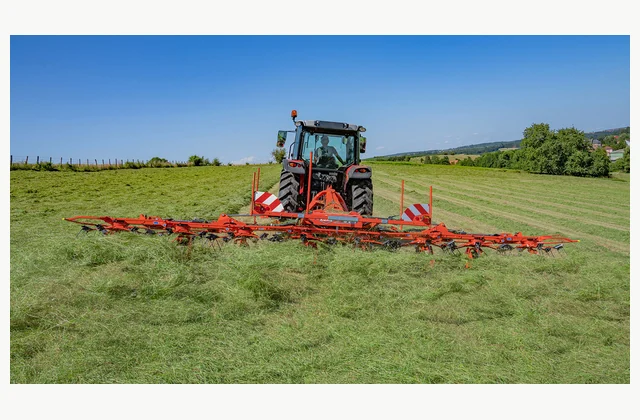
Shown as a configuration reference. Availability and the equipment offered for your project are confirmed separately.
Define the tedding objective
A tedder spreads and aerates cut forage; it does not make the final pickup windrow. Describe the mower swath, crop type and intended drying sequence. Decide when and how the crop will be raked afterward so the equipment fits the complete harvest workflow.
Match rotor coverage and crop flow
Working width must suit swath spacing and tractor travel without leaving dense strips. Compare rotor diameter, tine arrangement and adjustment options on representative forage. Excessive aggression can increase leaf loss, so uniform distribution and retained crop quality should guide the trial settings.
Check ground following and contamination
Uneven ground requires appropriate wheel and articulation behavior. Set tine height using the machine instructions and inspect soil or stone pickup. Aggressive ground contact may appear to clear the field while introducing contamination and wear that compromise the harvested feed.
Consider moisture and handling timing
Crop condition changes the useful intensity and timing of tedding. State the range expected during the harvest window and involve the forage specialist. A machine demonstration in one dry crop cannot prove the desired leaf retention and distribution in all moisture conditions.
Review tractor and folding interfaces
Confirm linkage, PTO, hydraulic connections and the exact mounted or trailed arrangement. Check folded height, transport width and parking support. The offered working width must remain practical at gates, headlands and storage entrances, with the correct transport locking procedure.
Plan tine inspection and seasonal support
Tines, tine arms, joints and wheels experience impact and cyclic work. Obtain model-specific parts identification and inspection instructions. Verify access for lubrication and replacement with the machine safely supported, and include reasonable spares for the farm's peak harvesting period.
Compare a complete hay tedder scope
| Decision | Information to compare |
|---|---|
| Define the tedding objective | Crop species, mower swath, drying objective and later raking sequence |
| Match rotor coverage and crop flow | Swath spacing, rotor configuration, crop volume and distribution criteria |
| Check ground following and contamination | Field contours, tine height, ground contact and contamination limits |
| Consider moisture and handling timing | Moisture conditions, intended operating passes and crop-quality assessment |
| Review tractor and folding interfaces | Tractor, linkage/PTO, hydraulics, folding envelope and parking conditions |
| Plan tine inspection and seasonal support | Tine/arm parts, driveline service, wheel components and seasonal spares |
Plan installation and access
Arrange delivery and assembly on level ground with adequate support for the mounted or trailed unit. Review tractor attachment, transport lighting and hydraulic hose routing. Provide protected parking and safe access around folded rotors without using unsupported parts as lifting points.
Agree acceptance evidence before ordering
Demonstrate coverage across representative mower swaths and uneven ground. Assess remaining dense strips, leaf loss and unwanted soil pickup using agreed methods. Record speed and adjustments with crop moisture and field condition, then verify folding, transport locks and return to the approved working position.
Define OEM/ODM engineering boundaries
OEM labeling and selected tractor interfaces may be considered. ODM changes to tine geometry, rotor drives or folding structures need mechanical assessment and forage trials. Reference photos show the family configuration; they establish neither stock nor permission to reproduce a manufacturer's protected mechanisms.
Prepare comparable quotations
Use the hay tedder inquiry to identify the duty described above, the included configuration and the evidence that will demonstrate it. Separate base equipment from required accessories, commissioning and operator training. Record deviations against the requested crop species, mower swath, drying objective and later raking sequence before price comparison. The illustrated reference establishes a discussion point; the offered unit still needs its own identifiable configuration and written commercial scope.
What should your hay tedder RFQ include?
- Crop species, mower swath, drying objective and later raking sequence
- Swath spacing, rotor configuration, crop volume and distribution criteria
- Field contours, tine height, ground contact and contamination limits
- Moisture conditions, intended operating passes and crop-quality assessment
- Tractor, linkage/PTO, hydraulics, folding envelope and parking conditions
- Tine/arm parts, driveline service, wheel components and seasonal spares
- Destination, working environment, access and delivery constraints
- Installation responsibility, utilities and connection drawings
- Acceptance samples, documented test method, operator training and maintenance scope
- OEM/ODM changes requested: identification, tooling, interfaces or new design; engineering feasibility to be confirmed
Need OEM / ODM customization?
Submit branding, packaging, configuration or engineering requirements for this equipment. Include the target market, initial and annual quantities, required changes and acceptance criteria.
Customization feasibility, permitted branding, development responsibilities, minimum quantity, cost and lead time are reviewed for the proposed supplier and configuration before a quotation is confirmed.
Frequently asked questions
How do I define the tedding objective?
A tedder spreads and aerates cut forage; it does not make the final pickup windrow. Describe the mower swath, crop type and intended drying sequence. Decide when and how the crop will be raked afterward so the equipment fits the complete harvest workflow.
How do I match rotor coverage and crop flow?
Working width must suit swath spacing and tractor travel without leaving dense strips. Compare rotor diameter, tine arrangement and adjustment options on representative forage. Excessive aggression can increase leaf loss, so uniform distribution and retained crop quality should guide the trial settings.
How do I check ground following and contamination?
Uneven ground requires appropriate wheel and articulation behavior. Set tine height using the machine instructions and inspect soil or stone pickup. Aggressive ground contact may appear to clear the field while introducing contamination and wear that compromise the harvested feed.
How do I consider moisture and handling timing?
Crop condition changes the useful intensity and timing of tedding. State the range expected during the harvest window and involve the forage specialist. A machine demonstration in one dry crop cannot prove the desired leaf retention and distribution in all moisture conditions.
How do I review tractor and folding interfaces?
Confirm linkage, PTO, hydraulic connections and the exact mounted or trailed arrangement. Check folded height, transport width and parking support. The offered working width must remain practical at gates, headlands and storage entrances, with the correct transport locking procedure.
How do I plan tine inspection and seasonal support?
Tines, tine arms, joints and wheels experience impact and cyclic work. Obtain model-specific parts identification and inspection instructions. Verify access for lubrication and replacement with the machine safely supported, and include reasonable spares for the farm's peak harvesting period.
Reference information
- KUHN GF 1003 official product reference
- KUHN hay tedder official family or technical reference
Reference data and images explain equipment configurations. IndustryApex engineers confirm the offered model, specification and commercial scope in your project quotation.