
Choose an electropneumatic proportional valve or pressure regulator from the controlled variable, pressure/flow range and required response at the load. Match the command, feedback and supply conditions, then test the complete pneumatic control loop under changing demand. Apply representative steps and ramps across the intended range with minimum and maximum downstream demand. Measure response at the agreed process point, including overshoot, steady error and recovery after interruption. Record air supply, tubing, load volume, command scaling and offered part number with the results. Submit the intended configuration and any OEM/ODM changes for project-specific feasibility review.
Choose an electropneumatic proportional valve or pressure regulator from the controlled variable, pressure/flow range and required response at the load. Match the command, feedback and supply conditions, then test the complete pneumatic control loop under changing demand.
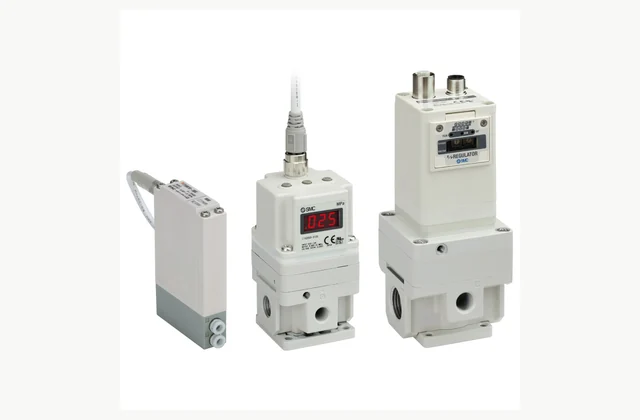
Shown as a configuration reference. Availability and the equipment offered for your project are confirmed separately.
Distinguish pressure from flow control
A proportional pressure regulator and a proportional flow valve perform different duties. State what must be controlled at the workpiece and how it is measured. The SMC ITV reference illustrates pressure regulation; it should not be assumed to provide a commanded flow independent of the connected load.
Define supply and output ranges
Provide inlet pressure limits, target output range and downstream demand. Regulation depends on sufficient supply and the actual exhaust arrangement. A wide displayed range does not establish usable control at every flow or near the endpoints, so the offered variant needs a duty-specific review.
Match electrical command and feedback
Specify analog voltage, current or communication protocol together with supply and grounding. Confirm scaling, polarity and feedback meaning. A connector that fits mechanically may still have a different pinout, and displayed pressure is not necessarily the same signal used by the machine controller.
Assess response with real pneumatic volume
Tubing length, downstream chamber volume and changing flow influence response and stability. Define the required ramp, settling time and allowed overshoot at the actual load. A fast unloaded command response cannot establish the behavior of a large connected actuator or process volume.
Review power and communication faults
Determine what pressure remains or changes after power, command or network loss. Include startup and recovery in the process review. Standard proportional regulation is not automatically a safety pressure-control function, and any required pressure retention or discharge needs a separate engineered system strategy.
Control air cleanliness and service access
Contaminated or wet air can affect small regulating passages and control repeatability. Confirm filtration, moisture and lubrication requirements for the exact variant. Provide access for replacement and re-scaling, and keep the accepted parameters so a serviced unit can be checked against the original process requirement.
Compare a complete electropneumatic proportional valve scope
| Decision | Information to compare |
|---|---|
| Distinguish pressure from flow control | Controlled pressure or flow, measurement point and process objective |
| Define supply and output ranges | Supply range, output span, downstream flow and exhaust arrangement |
| Match electrical command and feedback | Command type, scaling, pinout, feedback and controller power |
| Assess response with real pneumatic volume | Downstream volume, tubing, ramps, settling time and overshoot limits |
| Review power and communication faults | Power/command-loss behavior, startup state and approved fault response |
| Control air cleanliness and service access | Required air quality, contamination exposure, service access and parameter backup |
Plan installation and access
Install in the permitted orientation with supported air connections, unobstructed exhaust and appropriately routed signal cables. Separate electrical noise sources as required by the instructions. Provide accessible pressure measurement and safe isolation of the downstream volume before adjustments or replacement.
Agree acceptance evidence before ordering
Apply representative steps and ramps across the intended range with minimum and maximum downstream demand. Measure response at the agreed process point, including overshoot, steady error and recovery after interruption. Record air supply, tubing, load volume, command scaling and offered part number with the results.
Define OEM/ODM engineering boundaries
OEM connectors, mounting and control integration can be evaluated. ODM valve, sensor, firmware or pressure-boundary changes require engineering and control-loop validation. The reference image identifies a pressure-regulating family and does not transfer its specifications or manufacturer authorization to another design.
What should your electropneumatic proportional valve RFQ include?
- Controlled pressure or flow, measurement point and process objective
- Supply range, output span, downstream flow and exhaust arrangement
- Command type, scaling, pinout, feedback and controller power
- Downstream volume, tubing, ramps, settling time and overshoot limits
- Power/command-loss behavior, startup state and approved fault response
- Required air quality, contamination exposure, service access and parameter backup
- Destination, working environment, access and delivery constraints
- Installation responsibility, utilities and connection drawings
- Acceptance samples, documented test method, operator training and maintenance scope
- OEM/ODM changes requested: identification, tooling, interfaces or new design; engineering feasibility to be confirmed
Need OEM / ODM customization?
Submit branding, packaging, configuration or engineering requirements for this equipment. Include the target market, initial and annual quantities, required changes and acceptance criteria.
Customization feasibility, permitted branding, development responsibilities, minimum quantity, cost and lead time are reviewed for the proposed supplier and configuration before a quotation is confirmed.
Frequently asked questions
How do I distinguish pressure from flow control?
A proportional pressure regulator and a proportional flow valve perform different duties. State what must be controlled at the workpiece and how it is measured. The SMC ITV reference illustrates pressure regulation; it should not be assumed to provide a commanded flow independent of the connected load.
How do I define supply and output ranges?
Provide inlet pressure limits, target output range and downstream demand. Regulation depends on sufficient supply and the actual exhaust arrangement. A wide displayed range does not establish usable control at every flow or near the endpoints, so the offered variant needs a duty-specific review.
How do I match electrical command and feedback?
Specify analog voltage, current or communication protocol together with supply and grounding. Confirm scaling, polarity and feedback meaning. A connector that fits mechanically may still have a different pinout, and displayed pressure is not necessarily the same signal used by the machine controller.
How do I assess response with real pneumatic volume?
Tubing length, downstream chamber volume and changing flow influence response and stability. Define the required ramp, settling time and allowed overshoot at the actual load. A fast unloaded command response cannot establish the behavior of a large connected actuator or process volume.
How do I review power and communication faults?
Determine what pressure remains or changes after power, command or network loss. Include startup and recovery in the process review. Standard proportional regulation is not automatically a safety pressure-control function, and any required pressure retention or discharge needs a separate engineered system strategy.
How do I control air cleanliness and service access?
Contaminated or wet air can affect small regulating passages and control repeatability. Confirm filtration, moisture and lubrication requirements for the exact variant. Provide access for replacement and re-scaling, and keep the accepted parameters so a serviced unit can be checked against the original process requirement.
Reference information
- SMC ITV official product reference
- SMC electropneumatic proportional valve official family or technical reference
Reference data and images explain equipment configurations. IndustryApex engineers confirm the offered model, specification and commercial scope in your project quotation.