
Specify an electric rotary indexing table from station angles, payload inertia and the process performed at each stop. Match the drive, bearings, settling behavior and machine handshake, then prove usable indexing time with the real fixture and workpieces. Use the production fixture and representative workpieces to check every station, including the most eccentric load. Measure angular and working-point repeatability, settle time and complete-cycle output. Test the approved stop, home and restart sequence and retain payload, drive parameters and fixture revision with the results. Submit the intended configuration and any OEM/ODM changes for project-specific feasibility review.
Specify an electric rotary indexing table from station angles, payload inertia and the process performed at each stop. Match the drive, bearings, settling behavior and machine handshake, then prove usable indexing time with the real fixture and workpieces.
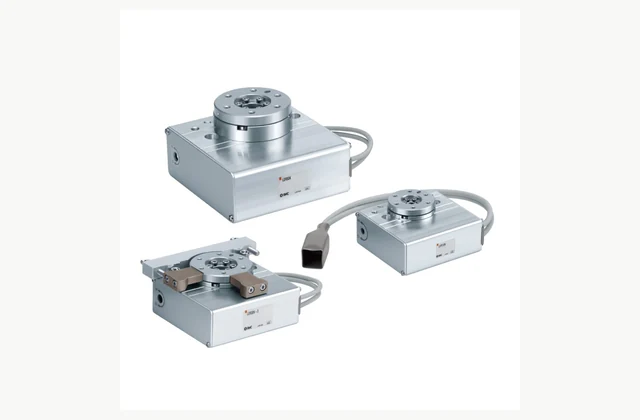
Shown as a configuration reference. Availability and the equipment offered for your project are confirmed separately.
Define the station sequence
List each indexed angle, rotation direction, dwell and any continuous or return movement. Equal station spacing and arbitrary positioning can need different control arrangements. Include loading and process interlocks so the quotation reflects the actual assembly sequence rather than a simple unloaded rotation.
Calculate inertia and bearing moments
Payload mass alone does not describe a rotating fixture. Supply its mass distribution, center of gravity and forces applied at each station. Eccentric loads and machining or pressing reactions need a bearing and structure review independent of the motor's nominal torque.
Separate indexing from settling
A table can reach its commanded angle before the fixture is stable enough for the process. Define allowable vibration and position error at the working point. Compare index-plus-settle time under the real inertia, rather than using maximum rotational speed to predict useful station output.
Check stops and holding requirements
Determine whether the process needs a mechanical stop, brake or separate locking arrangement. Servo holding torque is not universally equivalent to a rigid process lock. Review power-loss and emergency-stop behavior, especially where an offset load could rotate unexpectedly during operator access.
Integrate position confirmation and utilities
Specify drive protocol, homing, ready and in-position signals and the host controller. Route cables or hoses crossing the rotating assembly with defined rotation limits. If slip rings or rotary unions are needed, itemize them and confirm their interfaces rather than assuming table supply includes them.
Plan lubrication and fixture changeover
Provide access to mounting bolts and the maintenance points after the full fixture is installed. Establish a datum and settings backup for changeovers. Replacement bearings, stops or motors may require a new reference setup, so the service instructions should explain how positioning is restored.
Compare a complete electric rotary indexing table scope
| Decision | Information to compare |
|---|---|
| Define the station sequence | Station angles, directions, dwell periods and process sequence |
| Calculate inertia and bearing moments | Fixture geometry, inertia, center of gravity and external station forces |
| Separate indexing from settling | Index time, settling criterion, working-point error and allowable vibration |
| Check stops and holding requirements | Holding/locking method, power-loss state and permitted process torque |
| Integrate position confirmation and utilities | Protocol, home/in-position handshake, cable rotation and utility transfer |
| Plan lubrication and fixture changeover | Mounting datum, fixture changes, lubrication, service parts and re-reference |
Plan installation and access
Support the table on a stiff, level mounting structure designed for the combined process and dynamic loads. Confirm bolt engagement and locating features. Guard rotating fixtures and pinch points, and arrange commissioning so the table cannot collide with tools, services or neighboring stations.
Agree acceptance evidence before ordering
Use the production fixture and representative workpieces to check every station, including the most eccentric load. Measure angular and working-point repeatability, settle time and complete-cycle output. Test the approved stop, home and restart sequence and retain payload, drive parameters and fixture revision with the results.
Define OEM/ODM engineering boundaries
OEM fixture plates, cable interfaces and control integration can be reviewed. ODM changes to bearings, transmission or braking require engineering and positioning/endurance trials. A manufacturer's rotary-table photo provides configuration context and establishes neither authorization nor performance equivalence for another design.
What should your electric rotary indexing table RFQ include?
- Station angles, directions, dwell periods and process sequence
- Fixture geometry, inertia, center of gravity and external station forces
- Index time, settling criterion, working-point error and allowable vibration
- Holding/locking method, power-loss state and permitted process torque
- Protocol, home/in-position handshake, cable rotation and utility transfer
- Mounting datum, fixture changes, lubrication, service parts and re-reference
- Destination, working environment, access and delivery constraints
- Installation responsibility, utilities and connection drawings
- Acceptance samples, documented test method, operator training and maintenance scope
- OEM/ODM changes requested: identification, tooling, interfaces or new design; engineering feasibility to be confirmed
Need OEM / ODM customization?
Submit branding, packaging, configuration or engineering requirements for this equipment. Include the target market, initial and annual quantities, required changes and acceptance criteria.
Customization feasibility, permitted branding, development responsibilities, minimum quantity, cost and lead time are reviewed for the proposed supplier and configuration before a quotation is confirmed.
Frequently asked questions
How do I define the station sequence?
List each indexed angle, rotation direction, dwell and any continuous or return movement. Equal station spacing and arbitrary positioning can need different control arrangements. Include loading and process interlocks so the quotation reflects the actual assembly sequence rather than a simple unloaded rotation.
How do I calculate inertia and bearing moments?
Payload mass alone does not describe a rotating fixture. Supply its mass distribution, center of gravity and forces applied at each station. Eccentric loads and machining or pressing reactions need a bearing and structure review independent of the motor's nominal torque.
How do I separate indexing from settling?
A table can reach its commanded angle before the fixture is stable enough for the process. Define allowable vibration and position error at the working point. Compare index-plus-settle time under the real inertia, rather than using maximum rotational speed to predict useful station output.
How do I check stops and holding requirements?
Determine whether the process needs a mechanical stop, brake or separate locking arrangement. Servo holding torque is not universally equivalent to a rigid process lock. Review power-loss and emergency-stop behavior, especially where an offset load could rotate unexpectedly during operator access.
How do I integrate position confirmation and utilities?
Specify drive protocol, homing, ready and in-position signals and the host controller. Route cables or hoses crossing the rotating assembly with defined rotation limits. If slip rings or rotary unions are needed, itemize them and confirm their interfaces rather than assuming table supply includes them.
How do I plan lubrication and fixture changeover?
Provide access to mounting bolts and the maintenance points after the full fixture is installed. Establish a datum and settings backup for changeovers. Replacement bearings, stops or motors may require a new reference setup, so the service instructions should explain how positioning is restored.
Reference information
- SMC LER official product reference
- SMC electric rotary indexing table official family or technical reference
Reference data and images explain equipment configurations. IndustryApex engineers confirm the offered model, specification and commercial scope in your project quotation.