
Choose an electric gripper from part geometry, finger length, required holding force and the programmed handling cycle. Evaluate workpiece detection and loss-of-power behavior with the actual robot or machine, including controller, cables and custom fingers in the quotation. Handle representative minimum and maximum parts through the complete acceleration, orientation and release cycle. Measure slip, marking, repeatability and false grip confirmations. Demonstrate an empty pickup, communication interruption and power-loss recovery with an agreed safe method, keeping fingers and controller settings in the acceptance record. Submit the intended configuration and any OEM/ODM changes for project-specific feasibility review.
Choose an electric gripper from part geometry, finger length, required holding force and the programmed handling cycle. Evaluate workpiece detection and loss-of-power behavior with the actual robot or machine, including controller, cables and custom fingers in the quotation.
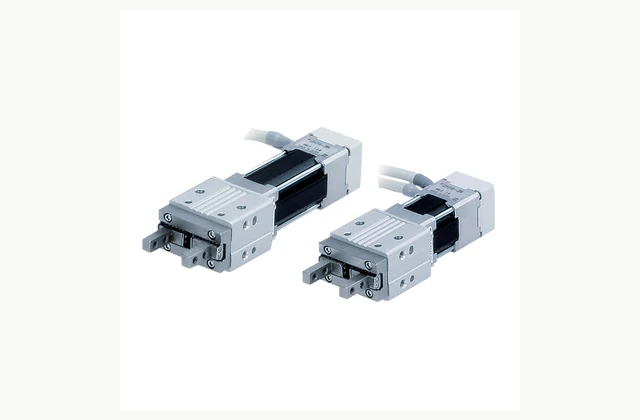
Shown as a configuration reference. Availability and the equipment offered for your project are confirmed separately.
Define the gripping contact
Provide drawings, mass, surface finish and allowable marking for every part. Distinguish friction gripping from mechanically supported gripping. Contact geometry and jaw extension can determine whether the selected unit holds the part reliably, even when its nominal force appears sufficient.
Calculate force at the finger tips
Published force needs interpretation at the proposed gripping point and operating setting. Long custom fingers increase moments on the jaws. Include acceleration and external process loads in the engineering review; a stationary hand-held demonstration does not reproduce the dynamic handling duty.
Match stroke and part variation
The fingers must open far enough for loading while closing on the smallest intended workpiece. Compare usable stroke with tolerances and approach clearance. A short-stroke gripper may need different finger sets rather than a controller setting to handle widely different parts.
Define position and grip confirmation
Specify the controller commands and the conditions that confirm a successful grip. Motor position alone may not distinguish a correctly seated part from an obstruction. Include empty-jaw, misloaded-part and release tests and decide how the machine responds when a grip is uncertain.
Review holding during power loss
A stopped motor does not automatically mean a safely retained workpiece. Ask how the offered mechanism behaves when power or communication is lost, and assess the complete handling risk. If retained load is necessary, specify the approved mechanical or system-level provision explicitly.
Protect guides and service cables
Consider chips, coolant, dust and cleaning around the finger guides and seals. Specify cable flexing, connectors and replacement access on the moving assembly. Obtain the maintenance and adjustment procedure for the exact gripper/controller combination, including records needed after a finger change.
Compare a complete electric gripper scope
| Decision | Information to compare |
|---|---|
| Define the gripping contact | Part drawings, mass, friction conditions, contact locations and marking limits |
| Calculate force at the finger tips | Finger length, gripping point, acceleration, load directions and force margin |
| Match stroke and part variation | Part size range, tolerances, jaw opening, approach clearance and finger kits |
| Define position and grip confirmation | Position/force command, part detection, fault response and machine handshake |
| Review holding during power loss | Power-loss state, retained-load requirement and recovery sequence |
| Protect guides and service cables | Environment, ingress exposure, flex cables, lubrication and replacement access |
Plan installation and access
Check mounting face, locating features and loads on the robot flange or machine slide. Route power and communication cables clear of finger motion. Confirm controller supply, grounding, available programming tools and the protective arrangements for commissioning around pinch points.
Agree acceptance evidence before ordering
Handle representative minimum and maximum parts through the complete acceleration, orientation and release cycle. Measure slip, marking, repeatability and false grip confirmations. Demonstrate an empty pickup, communication interruption and power-loss recovery with an agreed safe method, keeping fingers and controller settings in the acceptance record.
Define OEM/ODM engineering boundaries
OEM fingers, brackets and machine interfaces can be reviewed. ODM changes to drive, guides, load retention or electronics require engineering and renewed verification. The reference photo identifies an existing electric-gripper family and does not establish stock or permission to reproduce its protected design.
What should your electric gripper RFQ include?
- Part drawings, mass, friction conditions, contact locations and marking limits
- Finger length, gripping point, acceleration, load directions and force margin
- Part size range, tolerances, jaw opening, approach clearance and finger kits
- Position/force command, part detection, fault response and machine handshake
- Power-loss state, retained-load requirement and recovery sequence
- Environment, ingress exposure, flex cables, lubrication and replacement access
- Destination, working environment, access and delivery constraints
- Installation responsibility, utilities and connection drawings
- Acceptance samples, documented test method, operator training and maintenance scope
- OEM/ODM changes requested: identification, tooling, interfaces or new design; engineering feasibility to be confirmed
Need OEM / ODM customization?
Submit branding, packaging, configuration or engineering requirements for this equipment. Include the target market, initial and annual quantities, required changes and acceptance criteria.
Customization feasibility, permitted branding, development responsibilities, minimum quantity, cost and lead time are reviewed for the proposed supplier and configuration before a quotation is confirmed.
Frequently asked questions
How do I define the gripping contact?
Provide drawings, mass, surface finish and allowable marking for every part. Distinguish friction gripping from mechanically supported gripping. Contact geometry and jaw extension can determine whether the selected unit holds the part reliably, even when its nominal force appears sufficient.
How do I calculate force at the finger tips?
Published force needs interpretation at the proposed gripping point and operating setting. Long custom fingers increase moments on the jaws. Include acceleration and external process loads in the engineering review; a stationary hand-held demonstration does not reproduce the dynamic handling duty.
How do I match stroke and part variation?
The fingers must open far enough for loading while closing on the smallest intended workpiece. Compare usable stroke with tolerances and approach clearance. A short-stroke gripper may need different finger sets rather than a controller setting to handle widely different parts.
How do I define position and grip confirmation?
Specify the controller commands and the conditions that confirm a successful grip. Motor position alone may not distinguish a correctly seated part from an obstruction. Include empty-jaw, misloaded-part and release tests and decide how the machine responds when a grip is uncertain.
How do I review holding during power loss?
A stopped motor does not automatically mean a safely retained workpiece. Ask how the offered mechanism behaves when power or communication is lost, and assess the complete handling risk. If retained load is necessary, specify the approved mechanical or system-level provision explicitly.
How do I protect guides and service cables?
Consider chips, coolant, dust and cleaning around the finger guides and seals. Specify cable flexing, connectors and replacement access on the moving assembly. Obtain the maintenance and adjustment procedure for the exact gripper/controller combination, including records needed after a finger change.
Reference information
- SMC LEHZ official product reference
- SMC electric gripper official family or technical reference
Reference data and images explain equipment configurations. IndustryApex engineers confirm the offered model, specification and commercial scope in your project quotation.