
A hydraulic dock leveler bridges a defined height difference between the loading dock and a vehicle. Selection should consider the truck used for loading, its carried load, concentrated wheel loads and crossing frequency, rather than just pallet mass. Record the lowest and highest trailer beds expected during operation and the dock's fixed height. Include unusual vehicle types and the sequence used to secure them. The equipment must be reviewed as part of a loading-dock system.
Describe loaded crossings and the trailer range
A hydraulic dock leveler bridges a defined height difference between the loading dock and a vehicle. Selection should consider the truck used for loading, its carried load, concentrated wheel loads and crossing frequency, rather than just pallet mass. Record the lowest and highest trailer beds expected during operation and the dock’s fixed height. Include unusual vehicle types and the sequence used to secure them. The equipment must be reviewed as part of a loading-dock system. A heavy headline capacity does not establish a suitable lip engagement, approach angle or building connection for every trailer in a mixed fleet.
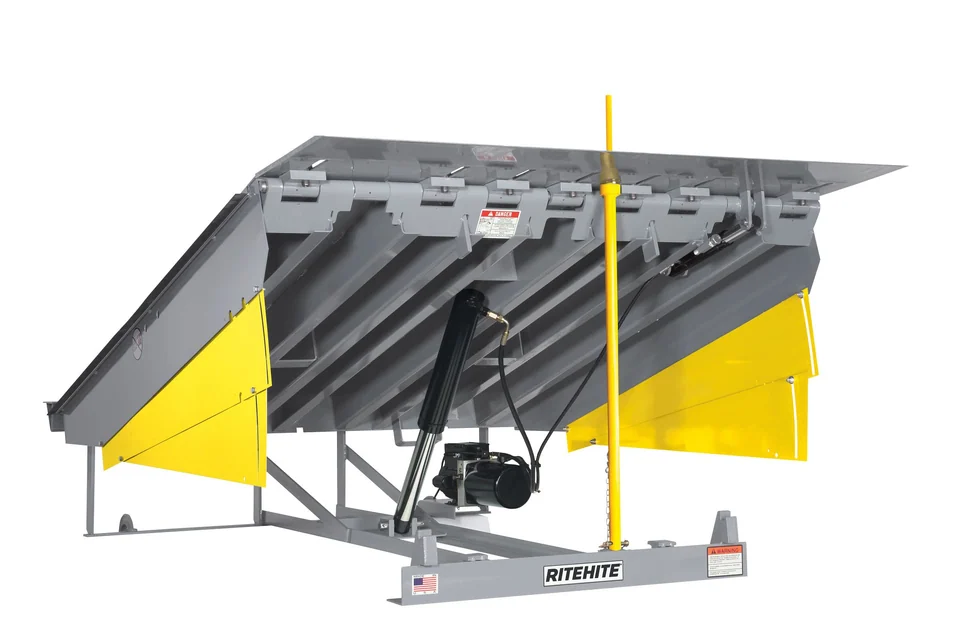
Shown as a configuration reference. Availability and the equipment offered for your project are confirmed separately.
Match deck geometry and transfer conditions
Compare deck length, width, lip length and operating range against the dock and trailer layout. Ask how the proposed geometry affects slope and the transition for the actual forklift or pallet truck. Confirm the engagement conditions across the expected vehicle mix and loading pattern. A telescopic lip may solve a different access problem from a hinged lip, so include the specific loading need in the RFQ. Define full-width or end-load access where relevant. Request structural and load evidence for the exact configuration rather than treating a catalogue dimension or nominal rating as approval of an unusual crossing arrangement.
Review the pit, vehicle restraint and controls
Provide measured pit dimensions and building drawings, including concrete condition, supports, drainage and cable routes. A retrofit should be surveyed before a standard unit is selected. Coordinate the leveler, door, vehicle restraint, traffic lights and other dock controls through a documented operating sequence. Define behavior when the vehicle moves or an interlock is not satisfied, with responsibilities assigned to the site designer and installer. Include access for maintenance and an approved support arrangement. Electrical supply, corrosion exposure and water management need review, especially where a pit collects runoff or the dock opens to harsh weather.
Compare the complete dock installation
Quote the leveler, hydraulic equipment, controls, lip options, interlocks and specified protection at equal scope. Add pit repairs, concrete work, lifting, cabling, restraint integration and local commissioning. Include manuals, operator training and maintenance access rather than treating them as incidental costs. Ask for spare seals, hoses and control components with service responsibility identified. Compare proposals using the actual crossing duty and vehicle mix. A mechanical-to-hydraulic conversion and a new dock pit are different projects, and their cost boundaries should remain clear so a lower initial equipment price does not hide substantial site preparation work.
Accept the installed loading sequence
Acceptance should verify the approved deck and lip geometry against representative trailers and the stated loading conditions. Check transitions using the reviewed handling vehicle and load within manufacturer limits. Record control sequencing, normal stop and restart and the response to agreed interlock conditions through competent personnel. Inspect structural installation, supports, drainage and component identifiers against the drawings. Operator instructions should cover vehicle securing and the maintenance support procedure. A factory cycling demonstration proves basic motion, but the final acceptance also needs the installed building connection and the actual dock-to-trailer interface.
Make retrofit and customization requirements explicit
Send pit measurements, dock and trailer data, vehicle loads and the control sequence with the inquiry. OEM requests can include branding, languages and buyer-specific manuals. ODM adaptations to pit geometry, deck, lip or interlocks require engineered drawings and a responsible site review. Confirm who supplies structural calculations, installation and destination-specific evidence. Retain approved dimensions and spare identifiers for future maintenance. The manufacturer family reference illustrates hydraulic docking equipment; it does not establish that a standard unit fits an existing pit or that any capacity applies to every loaded crossing.
Manufacturer configuration references
Review the linked manufacturer information as configuration references. Request the current sheet, included scope and relevant evidence for the exact proposed equipment; these references do not establish an IndustryApex supply relationship.
What should you include in your RFQ?
- Dock height and pit dimensions
- Trailer bed range and vehicle mix
- Forklift plus load operating mass
- Wheel loads and crossing frequency
- Deck width length and lip engagement
- Vehicle restraint and door sequence
- Floor concrete and structural drawings
- Drainage corrosion and outdoor exposure
- Power hydraulic unit and controls
- Maintenance supports and access
- Installation service and destination review
- OEM layout and acceptance scope
For OEM / ODM requests, include the branding, packaging, configuration or engineering changes you need, initial and annual quantities, target market, sample approval and acceptance requirements. Feasibility and commercial scope are confirmed for the specific project.
Need OEM / ODM customization?
Submit branding, packaging, configuration or engineering requirements for this equipment. Include the target market, initial and annual quantities, required changes and acceptance criteria.
Customization feasibility, permitted branding, development responsibilities, minimum quantity, cost and lead time are reviewed for the proposed supplier and configuration before a quotation is confirmed.
Frequently asked questions
Which loads matter for a dock leveler?
Consider the handling vehicle and its load together, including wheel loads, crossing frequency and trailer-height variation. Pallet mass or a nominal leveler rating alone cannot determine the required deck, transition or structural installation.
How should deck and lip geometry be selected?
Select deck length, width and lip from dock height, trailer range, vehicle geometry and loading pattern. Review slope, transition and lip engagement for the actual operation, including end loads, rather than choosing from pit width alone.
What building and control interfaces need review?
Review pit dimensions, concrete, supports, drainage and power, then define the door, restraint and leveler operating sequence. Assign site engineering, interlocks, maintenance supports and fault recovery responsibilities to the project designer and installer.
What belongs in the installed dock-leveler cost?
Include leveler, hydraulic equipment, lip options, controls, interlocks and specified protection. Add concrete or pit repairs, lifting, wiring, restraint integration, commissioning, training and local maintenance so retrofit and new-build offers have comparable boundaries.
How should dock transfer be accepted?
Verify geometry and lip engagement with representative trailers and the reviewed vehicle/load. Test the approved control sequence and faults under competent supervision, inspect installation and drainage, and retain drawings and component identifiers with operator instructions.
Can a dock leveler be engineered for a retrofit pit?
Yes. Supply a measured pit survey, structural details, trailer range and loaded-vehicle data for an engineered proposal. OEM or ODM adaptations require reviewed drawings, destination evidence and explicit responsibility for structural work, installation and acceptance.
Reference information
- Rite-Hite: RHH-4000 hydraulic dock leveler
- Rite-Hite: Hydraulic dock levelers
Reference data and images explain equipment configurations. IndustryApex engineers confirm the offered model, specification and commercial scope in your project quotation.