
Cut forage and apply the intended conditioning action with a mower conditioner selected for crop, terrain and tractor arrangement. Compare cutting, conditioning and swath handling together, then assess the complete field result and service scope using representative crop conditions. Prioritize crop, conditioning, cutting. Use the checkpoints to build a consistent equipment scope and confirm the intended trial or installation evidence. The official image is a product reference; it does not establish availability or an authorized supplier relationship. Submit OEM/ODM changes for application-specific feasibility review.
Cut forage and apply the intended conditioning action with a mower conditioner selected for crop, terrain and tractor arrangement. Compare cutting, conditioning and swath handling together, then assess the complete field result and service scope using representative crop conditions.
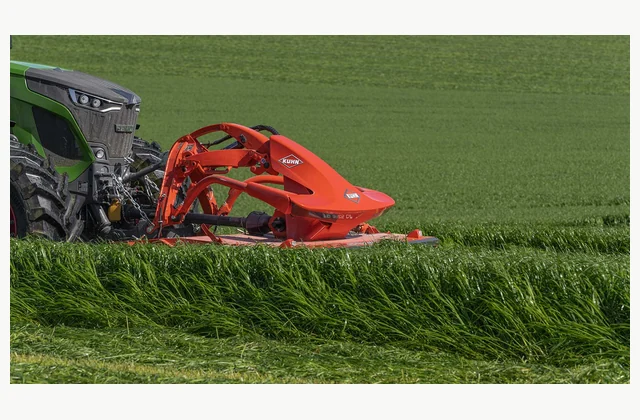
Shown as a configuration reference. Availability and the equipment offered for your project are confirmed separately.
Define the crop and forage-making system
A disc mower conditioner combines cutting with a selected treatment of the crop to support the subsequent forage process. Describe crop species, maturity, yield condition and the planned silage, hay or other route. The suitable arrangement depends on the material and management objectives; conditioning is not a universal guarantee of a particular drying time. Include the following tedding, raking, pickup or other operation so the mower’s output fits the complete system.
Choose the conditioning mechanism for the crop
Conditioning designs can differ in how they treat stems and leaves. Ask which mechanism and adjustment range is proposed and why it suits the intended forage. Consider undesirable crop damage or leaf loss alongside the desired treatment. The KUHN FC 1025 F reference is a front-mounted mower-conditioner range with a particular offered arrangement. Do not assume a reference-family image establishes that every conditioning option is available or included on the quoted model.
Evaluate cutting and ground following
Cutterbar, blades and suspension or ground-following arrangements affect work on the actual terrain. Describe stones, uneven ground and crop conditions and ask about protection and maintenance. A clean cut on a level demonstration field does not establish performance across the farm. Identify the desired cutting result and assess it with representative ground. Working width should be considered alongside contour following and the practical condition left for the next operation.
| Selection issue | Information to specify |
|---|---|
| Crop | Species, maturity and intended forage-making route. |
| Conditioning | Proposed mechanism, adjustments and acceptable crop treatment. |
| Cutting | Terrain, stones, ground following and required cut. |
| Tractor | Mounting, PTO, hydraulics and full combination loads. |
| Discharge | Swath or spread needed by the following operation. |
| Evidence | Representative cut, treatment and complete field-trial record. |
Match the tractor and mounting position
Front, rear and combination arrangements have different hitch, PTO, hydraulic and visibility requirements. Provide the tractor and complete planned setup, including any other mounted machines. Check lifting, axle loads and clearances as well as power demand. A nominally compatible PTO or hitch does not prove the full combination is suitable. The supplied couplings and any required adapters should be documented, with responsibility for approving the integrated tractor-and-mower arrangement made explicit.
Specify swath or spread requirements
The required crop presentation depends on the next operation and field plan. State whether a particular swath arrangement or wider spread is needed and confirm the equipment that creates it. Check pickup compatibility where relevant and assess crop distribution through turns and changing conditions. A conditioning unit and a deflector arrangement are not interchangeable features. Ask for the actual included components and adjustments rather than inferring the discharge result from a product photograph.
Use a full cutting-and-conditioning trial
Trial the intended crop with the proposed tractor and settings. Assess cut, crop treatment, losses where relevant, ground following and the delivered swath or spread using agreed methods. Record maturity and conditions so the result is not generalized to unrelated weather or material. Review knife replacement, lubrication and other routine service using the model’s instructions. Include transport, parking and farm access in the acceptance discussion, not only the visible field finish.
Bound OEM/ODM to the complete forage task
Hitch interfaces, swath organization, identification and selected accessories can be submitted for review. Changes to cutterbar, conditioning mechanism, suspension or structural loads require engineering and crop trials. Provide tractor, terrain and forage requirements with the brief. A customized alternative needs its own cutting and crop-handling evidence and identifiable parts. Private labeling cannot transfer a reference manufacturer’s performance claims or settle suitability of an untested implement combination.
What should your disc mower conditioner RFQ include?
- Crop: Species, maturity and intended forage-making route.
- Conditioning: Proposed mechanism, adjustments and acceptable crop treatment.
- Cutting: Terrain, stones, ground following and required cut.
- Tractor: Mounting, PTO, hydraulics and full combination loads.
- Discharge: Swath or spread needed by the following operation.
- Evidence: Representative cut, treatment and complete field-trial record.
- Destination, site conditions and delivery access
- Installation boundary, utilities and connection drawings
- Acceptance procedure, documentation and training scope
- OEM/ODM changes: interface, material, branding or new design; written engineering feasibility required
Need OEM / ODM customization?
Submit branding, packaging, configuration or engineering requirements for this equipment. Include the target market, initial and annual quantities, required changes and acceptance criteria.
Customization feasibility, permitted branding, development responsibilities, minimum quantity, cost and lead time are reviewed for the proposed supplier and configuration before a quotation is confirmed.
Frequently asked questions
Does conditioning guarantee a fixed reduction in drying time?
No universal result should be assumed. Crop, maturity, weather, settings and later operations influence the forage process. Define the intended conditioning objective and assess representative material rather than convert a catalogue claim into a guaranteed drying outcome for every field and harvest condition.
How should the conditioning mechanism be chosen?
Describe the forage species and desired treatment and discuss the offered mechanism and adjustments. Evaluate unwanted crop damage or leaf loss alongside the objective. Check the exact model’s configuration rather than assume every mechanism shown across a mower-conditioner family is available on the quoted machine.
What tractor details are needed for a front mower conditioner?
Provide hitch, PTO, hydraulic and lifting information and the complete planned implement combination. Check clearances, visibility and permissible loads as well as engine power. A matching connection designation alone does not establish that the integrated tractor and mower arrangement suits field and transport use.
Are swath and spread arrangements always included?
Inclusion depends on the selected equipment. State the crop presentation needed by the following operation and request the exact deflectors or other components supplied. A photo of one arrangement does not establish what another model or base quotation will deliver behind the conditioner.
What should a mower-conditioner field trial assess?
Use representative crop, ground and the intended tractor and settings. Inspect cutting, crop treatment, ground following and final swath or spread, with losses where relevant. Record conditions and configuration so the evidence supports the actual forage-making system rather than an unrelated demonstration pass.
Can a mower conditioner be customized for a farm system?
Interfaces, selected accessories and crop-presentation arrangements may be reviewed. Changes to cutting, conditioning, suspension or structure require engineering and crop trials. Provide terrain, tractor and forage requirements in the OEM/ODM brief and agree evidence and parts documentation for the final combination.
Reference information
- Front mounted mower conditioners FC 1025 F | KUHN
- Disc Mower Conditioners | KUHN
Reference data and images explain equipment configurations. IndustryApex engineers confirm the offered model, specification and commercial scope in your project quotation.