
Roller and finger conditioners treat forage differently. Steel fingers handle heavy, mature or high-throughput crops with aggressive stem treatment. Polyurethane rollers suit delicate forage needing gentler crimping. Match the mechanism to crop species, maturity and forage objectives, then assess field results with the intended settings and equipment.
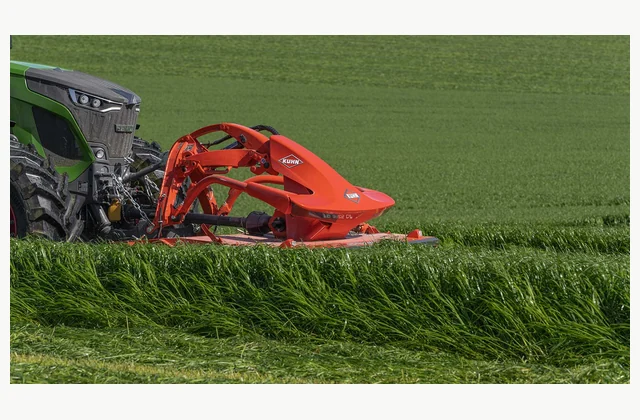
Shown as a configuration reference. Availability and the equipment offered for your project are confirmed separately.
Conditioning mechanism determines crop treatment
A disc mower conditioner’s output depends on how the conditioning unit treats the cut material. Roller and finger systems differ in their mechanical action on stems and leaves, affecting crop presentation, throughput capacity and power demand. The suitable choice depends on forage species, maturity, yield density and the planned silage, hay or other route. Assess mechanism, adjustment range and the actual field result together rather than selecting conditioning type in isolation from the complete forage-making system.
Steel finger conditioners for heavy and mature crops
Steel tine or finger conditioners lift and agitate the crop, applying an aggressive treatment to stems. The steel tine conditioner is very efficient in heavy, long or mature forage but also in short forage as it has a good throughput capacity [S1]. The fingers cause the crop to swell and rise before falling into the swath, creating an aerated presentation. This mechanism suits crops where stem breakage and aggressive conditioning support the forage objective, such as mature grass or lucerne when settings are correct.
Power absorbed by finger conditioning is typically lower than roller systems due to reduced crop dwell time and no recycling through the mechanism [S1]. Consider this alongside tractor PTO capacity and the complete implement load. Conditioning intensity on finger units is adjusted by deflector plate position and conditioner rotation speed; verify the exact adjustment method and available range on the quoted model.
Polyurethane roller conditioners for delicate forage
Roller conditioners crimp the crop between two counter-rotating rollers, applying controlled pressure along the stem length. Polyurethane roller treads grip material in any leaning direction and provide gentler treatment than steel fingers. This suits crops where preserving leaves and avoiding excessive stem damage are priorities, such as immature grass, ryegrass or other delicate forage. Pressure between rollers is adjustable, and the gap can be widened to pass foreign bodies without damage.
Both rollers are driven by a gearbox and are synchronised for life, with both rollers rotating at 780 min-1 to ensure optimum functioning in all conditions [S1]. Request the drive arrangement, adjustment method and maintenance requirements for the specific model offered. A roller conditioner’s throughput and power demand differ from finger systems; confirm these alongside the tractor and complete field setup.
Decision table: match conditioning to crop and objectives
| Buyer input | Steel finger system | Polyurethane roller system |
|---|---|---|
| Crop maturity and stem structure | Mature, heavy or high-lignin stems needing aggressive treatment | Immature or delicate crops where leaf retention and gentle crimping are priorities |
| Throughput and power | High throughput capacity; lower power absorption due to reduced dwell time | Controlled crimping with synchronized rollers; verify power demand for complete setup |
| Conditioning adjustments | Deflector position and rotor speed selection; verify available range | Roller pressure and gap adjustment; confirm method and maximum pressure rating |
| Forage presentation | Lifted, swelled and aerated swath with aggressive stem breakage | Crimped material with controlled pressure and preserved leaf structure |
| Rejection condition | Reject if crop is too delicate for finger agitation or if excessive leaf loss occurs | Reject if crop is too heavy or mature for roller throughput, or if inadequate stem treatment results |
Verify conditioning performance with representative crop
Trial the proposed mechanism with actual crop species, maturity and yield conditions using the intended tractor, settings and complete implement combination. Assess stem treatment, leaf retention, swath formation and any losses using agreed measurement methods. Record weather, ground conditions and equipment configuration so results apply to the planned forage system rather than an unrelated demonstration pass. A manufacturer’s reference performance or drying claim does not establish the outcome for a different crop, setting or field condition.
Inspect power demand, maintenance access and adjustment operation during the trial. Verify that deflector, pressure or speed changes produce the expected conditioning effect without unacceptable crop damage. If the first mechanism tested does not deliver the required result, request an alternative and repeat representative trials before finalizing the equipment selection.
Request configuration-specific evidence and quotation scope
Conditioning mechanism, adjustment hardware, drive arrangement and included accessories must be explicit in the quotation. A mower-conditioner family may offer both roller and finger options; do not assume the image or base model designation establishes what is supplied. Ask which conditioning unit is included, what adjustments are provided, and whether deflectors, speed-selection controls or pressure systems match the application requirements.
Maintenance, parts identification and service instructions differ between mechanisms. Request documentation for the exact conditioning unit offered, including lubrication points, wear parts, adjustment procedures and any seasonal setup changes. For OEM or customized arrangements, the conditioning mechanism and its integration with cutterbar, frame and discharge require separate engineering review and crop trials. Private labeling or interface changes do not transfer a reference manufacturer’s crop-handling claims to an untested combination.
Discuss your forage crop, maturity and conditioning objectives with IndustryApex engineers. We work directly with customers on mechanism selection, tractor compatibility and complete mower-conditioner configuration. Read the full disc mower conditioner guide for cutting, mounting and trial considerations, then request an equipment solution tailored to your forage-making system.
Define your equipment requirements
Review the Disc mower conditioner buying guide for the complete equipment scope.
Discuss this equipment project ↗ · OEM requirements · ODM requirements. Configuration and feasibility are reviewed for your application.
Explore the Disc mower conditioner buying guide and RFQ checklist ↗
Frequently asked questions
Does a steel finger conditioner work in all crop types?
Steel fingers are efficient in heavy, long or mature forage and also handle short crops with good throughput. They suit applications needing aggressive stem treatment and aerated swaths. For delicate crops where leaf retention is critical, verify field results or consider a roller alternative. Conditioning effectiveness depends on crop species, maturity, settings and complete forage-making conditions.
How is conditioning intensity adjusted on each mechanism type?
Finger conditioners typically adjust via deflector plate position and rotor speed selection. Roller conditioners adjust through pressure settings between rollers and gap width. Request the exact adjustment method, available range and control location for the quoted model. Field trials should confirm that the adjustment range suits the intended crop and forage objectives.
What power and throughput differences should be expected?
Steel finger conditioners generally absorb less power due to reduced crop dwell time and no material recycling. Roller systems apply controlled pressure with synchronized rotation, affecting power demand differently. Provide tractor PTO capacity and complete implement load when requesting equipment options. Verify actual power requirement and throughput capacity with representative crop trials rather than relying on nominal ratings.
Can conditioning mechanism be changed after equipment is delivered?
Mechanism interchangeability depends on the specific mower-conditioner model and manufacturer design. Some platforms offer field-swappable conditioner units; others require factory configuration. Ask whether the quoted equipment supports mechanism changes, what components and labor are involved, and whether warranty or structural modifications apply. Request this information before finalizing the purchase if future flexibility is needed.
What evidence should a conditioning trial provide?
Trial the proposed mechanism with actual crop species, maturity and yield using the intended tractor and settings. Assess stem treatment, leaf retention, swath formation and any losses with agreed measurement methods. Record weather, ground and equipment configuration so results support the planned forage system. Inspect conditioning adjustments, power demand and maintenance access during the trial to confirm the mechanism suits the complete operation.
Are roller and finger options always available on the same mower model?
Availability depends on the manufacturer and specific mower-conditioner platform. A product family reference does not establish that every conditioning mechanism is offered on the quoted model or base configuration. Request explicit confirmation of the included conditioning unit, adjustments and any optional alternatives. Verify compatibility with the intended crop, tractor and complete forage-making system before assuming mechanism choice.
Reference information
- Front mounted mower conditioners FC 1025 F | KUHN
Reference data and images explain equipment configurations. IndustryApex engineers confirm the offered model, specification and commercial scope in your project quotation.