
Choose an ATC CNC router by the parts and material you process, usable work area, tool changes and hold-down requirements. Fix the spindle, controller, software and extraction scope, then test accepted parts and complete cycle time on representative jobs.
When this equipment fits your project
An automatic tool changer is useful when panel, furniture or sign-making jobs need several operations without manual tool swaps. It should solve a defined workflow: nesting, drilling, profiling or finishing. Specify the largest stock and the smallest retained part. Material suitability, accuracy and finish should be demonstrated on your jobs rather than inferred from a list of supported materials.
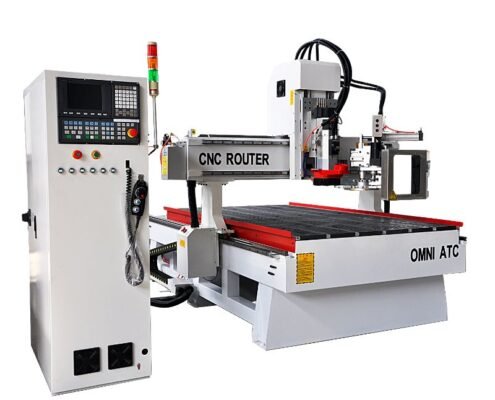
Shown as a configuration reference. Availability and the equipment offered for your project are confirmed separately.
Specify the complete configuration
| Decision | Include in your request | Evidence to compare |
|---|---|---|
| Work area | Sheet size, usable travel, Z clearance and fixtures | Dimensioned machine/fixture drawing |
| Tool changes | Tools per program, taper, collets and positions | Included tooling list and demonstrated tool-change sequence |
| Spindle/control | Exact spindle, drives, controller and interfaces | Single locked configuration in the offer |
| Hold-down | Small parts, porous boards, zones and pump | Trial with your nesting pattern and stock |
| Software/utilities | CAM, postprocessor, extraction, air and electricity | License scope, utility sheets and acceptance job files |
The Blue Elephant 1325 linear ATC reference lists a 1,300 × 2,500 mm table, but its page includes alternative configurations. Fix one offer rather than combining tables. A NIOSH router dust-control study supports asking about extraction at the cutting zone; its older experimental result is not a universal dust-removal claim.
Compare installed cost and support
Include tooling, collets, vacuum pump, extraction, air supply, electrical connection, CAD/CAM licenses and the correct postprocessor. Confirm installation, operator training, spoilboard preparation and spare tooling scope. Compare the cost per accepted job using measured setup, cutting, tool changes, unloading and cleanup. Maximum travel speed alone leaves most of that cost unresolved.
Keep the delivery term, currency, quote validity and included scope consistent. Use the complete project budget tool to organize assumptions, then replace estimates with dated quotations and destination-specific charges. Discuss supplier checks through our sourcing process.
Agree an acceptance test before ordering
Run agreed CAM files with production material and the quoted tooling. Check dimensions, edge quality, tool sensing, small-part retention and restart behavior. Record the complete load-to-unload cycle and rejected parts. Confirm that the extraction and hold-down arrangement used in the test matches the delivered system, with the site dust-control assessment completed for the material and installation.
What to include in your RFQ
- Material types, grades, thicknesses and maximum sheet/workpiece dimensions
- Part drawings, tolerances, edge/finish requirements and representative CAM jobs
- Target accepted parts per shift, batch sizes and tool-change frequency
- Required tool types, count, spindle taper, collets and tooling package
- Usable X/Y travel, Z clearance and fixtures or aggregate-head needs
- Spindle, controller, drives and exact machine configuration
- Vacuum zones, pump, clamps and hold-down requirements for small parts
- CAD/CAM software, postprocessor, file formats and license scope
- Dust extraction, compressed air, electrical supply, space and access
- Destination, installation, training, spares and service responsibilities
Need OEM / ODM customization?
Submit branding, packaging, configuration or engineering requirements for this equipment. Include the target market, initial and annual quantities, required changes and acceptance criteria.
Customization feasibility, permitted branding, development responsibilities, minimum quantity, cost and lead time are reviewed for the proposed supplier and configuration before a quotation is confirmed.
Frequently asked questions
What does 1325 describe, and is that enough to specify a CNC router?
1325 commonly identifies a 1,300 × 2,500 mm size class in the cited model, but it is not a complete specification. Confirm usable travel, Z clearance, table, spindle, controller, tool positions and included utilities for the actual offer.
How many automatic tool positions does my process need?
Count the tools used in a representative program and allow for the changeover strategy you need. Ask the supplier to demonstrate the complete tool sequence. Spare positions are useful only if the tooling, control and job workflow support them.
Which spindle, taper, controller and software details should be fixed in the quote?
Fix the spindle model/power, taper, collets, tool count, drives, controller, software licenses and postprocessor. Ask for one signed configuration list so that optional combinations are not treated as included equipment.
How should I test hold-down and edge quality on small or thin parts?
Run the smallest and thinnest production parts with the actual stock, nesting pattern, tools and table arrangement. Measure finish and retention through the whole job, including the final cut where support may be reduced.
What dust-extraction and utility information should I request?
Request extraction connection, airflow/design requirements, dust hood arrangement, compressed-air consumption and electrical supply details. Arrange a site assessment for the materials and installation; a generic collector description does not establish adequate control.
How can I compare useful cycle time rather than maximum travel speed?
Time the whole job: loading, locating, cutting, tool changes, stops, unloading and cleanup. Compare accepted parts at the agreed finish and tolerance. Rapid travel is only one motion in that complete cycle.
Reference information
- Blue Elephant: 1325 Linear ATC CNC Router—Automatic Tool Change CNC Machine
- NIOSH Hazard Controls HC6: Control of Wood Dust from Automated Routers
Reference data and images explain equipment configurations. IndustryApex engineers confirm the offered model, specification and commercial scope in your project quotation.