
Agree a written acceptance plan for the exact forklift configuration before ordering. Use the intended pallets, load centre, lift height, warehouse route and shift pattern as buyer inputs. Ask qualified personnel to validate the proposed truck against its approved capacity information and site conditions. Record results, exceptions and corrective actions before signing the equipment handover.
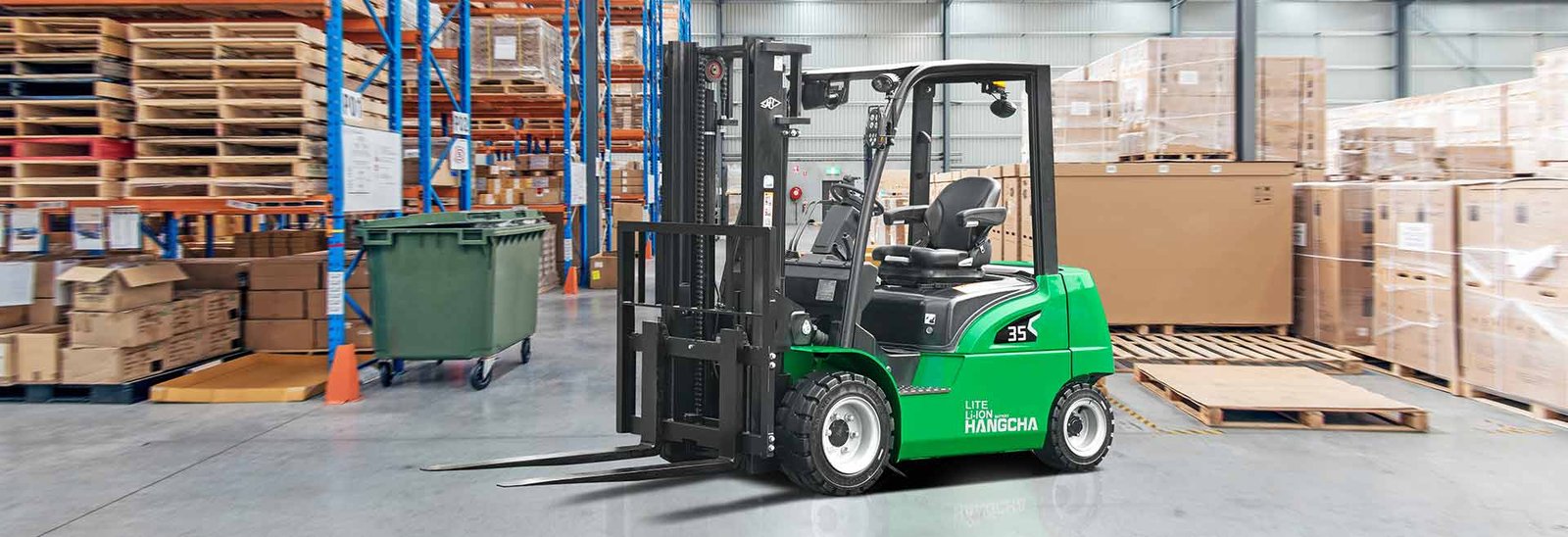
Shown as a configuration reference. Availability and the equipment offered for your project are confirmed separately.
Define the job before writing the acceptance criteria
A useful lithium forklift acceptance plan starts with the warehouse task. Record the pallet dimensions, load shape, load centre, required placement height, proposed attachments and operating route. Include the normal job and the most demanding intended job. A supplier cannot assess a vague requirement such as “general warehouse use” against a specific truck configuration.
Separate buyer requirements from promised equipment performance. Your target is a requirement to verify, not proof that a quoted forklift can meet it. Ask the supplier to identify the exact truck, mast, forks, attachments, battery, charger and software options in its proposal. Use the lithium electric forklift buying guide for the broader equipment comparison; this checklist addresses acceptance of the selected configuration.
Request configuration-specific capacity and site evidence
Request the applicable capacity plate, load information, operating instructions and configuration documents. Have the supplier explain how the intended load centre, lifting arrangement and attachments are covered. Do not approve a trial outside the manufacturer’s permitted operating conditions. If the documentation does not establish suitability for an intended task, resolve that question with the supplier before the trial.
Ask the site’s responsible personnel to review the route, working space, ground conditions, access restrictions and installation interfaces. A demonstration on an empty, open surface does not answer every question about your proposed warehouse job. The site review and trial must follow the manufacturer’s instructions and the site’s approved safety arrangements, using qualified personnel.
OSHA’s US forklift load-handling reference explains that load shape and position affect the load’s centre of gravity [S2]. This supports documenting the actual cargo geometry; it does not approve a particular forklift configuration or replace the requirements for your destination and site.
Agree the acceptance record and responsibilities
Write down what will be checked, which document defines the requirement, who records the result and how an exception will be handled. The following is a procurement worksheet, not a forklift operating procedure. The supplier and your competent site team should turn it into a project-specific plan with safe test methods and agreed acceptance criteria.
| Decision area | Buyer inputs | Evidence to retain |
|---|---|---|
| Load and lifting configuration | Representative pallet, load centre, placement height and attachments | Applicable capacity information, configuration identification and agreed trial record |
| Warehouse fit | Route, working space, floor conditions and access restrictions | Site review, agreed observations and unresolved limitations |
| Shift and charging fit | Actual work pattern, charging opportunities and proposed electrical interface | Recorded duty, battery and charger identification, and the agreed energy review |
| Controls and options | Ordered functions, operator requirements and project interfaces | Order-to-delivery checklist, instructions and recorded demonstrations |
| Handover and support | Training, documentation, maintenance and service responsibilities | Documents received, open issues, responsible parties and closure dates |
Distinguish an observation from a pass. “The truck completed a demonstration” is an observation. Acceptance requires comparison with the previously agreed conditions and criteria. Keep exceptions visible rather than replacing them with a general statement that the machine is satisfactory.
Evaluate shift duty and charging as a complete arrangement
Give the supplier a realistic work pattern: tasks, travel, lifting, pauses, changes in demand and available charging windows. Ask it to state the assumptions behind its battery and charger proposal. Identify which aspects of your intended operation the demonstration represents and which remain unverified. A short demonstration should not be presented as proof of an entire shift.
Request a record of the trial conditions and energy observations, together with the relevant battery and charger information. Have qualified personnel confirm the proposed electrical and installation requirements. If the operating pattern changes, ask for a renewed suitability review instead of assuming the original proposal still applies. Agree how any remaining duty or charging question will be resolved before final acceptance.
Check delivered options and OEM / ODM requirements
Use an order-to-delivery checklist for features and options. The HANGCHA XC light-duty reference describes a handbrake alarm as an option [S1]. This illustrates why a feature mentioned in reference material should be confirmed in the actual quotation and delivered configuration. The reference is not evidence that IndustryApex has supplied, tested or stocked that equipment.
For OEM / ODM requests, identify the drawing revision, intended interface, labelling requirements and validation responsibility. Ask the supplier to confirm feasibility and explain which changes require revised configuration information or additional validation. Record approved changes before delivery. The OEM / ODM requirements page explains the project information to prepare.
Close exceptions before signing the handover
Keep an acceptance file containing the agreed plan, configuration documents, observations, unresolved items and corrective actions. Assign an owner and proposed closure date to each exception. Where a requirement remains unverified, describe that limitation explicitly and agree the next step with the responsible parties.
Before handover, confirm the agreed documentation, operator instruction, maintenance information, support contact and spare-parts scope have been provided. Acceptance should establish what was delivered and checked for your intended project. It should not create unsupported claims about every application, every market or future performance under different conditions.
Define your equipment requirements
Review the Lithium electric forklift buying guide for the complete equipment scope.
Discuss this equipment project ↗ · OEM requirements · ODM requirements. Configuration and feasibility are reviewed for your application.
Explore the Lithium electric forklift buying guide and RFQ checklist ↗
Frequently asked questions
What should a buyer send before a lithium forklift acceptance trial?
Send the pallet and load details, load centre, intended placement height, attachments, route conditions, work pattern and available charging windows. Ask the supplier to confirm the applicable truck configuration and the documents needed to assess that job.
Can the nominal forklift capacity alone establish suitability?
Request the capacity information for the actual lifting configuration, load conditions and attachments. Have the supplier confirm how it covers the intended task. Resolve unclear or unsupported requirements before authorising a trial or accepting the truck.
Does a short demonstration prove the forklift will cover a full shift?
Record the conditions represented by the demonstration and the limits of that evidence. Compare them with the intended work pattern, battery and charging arrangement. Ask for further configuration-specific evaluation when the proposed duty remains unverified.
How should OEM / ODM changes enter the acceptance plan?
List the agreed drawing revisions, interfaces, labels and other changes in the order-to-delivery checklist. Ask the supplier to identify any additional validation or updated configuration information required, then assign responsibility for checking those items before handover.
Does an optional handbrake alarm in reference material mean it is included?
Confirm the exact feature in the quotation, order and delivered configuration. The HANGCHA reference describes a handbrake alarm as an option; that reference does not establish inclusion in a particular offer or demonstrate that it is a drive interlock.
What if an intended load is not covered by the supplied capacity information?
Ask the manufacturer or supplier to resolve the configuration and permitted operating conditions before authorising a trial. Do not use an approximate calculation, a short demonstration or a general product-family rating as approval for an undocumented lifting task.
Reference information
- HANGCHA XC light-duty lithium forklift — manufacturer reference [S1]
- OSHA US forklift load-handling reference [S2]
Reference data and images explain equipment configurations. IndustryApex engineers confirm the offered model, specification and commercial scope in your project quotation.