
A metal detector aperture sensitivity trial confirms that the selected aperture size, product temperature, moisture, salt content and packaging material allow detection of the agreed ferrous, nonferrous and stainless test pieces at the specified positions and line speed without excessive false rejects. Choose the aperture from the largest pack dimensions, then trial difficult product recipes with challenge pieces placed at leading, central and trailing positions through representative production samples, recording both detection results and false-reject frequency before finalizing the equipment specification.
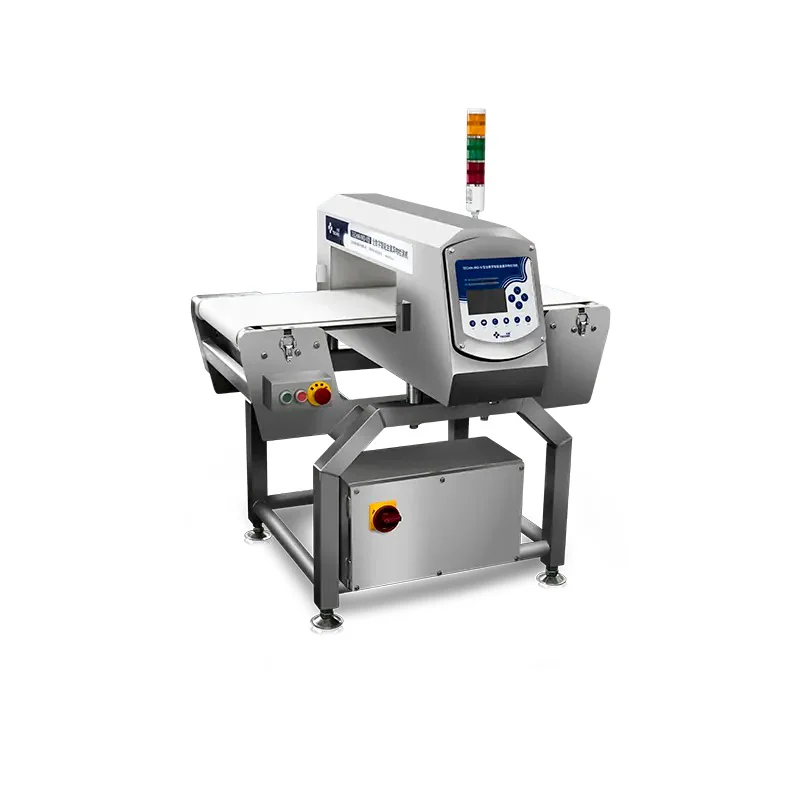
Shown as a configuration reference. Availability and the equipment offered for your project are confirmed separately.
When aperture selection determines achievable sensitivity
A larger inspection aperture reduces achievable metal sensitivity for a given detector technology. The aperture must accommodate the tallest and widest pack with sufficient handling clearance, but selecting unnecessary headroom degrades detection performance in conductive or high-moisture products. Metalized packaging, wet meat, salty snacks and products at elevated temperature each create a product signal that complicates separation from the small metal response you need to detect.
Techik describes the IMD conveyor-belt family as suitable for aquatic products, meat and poultry, salted products, pastry, nuts, vegetables and other food sectors [S1]. Request sensitivity data for your actual product recipes and aperture rather than comparing numbers from an empty-belt test or a different detector size. The trial resolves whether the proposed aperture and detector configuration meet the agreed detection criteria without creating unmanageable false rejects during normal production variation.
Define the product conditions that affect detector response
Product temperature, moisture content, salt concentration and packaging material all influence the detector signal. A frozen product may pass cleanly while the same recipe at ambient temperature triggers false rejects or masks small contaminants. Metalized film or foil-lined cartons require assessment with actual packaging samples; conductive layers can obscure metal responses or demand a different inspection technology or inspection point upstream of packaging.
Provide the quality team’s complete product range, including difficult recipes and their normal variation, before the trial. Record the temperature range, moisture percentage, salt content and packaging construction so the trial conditions match production reality. A trial conducted on ideal samples at controlled temperature will not predict performance when moisture rises during summer production or when a reformulated recipe changes conductivity.
Plan challenge placement and acceptance criteria
Challenge test pieces must be placed at the leading edge, center and trailing positions within representative packs, not simply passed through an empty aperture. Small contaminants near the pack edge or surface may be detected reliably, while the same metal buried in the product center or overlapping another pack can be missed. Agree ferrous, nonferrous and stainless-steel sizes with the quality team, and confirm that these sizes are based on the actual hazard assessment rather than copied from another facility’s protocol.
The acceptance record should specify metal type, size, placement within the pack, product identity, temperature, line speed and pack spacing. Run consecutive challenged packs to verify that detection remains stable and that one challenged item does not mask the next. Count false rejects on unchallenged production separately; a detector that meets the detection requirement but stops the line every few minutes due to false alarms has not passed a useful trial.
Trial worksheet: required inputs and observations
| Input requirement | Trial configuration | Acceptance observation |
|---|---|---|
| Product recipes with temperature and moisture ranges | Actual product samples representing difficult recipes and normal variation | Detection result recorded for each recipe at specified temperature and moisture |
| Salt content and conductive ingredients | High-salt or high-conductivity recipe included in trial matrix | Sensitivity and false-reject rate compared between low-salt and high-salt versions |
| Pack materials including metalized film or foil | Actual packaging material used, not substitute samples | Detection confirmed through packaging; alternative inspection point proposed if packaging blocks detection |
| Maximum pack dimensions and required aperture | Largest production pack with specified handling clearance | Pack clears aperture without contact; sensitivity measured at this aperture rather than smaller reference size |
| Line speed and pack spacing | Production speed and minimum gap between consecutive packs | Detection stable at specified speed; consecutive challenges do not interfere |
| Ferrous, nonferrous and stainless test pieces with sizes | Test pieces placed at leading, central and trailing positions within product | All challenge locations detected; placement method and result recorded for each metal type and size |
| False-reject target or tolerance | Unchallenged production packs run through detector | False-reject count per hundred packs recorded; decision on acceptability made by quality and production teams |
Aperture and sensitivity tradeoffs
Requesting a larger aperture than the actual pack requires provides belt-tracking margin and mechanical clearance, but the sensitivity penalty can be significant in difficult products. The manufacturer’s specification table lists sensitivity by aperture height, but product effect is configuration-specific and must be demonstrated rather than extrapolated.
If the largest pack is infrequent, consider whether two detector installations with different apertures would provide better overall sensitivity. If product temperature or moisture varies by season or shift, establish whether recipe selection or detector parameter adjustment is needed and whether such changes require revalidation. The trial should reveal these boundaries before the purchase decision, not during commissioning.
Record trial results and open conditions
The acceptance record must identify the exact product samples, their measured or declared temperature and moisture, the challenge metal types and sizes, placement method, pack speed and spacing, detection results for each challenge, and the false-reject count over a defined production period. Retain challenged packs and the detector configuration settings with the record. An unsigned trial report or a summary without the underlying data does not establish acceptance.
Flag any product recipes not tested, packaging materials not available for the trial, or acceptance criteria that could not be confirmed. Agree responsibility for retesting when formulation, packaging or line speed changes. Identify maintenance tasks that require recalibration or sensitivity verification and the method for that verification. The trial establishes baseline performance; long-term compliance depends on documented procedures and qualified personnel.
Request trial scope and sample requirements
Send the complete product range, packaging samples, maximum pack dimensions, line speed and the quality team’s challenge protocol when requesting a trial. State whether the trial will be conducted at the supplier’s facility with shipped samples or at your site with the proposed equipment. Agree who supplies challenge test pieces, how product temperature and moisture will be controlled or measured, the duration of unchallenged production for false-reject assessment, and the data format for the acceptance record.
For food metal detectors, IndustryApex engineers review the application requirements, propose the detector configuration and aperture, and define the trial scope. Request a written trial plan before committing production samples or line time. Retain the trial record with the equipment file and reference it when investigating future detection issues or line changes. For OEM requirements or integrated inspection systems, discuss customization scope and acceptance responsibilities before the trial. Refer to the RFQ checklist for the complete project input list.
Define your equipment requirements
Review the Food metal detector buying guide for the complete equipment scope.
Discuss this equipment project ↗ · OEM requirements · ODM requirements. Configuration and feasibility are reviewed for your application.
Explore the Food metal detector buying guide and RFQ checklist ↗
Frequently asked questions
Why does aperture size affect metal detection sensitivity?
A larger aperture reduces sensitivity because the detector must generate a uniform inspection field across a greater volume, making it harder to resolve small metal signals against background noise or product effect. Choose the aperture from the largest pack dimensions with necessary clearance, then confirm achievable detection through product trials rather than empty-aperture specifications.
What product conditions must be included in the trial?
Include the complete range of recipes with their temperature and moisture variation, high-salt or conductive formulations, and actual packaging materials including metalized film or foil. Products at different temperatures or moisture levels produce different detector responses, so the trial must cover the production reality that the installed detector will face.
How should challenge test pieces be positioned during the trial?
Place challenge pieces at the leading edge, center and trailing positions within representative packs, not through an empty aperture. Small metals near the surface or pack edge may detect reliably while the same size buried in the product center or overlapping another pack can be missed. Record detection results for each placement and metal type separately.
What belongs in the acceptance record for an aperture sensitivity trial?
Record the exact product samples with measured temperature and moisture, challenge metal types and sizes, placement method within packs, line speed and spacing, detection results for each challenge location, and false-reject count over a defined unchallenged production period. Retain challenged packs and detector settings with the signed record.
When should metalized packaging trigger a different inspection approach?
When actual packaging samples cause unacceptable false rejects or mask the required metal sizes during the trial, request assessment of an alternative inspection point before packaging or a different inspection technology. Do not finalize the detector purchase assuming that software adjustment will resolve a packaging-interference problem without confirmed trial evidence.
Can one trial cover all future product recipes?
No. The trial establishes baseline performance for the tested recipes and conditions. When formulation, packaging, line speed or product temperature changes significantly, agree responsibility for retesting and the conditions that trigger revalidation. Document the tested range in the acceptance record so future changes can be assessed against that baseline.
Reference information
- China Conveyor Belt Metal Detector factory and suppliers | Techik
Reference data and images explain equipment configurations. IndustryApex engineers confirm the offered model, specification and commercial scope in your project quotation.