
Tray-supported products introduce rigidity, height and presentation constraints that require a matched film route and infeed support. Film-from-above and film-from-below configurations differ in how the product is carried and which surface faces the consumer. Evaluate infeed support continuity, end-seal clearance and product stability through the forming and sealing zones with production trays and realistic upstream spacing variation.
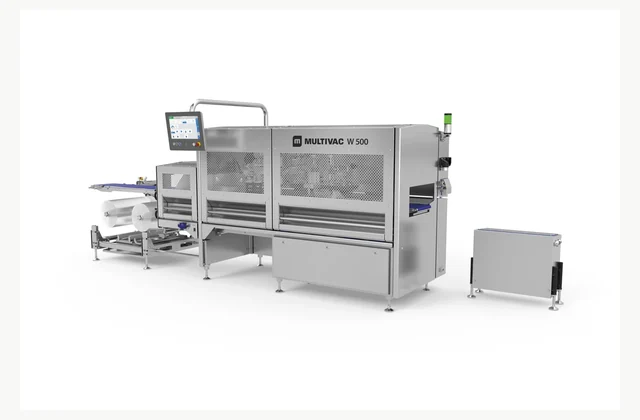
Shown as a configuration reference. Availability and the equipment offered for your project are confirmed separately.
Film route and product presentation
Tray-supported products introduce rigidity, height and presentation constraints that differ from flexible or self-supporting items. The tray determines minimum pack dimensions and limits how closely the film can wrap irregular surfaces. A horizontal flow wrapper must carry the tray continuously and avoid contact with the product surface intended for consumer display.
MULTIVAC describes film-from-below sealing on top for products without a recognizable top or bottom surface, such as sausages and cheese pieces, and film-from-above sealing on the bottom for products with a clearly defined top, such as minced meat in trays [S1]. The film route affects which side of the product contacts the forming belt and where the longitudinal seal appears in the completed pack.
Send tray dimensions including flange height, product height above the tray rim, and which side must face upward in the completed pack. State whether the tray base or product surface should contact the infeed belt. Include tray material, rigidity and any features such as vents or reinforcing ribs that might interfere with film folding or seal contact.
Infeed support and transfer risk
A rigid tray can bridge short unsupported spans, but product stability depends on how the tray is carried and whether gaps in the belt arrangement permit tipping or rotation. Inspect infeed flight geometry, belt width and transfer points where the tray moves from one support to the next. A tall or top-heavy product may become unstable if the tray tilts during acceleration or at the point where forming begins.
Product detection logic must handle realistic upstream variation. A manually aligned demonstration with perfect spacing does not prove that the wrapper will avoid trapping trays in the end-seal jaws when production feed introduces gaps, double arrivals or skewed items. Request a trial with intentional spacing errors and product-detection recovery after a simulated upstream stoppage.
Film-from-below configurations typically support the tray on a continuous belt through the seal area. Film-from-above routes may require flights or lugs to carry the tray while film forms around it. Confirm how tray flanges are guided and whether the transition between infeed and forming creates a risk of tray edge contact with film or forming geometry.
Seal clearance and film selection
End-seal clearance must accommodate the tallest product dimension and any tray feature that extends beyond the base footprint. A tray flange adds height that reduces available clearance between jaws. Measure product height variation and tray manufacturing tolerance; the wrapper must seal reliably at the upper limit without contacting the product or tray.
MULTIVAC offers flowpack films specially designed for diverse products and applications [S2]. A film suitable for a thin bar may not provide adequate seal strength or puncture resistance for a tray with sharp corners or protruding features. Submit production film reels and trays for seal trials; approved sample packs alone do not establish compatibility with production material variation.
Printed film registration adds a constraint when the artwork repeat differs from the natural product pitch. Decide whether registration is required and how misalignment will be detected. A registration mark outside the tray footprint may be obscured during forming, requiring an alternative sensor position or a change to the printing layout.
Buyer configuration worksheet
| Input | What to specify | Rejection condition |
|---|---|---|
| Tray dimensions | Base, flange, product height above rim, material and rigidity | Product or flange exceeds jaw clearance; tray cannot be carried without tilting |
| Film route | Which surface contacts the belt; which side must face the consumer | Configuration places display surface downward or seal on the visible side |
| Infeed support | Belt width, flight geometry, transfer gaps and tray guidance | Unsupported span causes tipping; tray flanges contact film or forming geometry |
| Product spacing | Nominal pitch, upstream variation range, detection and recovery logic | Spacing errors trap trays in sealing jaws; wrapper cannot recover from upstream gaps |
| Film and seals | Film structure, seal strength, tray corner clearance and opening feature | Film punctures on tray corners; seal strength insufficient; opening tears the product |
Evidence to request before quotation
Request a configuration drawing showing tray support, film route, forming geometry and seal positions. Identify which surfaces contact product, tray base and tray flanges. Confirm jaw clearance at maximum tray and product height including manufacturing tolerance.
Require a format parts list for each tray size group. Identify shared and dedicated components. Observe a format change with production trays to confirm that setup can be returned to the reference condition without extensive trial-and-error film waste.
Run seal trials with production film and trays at realistic spacing variation. Include intentional gaps, double arrivals and upstream stoppages. Inspect end seals, longitudinal seals and product damage in accepted packs. Measure seal strength and opening behavior; a pack that appears acceptable at the wrapper may loosen or tear during downstream handling or shelf display.
OEM and ODM scope for tray applications
ODM requests may alter infeed flights, tray guides, film forming geometry or controls to suit a specific tray design or product presentation requirement. Require a revised configuration drawing and a joint trial with upstream equipment. OEM graphics or branding do not change the need for film compatibility and seal performance evidence.
DiscussOEM/ODM project requirements with IndustryApex engineers. The final acceptance should include discharge accumulation and the next process. Packages that appear stable at the wrapper can become unstable in a conveyor transfer or during accumulation before case packing. Retain both accepted and rejected reference samples.
Move your tray wrapper project forward
IndustryApex engineers assess tray dimensions, product presentation requirements and upstream feed characteristics to propose a suitable horizontal flow wrapper configuration. Request an equipment solution for tray-supported products through the horizontal flow wrapper product page.
Define your equipment requirements
Review the Horizontal flow wrapper buying guide for the complete equipment scope.
Discuss this equipment project ↗ · OEM requirements · ODM requirements. Configuration and feasibility are reviewed for your application.
Explore the Horizontal flow wrapper buying guide and RFQ checklist ↗
Frequently asked questions
Which film route should I specify for tray-supported products?
Specify which product surface must face the consumer and whether the tray base or product surface should contact the infeed belt. Film-from-below configurations seal on top and suit products without a preferred display side. Film-from-above routes seal on the bottom and keep the product surface visible. Request a configuration drawing showing tray support, film contact and seal positions.
How do I evaluate infeed support for rigid trays?
Inspect belt width, flight geometry and transfer points where the tray moves between supports. Confirm that unsupported spans do not permit tipping or rotation, especially for tall or top-heavy products. Request a trial with intentional spacing errors and product-detection recovery after a simulated upstream stoppage to verify that trays are not trapped in sealing jaws.
What tray information is needed before requesting a quotation?
Send tray base dimensions, flange height, product height above the tray rim, tray material and rigidity. State which side must face upward in the completed pack. Include any tray features such as vents or reinforcing ribs that might interfere with film folding or seal contact. Submit production trays for configuration and seal trials.
What evidence should I request for seal performance with trays?
Request seal trials with production film and trays at realistic spacing variation, including intentional gaps and double arrivals. Inspect end seals, longitudinal seals and product damage in accepted packs. Measure seal strength and opening behavior after the intended downstream handling. A pack that appears acceptable at the wrapper may loosen or tear during conveyor transfer or shelf display.
Which format parts are needed when changing tray sizes?
Request a format parts list for each tray size group. Identify shared components and dedicated parts. Observe a format change with production trays to confirm that the operator can return to the reference setup without extensive trial-and-error film waste. Confirm jaw clearance at maximum tray and product height including manufacturing tolerance.
What should I consider for ODM tray wrapper projects?
ODM requests may alter infeed flights, tray guides, film forming geometry or controls. Require a revised configuration drawing and a joint trial with upstream equipment. The final acceptance should include discharge accumulation and the next process to verify that packages remain stable during conveyor transfer and accumulation before case packing.
Reference information
- Flowpackers | MULTIVAC
- Packaging materials and consumables | MULTIVAC
Reference data and images explain equipment configurations. IndustryApex engineers confirm the offered model, specification and commercial scope in your project quotation.