
Match diaphragm dosing pump wetted materials to your chemical and concentration by requesting a compatibility review that covers the liquid end, diaphragm, valves and seals under actual temperature and viscosity. Verify suction arrangement, backpressure and the complete circuit configuration before ordering.
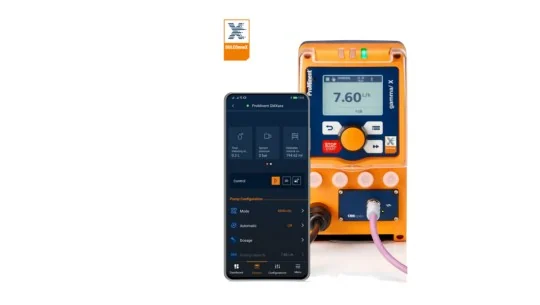
Shown as a configuration reference. Availability and the equipment offered for your project are confirmed separately.
Chemical compatibility determines whether a diaphragm dosing pump’s wetted materials will withstand the chemical, concentration, temperature and viscosity without degradation or failure. Request the supplier’s compatibility review for the liquid end, diaphragm, valves, seals and connections under the actual operating conditions, then verify the complete circuit configuration and acceptance criteria.
Wetted materials and the compatibility review
Specify the chemical name and concentration, operating temperature range, viscosity and any gas formation or vapor behavior. Ask the supplier to review the proposed liquid-end material against those conditions and identify any limitations or operating restrictions. Compatibility tables provide initial guidance, but actual service life depends on the complete chemical environment, including impurities, pH, oxidizing conditions and thermal cycling.
The gamma/X solenoid diaphragm metering pump is ideal for all metering work involving liquid media [S1]. Request the material identity code for the dosing head, connections, ball seats, seals and balls, and confirm that the proposed combination is approved for your chemical and operating window.
Diaphragm selection and operating limits
The diaphragm material and design affect chemical resistance, pressure rating and service life. Standard diaphragms and reinforced variants have different pressure and temperature limits. Confirm the diaphragm specification, maximum operating pressure and temperature range with the supplier, and verify that the proposed configuration is within those boundaries for the intended duty.
Some applications require specialty diaphragms for permeation resistance or higher temperature. State whether the chemical is prone to permeation, crystallization or coating, and whether cleaning or flushing is planned. These factors influence diaphragm selection and maintenance intervals.
Complete circuit configuration
Compatibility extends beyond the pump head to include tubing, fittings, injection valves, backpressure devices and any inline instruments. Specify discharge pressure, injection point and the complete flow path. Ask the supplier to identify compatible materials for every wetted component in the proposed circuit, and confirm that optional accessories such as pulsation dampeners, relief valves and calibration columns are approved for the chemical.
Suction conditions influence pump performance and material exposure. State tank levels, suction lift or positive head, and whether the pump must prime against a dry suction line. Identify whether the chemical is subject to vapor lock, gas entrainment or temperature rise that could affect the suction behavior.
Verification and acceptance
Request written confirmation of material compatibility for the exact chemical, concentration and operating conditions. Ask for reference installations, material test data or manufacturer approvals where available. Verify that the quotation includes all wetted components and identifies any items supplied by others.
Define the acceptance method and conditions before ordering. Specify calibration fluid, test backpressure, acceptable dose accuracy and the inspection or sampling procedure. Agree whether the trial uses the actual process chemical or a compatible substitute, and who provides the test fluid, containment and disposal.
Buyer input table
| Field | Description |
|---|---|
| Chemical and concentration | Specific chemical name or formulation, percentage or ratio, and any variations |
| Temperature and viscosity | Minimum and maximum operating temperature, viscosity at those temperatures |
| Gas and vapor behavior | Gas formation, vapor pressure, crystallization, coating or other relevant properties |
| Dosing flow range | Minimum and maximum required dose, continuous or intermittent operation |
| Backpressure and injection | Discharge pressure, injection point, inline restrictions, relief or backpressure devices |
| Suction arrangement | Tank levels, suction lift or flooded suction, priming requirement, anti-siphon needs |
| Proposed materials | Liquid-end material code, diaphragm type, seal and valve materials, tubing and fittings |
| Compatibility confirmation | Written approval for the chemical and conditions, reference data, material test results |
| Circuit scope | Complete wetted path from tank to injection, including optional accessories and instruments |
| Acceptance method | Test chemical, conditions, calibration procedure, dose accuracy requirement, inspection criteria |
Request a compatibility assessment
IndustryApex engineers review your chemical dosing application and recommend compatible diaphragm pump configurations. Provide the chemical name and concentration, temperature, viscosity and gas behavior, and the required dosing range and backpressure. Discuss the complete circuit, suction arrangement and acceptance criteria to obtain a verified equipment proposal and quotation.
For equipment inquiries and application-specific recommendations, visithttps://industryapex.com/equipment/chemical-dosing-pumps/
Define your equipment requirements
Review the Chemical dosing pump buying guide for the complete equipment scope.
Discuss this equipment project ↗ · OEM requirements · ODM requirements. Configuration and feasibility are reviewed for your application.
Explore the Chemical dosing pump buying guide and RFQ checklist ↗
Frequently asked questions
Which materials information should I provide for a chemical compatibility review?
Provide chemical name and concentration, operating temperature range, viscosity and any gas or vapor behavior. Ask the supplier to review the proposed liquid end, diaphragm, seals, valves and connections against those conditions and confirm approval in writing.
Does a compatibility table prove that a diaphragm pump configuration will work for my chemical?
Not alone. Compatibility tables provide initial guidance, but actual service depends on the complete chemical environment including impurities, temperature cycling and operating conditions. Request written confirmation for your specific chemical and conditions.
What should I verify beyond the pump head material?
Verify materials for tubing, fittings, injection valves, backpressure devices and any inline instruments. Ask the supplier to identify compatible materials for every wetted component and confirm that optional accessories are approved for the chemical.
How should I confirm diaphragm suitability for my chemical dosing duty?
State the chemical, concentration, temperature and viscosity, then ask the supplier to confirm the diaphragm specification, maximum operating pressure and temperature range. Verify that the proposed configuration is within those limits for the intended continuous or intermittent duty.
Which suction conditions affect chemical compatibility decisions?
State tank levels, suction lift or positive head, and whether the pump must prime against a dry line. Identify vapor lock, gas entrainment or temperature rise that could affect suction behavior, and ask the supplier to confirm priming and degassing provisions.
What acceptance evidence should I request before ordering a diaphragm dosing pump?
Request written material compatibility confirmation, reference installations or test data where available. Define the acceptance method, test conditions, calibration procedure and dose accuracy requirement, and agree who provides the test chemical and containment.
Reference information
- gamma/ X Solenoid Diaphragm Metering Pump - ProMinent
Reference data and images explain equipment configurations. IndustryApex engineers confirm the offered model, specification and commercial scope in your project quotation.