
Choose a total mixed ration feeder by ration ingredients, batch size and the barn's delivery route. Assess mixing uniformity, particle handling and discharge to the feed barrier as one cycle, then match tractor services or stationary utilities to the offered configuration. Mix representative minimum and maximum batches, sample distribution by the agreed method and weigh the delivered ration. Observe particle condition, residuals and the complete load-mix-discharge cycle. Demonstrate scale checks and recipe changeovers, recording ingredients, moisture, load order and machine settings rather than relying on a tub-volume label. Submit the intended configuration and any OEM/ODM changes for project-specific feasibility review.
Choose a total mixed ration feeder by ration ingredients, batch size and the barn's delivery route. Assess mixing uniformity, particle handling and discharge to the feed barrier as one cycle, then match tractor services or stationary utilities to the offered configuration.
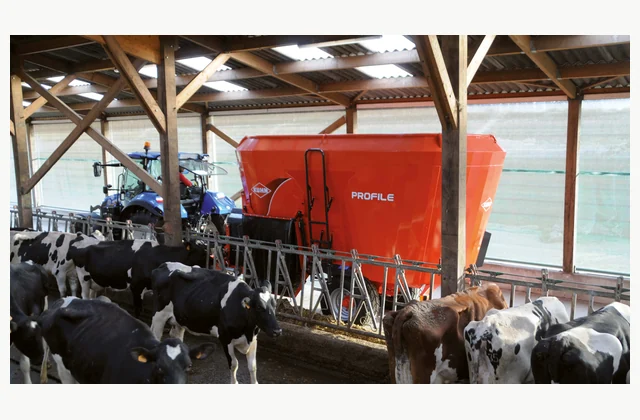
Shown as a configuration reference. Availability and the equipment offered for your project are confirmed separately.
Describe the ration ingredients
Provide the ingredient list, bulk forms, moisture and intended loading order. Long forage, dense concentrates and wet ingredients behave differently in a mixer. Discuss nutritional and particle-length objectives with the responsible feed specialist rather than using nominal tub volume as the only selection criterion.
Match batch size and usable fill
Specify the smallest and largest daily ration batches and the feeding groups. Nominal geometric volume is not a guarantee of effective mixing at every fill level. Confirm the offered auger or reel arrangement with representative batches, including the lighter group that may underfill the machine.
Assess cutting and particle preservation
Where knives cut long material, confirm the desired preparation and the risk of overprocessing. Measure the ration with the farm's agreed sampling method. Longer mixing time is not automatically better; the useful setting must achieve distribution while preserving the required physical character of the feed.
Plan accurate loading and weighing
Define scale resolution, loading access, ingredient sequence and operator prompts for the actual farm. Review calibration and the effects of uneven ground or material left in the tub. A controller recipe is only useful when the loading and weighing process can deliver it consistently.
Match discharge to the barn
Specify feed-barrier height, aisle width, side of discharge and route obstructions. Conveyors, doors and cross-belt options change how feed reaches the animals. Test residual feed and distribution along the barrier rather than assuming all pictured discharge devices are standard equipment.
Review daily cleaning and wear support
Knives, auger flights, liners and discharge parts are wearing items affected by the ration. Obtain identification and safe access procedures for the specific unit. Include the means of removing residual feed and inspecting the tub without entering a mechanism that can unexpectedly move.
Compare a complete total mixed ration feeder scope
| Decision | Information to compare |
|---|---|
| Describe the ration ingredients | Ingredient forms, moisture, loading order and ration objective |
| Match batch size and usable fill | Minimum/maximum batch mass, bulk density, herd groups and usable fill |
| Assess cutting and particle preservation | Knife arrangement, forage particle objective and sampling method |
| Plan accurate loading and weighing | Weighing system, calibration, recipe controls and loader access |
| Match discharge to the barn | Barn dimensions, barrier height, discharge side and conveyor/door options |
| Review daily cleaning and wear support | Wear liners, knives, auger/discharge parts and safe cleaning procedure |
Plan installation and access
Confirm trailer hitch, PTO, hydraulics and controls with the actual tractor, or define fixed foundations and utilities for a stationary mixer. Check loader reach, overhead clearance, turning radius and floor loading. Delivery access should include the narrowest point in the feeding route.
Agree acceptance evidence before ordering
Mix representative minimum and maximum batches, sample distribution by the agreed method and weigh the delivered ration. Observe particle condition, residuals and the complete load-mix-discharge cycle. Demonstrate scale checks and recipe changeovers, recording ingredients, moisture, load order and machine settings rather than relying on a tub-volume label.
Define OEM/ODM engineering boundaries
OEM weighing interfaces, discharge arrangements and identification can be evaluated. ODM changes to augers, tub geometry or drive require mechanical and ration trials. Reference imagery does not establish availability, manufacturer authorization or transferable feeding-performance claims for a customized alternative.
What should your total mixed ration feeder RFQ include?
- Ingredient forms, moisture, loading order and ration objective
- Minimum/maximum batch mass, bulk density, herd groups and usable fill
- Knife arrangement, forage particle objective and sampling method
- Weighing system, calibration, recipe controls and loader access
- Barn dimensions, barrier height, discharge side and conveyor/door options
- Wear liners, knives, auger/discharge parts and safe cleaning procedure
- Destination, working environment, access and delivery constraints
- Installation responsibility, utilities and connection drawings
- Acceptance samples, documented test method, operator training and maintenance scope
- OEM/ODM changes requested: identification, tooling, interfaces or new design; engineering feasibility to be confirmed
Need OEM / ODM customization?
Submit branding, packaging, configuration or engineering requirements for this equipment. Include the target market, initial and annual quantities, required changes and acceptance criteria.
Customization feasibility, permitted branding, development responsibilities, minimum quantity, cost and lead time are reviewed for the proposed supplier and configuration before a quotation is confirmed.
Frequently asked questions
How do I describe the ration ingredients?
Provide the ingredient list, bulk forms, moisture and intended loading order. Long forage, dense concentrates and wet ingredients behave differently in a mixer. Discuss nutritional and particle-length objectives with the responsible feed specialist rather than using nominal tub volume as the only selection criterion.
How do I match batch size and usable fill?
Specify the smallest and largest daily ration batches and the feeding groups. Nominal geometric volume is not a guarantee of effective mixing at every fill level. Confirm the offered auger or reel arrangement with representative batches, including the lighter group that may underfill the machine.
How do I assess cutting and particle preservation?
Where knives cut long material, confirm the desired preparation and the risk of overprocessing. Measure the ration with the farm's agreed sampling method. Longer mixing time is not automatically better; the useful setting must achieve distribution while preserving the required physical character of the feed.
How do I plan accurate loading and weighing?
Define scale resolution, loading access, ingredient sequence and operator prompts for the actual farm. Review calibration and the effects of uneven ground or material left in the tub. A controller recipe is only useful when the loading and weighing process can deliver it consistently.
How do I match discharge to the barn?
Specify feed-barrier height, aisle width, side of discharge and route obstructions. Conveyors, doors and cross-belt options change how feed reaches the animals. Test residual feed and distribution along the barrier rather than assuming all pictured discharge devices are standard equipment.
How do I review daily cleaning and wear support?
Knives, auger flights, liners and discharge parts are wearing items affected by the ration. Obtain identification and safe access procedures for the specific unit. Include the means of removing residual feed and inspecting the tub without entering a mechanism that can unexpectedly move.
Reference information
- KUHN PROFILE 2 DS official product reference
- KUHN total mixed ration feeder official family or technical reference
Reference data and images explain equipment configurations. IndustryApex engineers confirm the offered model, specification and commercial scope in your project quotation.