
Specify a fabric calender from the desired surface, density and handle. Match roll arrangement, nip control, heat and web handling to representative fabric, keeping mechanical fabric finishing distinct from sublimation ink transfer and verifying the result after the agreed conditioning or washing process. Calender representative fabrics at agreed recipe settings and compare center and edge samples for surface, density, handle and dimensions. Repeat the specified conditioning or care test to judge durability. Demonstrate threading, winding and a controlled stop and restart, recording good finished length and actual thermal and nip settings. Submit the intended configuration and any OEM/ODM changes for project-specific feasibility review.
Specify a fabric calender from the desired surface, density and handle. Match roll arrangement, nip control, heat and web handling to representative fabric, keeping mechanical fabric finishing distinct from sublimation ink transfer and verifying the result after the agreed conditioning or washing process.
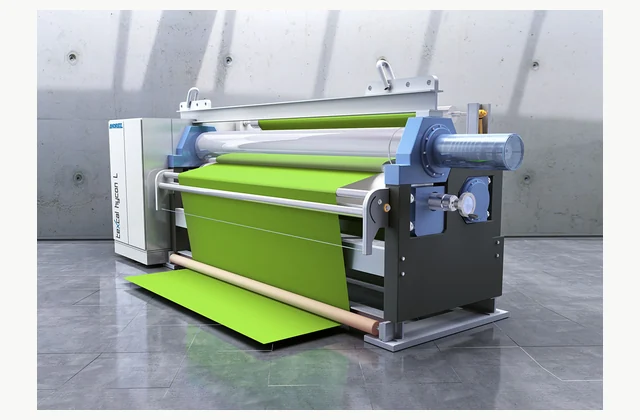
Shown as a configuration reference. Availability and the equipment offered for your project are confirmed separately.
Define the required fabric finish
Provide fiber, construction, width, mass and approved samples showing gloss, smoothness, density or handle. State which surface is treated and allowable dimensional change. A calender produces a particular mechanical and thermal finish; a visually polished sample alone does not establish the required feel or durability for the intended end use.
Select roll arrangement and covers
Review the number, material, surface and cover of the rolls in the offered stack. Identify which finish each arrangement is intended to produce. Different roll combinations create different contact conditions, so a general calender family image cannot establish that the quoted configuration includes the roll surfaces needed for the buyer's samples.
Control nip load across width
Define the operating width, loading method and required finish uniformity from center to edge. Review deflection compensation where offered and confirm its actual scope. A total-force value alone does not establish a uniform nip condition across varying fabric widths, and excessive pressure may damage a construction or alter its functional properties.
Coordinate temperature speed and moisture
Specify fabric entry moisture, thermal limits, roll-temperature measurement and the intended operating speed. Trial the combined recipe because these variables act together. Increasing heat or pressure independently may change shade, shrinkage or hand, so the supplier comparison should use accepted finishes at documented conditions rather than the largest operating envelope.
Stabilize tension cooling and winding
Describe incoming roll quality, guiding, tension limits and finished winding requirements. Check cooling and handling after the nip so the achieved finish is not distorted during collection. Smooth running at the rolls is insufficient if the exit route stretches fabric, produces creases or winds an unacceptable roll.
Plan roll service and safe access
Identify roll inspection, cover care, cleaning and replacement procedures with the responsible machinery specialist. Include access for maintenance and the required lifting arrangement. Worn or damaged surfaces can change the finish without an obvious control alarm, so define inspection evidence and approved restoration rather than rely on recipe settings alone.
Compare a complete fabric calender scope
| Decision | Information to compare |
|---|---|
| Define the required fabric finish | Fabric properties, treated face, finish samples and dimensional-change limits |
| Select roll arrangement and covers | Roll stack, surface/covers, finish objective and included configuration |
| Control nip load across width | Working width, nip loading, deflection control and across-width finish limits |
| Coordinate temperature speed and moisture | Entry moisture, temperature measurement, speed and approved combined process recipe |
| Stabilize tension cooling and winding | Entry/exit tension, guiding, cooling, creases and rewind requirements |
| Plan roll service and safe access | Roll inspection/care, cleaning, lifting, service access and approved restoration |
Plan installation and access
Qualified mechanical, electrical and heat-system specialists should coordinate foundations, roll loads, thermal services and fabric routes for the offered stack. Assess nip and hot-surface protection on the actual installation. Retain guiding and tension settings, roll-service instructions and safe isolation and lifting procedures for maintenance.
Agree acceptance evidence before ordering
Calender representative fabrics at agreed recipe settings and compare center and edge samples for surface, density, handle and dimensions. Repeat the specified conditioning or care test to judge durability. Demonstrate threading, winding and a controlled stop and restart, recording good finished length and actual thermal and nip settings.
Define OEM/ODM engineering boundaries
OEM roll arrangements, widths and approved web-handling interfaces can be reviewed. ODM roll loading, covers, heating or controls require engineering and finishing trials. Reference imagery establishes neither agency nor a guarantee of a particular hand or gloss on an untested construction, and does not imply ink-transfer capability.
What should your fabric calender RFQ include?
- Fabric properties, treated face, finish samples and dimensional-change limits
- Roll stack, surface/covers, finish objective and included configuration
- Working width, nip loading, deflection control and across-width finish limits
- Entry moisture, temperature measurement, speed and approved combined process recipe
- Entry/exit tension, guiding, cooling, creases and rewind requirements
- Roll inspection/care, cleaning, lifting, service access and approved restoration
- Destination, working environment, access and delivery constraints
- Installation responsibility, utilities and connection drawings
- Acceptance samples, documented test method, operator training and maintenance scope
- OEM/ODM changes requested: identification, tooling, interfaces or new design; engineering feasibility to be confirmed
Need OEM / ODM customization?
Submit branding, packaging, configuration or engineering requirements for this equipment. Include the target market, initial and annual quantities, required changes and acceptance criteria.
Customization feasibility, permitted branding, development responsibilities, minimum quantity, cost and lead time are reviewed for the proposed supplier and configuration before a quotation is confirmed.
Frequently asked questions
How do I define the required fabric finish?
Provide fiber, construction, width, mass and approved samples showing gloss, smoothness, density or handle. State which surface is treated and allowable dimensional change. A calender produces a particular mechanical and thermal finish; a visually polished sample alone does not establish the required feel or durability for the intended end use.
How do I select roll arrangement and covers?
Review the number, material, surface and cover of the rolls in the offered stack. Identify which finish each arrangement is intended to produce. Different roll combinations create different contact conditions, so a general calender family image cannot establish that the quoted configuration includes the roll surfaces needed for the buyer's samples.
How do I control nip load across width?
Define the operating width, loading method and required finish uniformity from center to edge. Review deflection compensation where offered and confirm its actual scope. A total-force value alone does not establish a uniform nip condition across varying fabric widths, and excessive pressure may damage a construction or alter its functional properties.
How do I coordinate temperature speed and moisture?
Specify fabric entry moisture, thermal limits, roll-temperature measurement and the intended operating speed. Trial the combined recipe because these variables act together. Increasing heat or pressure independently may change shade, shrinkage or hand, so the supplier comparison should use accepted finishes at documented conditions rather than the largest operating envelope.
How do I stabilize tension cooling and winding?
Describe incoming roll quality, guiding, tension limits and finished winding requirements. Check cooling and handling after the nip so the achieved finish is not distorted during collection. Smooth running at the rolls is insufficient if the exit route stretches fabric, produces creases or winds an unacceptable roll.
How do I plan roll service and safe access?
Identify roll inspection, cover care, cleaning and replacement procedures with the responsible machinery specialist. Include access for maintenance and the required lifting arrangement. Worn or damaged surfaces can change the finish without an obvious control alarm, so define inspection evidence and approved restoration rather than rely on recipe settings alone.
Reference information
- ANDRITZ Küsters texcal textile calender official product reference
- ANDRITZ Küsters fabric calender official family or technical reference
Reference data and images explain equipment configurations. IndustryApex engineers confirm the offered model, specification and commercial scope in your project quotation.