
Choose an insulation resistance tester by the asset's approved test voltage, expected resistance, capacitive load and diagnostic record needs. Review guard-terminal use, timed-test functions, discharge behavior and lead compatibility. Include calibration and a clear equipment-isolation procedure in the project. The Fluke 1555 FC reference illustrates a high-voltage insulation tester; its maximum capability should not be treated as the appropriate voltage for every asset.
An electrical insulation tester applies a defined test voltage and measures insulation resistance on suitable isolated equipment. Select its voltage range, charging capability and diagnostic functions around the asset and approved test plan. A higher maximum voltage is not automatically better, and insulation-resistance testing should be distinguished from dielectric withstand testing.
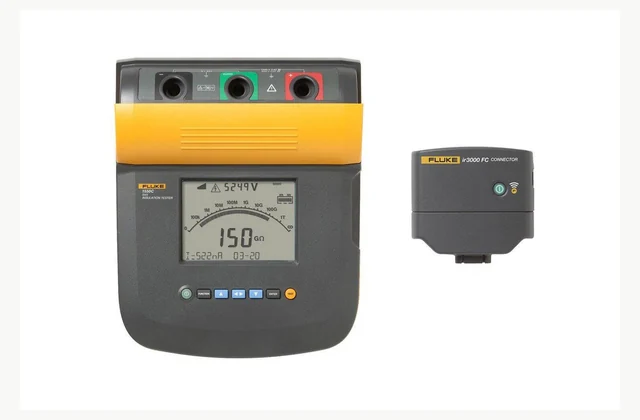
Shown as a configuration reference. Availability and the equipment offered for your project are confirmed separately.
Start with the asset's insulation test plan
Motors, cables, generators and switchgear can require different test conditions. The responsible engineer should identify the applicable voltage, duration, connections and interpretation before a buyer selects the instrument. More available voltage does not justify applying it to a sensitive circuit. Include equipment isolation and disconnection of incompatible electronics in the work planning. This guide concerns instrument procurement; the asset documentation and approved procedure govern the actual electrical test.
Test voltage and usable resistance range
Compare the resistance range and uncertainty at each required test voltage, including conditions near the expected reading. A headline maximum resistance can conceal much poorer usefulness at another voltage or under field conditions. Voltage-step control may matter for a particular diagnostic method, while a simpler fixed-voltage unit can serve routine checks. Request the actual specification table for the proposed configuration instead of combining a maximum voltage from one model with another model’s resistance range.
Capacitive load and discharge behavior
Long cables and large windings can store substantial electrical energy during an insulation test. The instrument’s charging capability affects how quickly the selected test condition is established, while controlled discharge and residual-voltage indication affect the subsequent workflow. Ask how the proposed instrument handles the expected load and how the operator recognizes the end of discharge. Do not equate an automatic discharge feature with permission to touch the asset or bypass the approved safety procedure.
Guard terminal and surface leakage
At high resistance, unwanted surface paths can contribute to the measured current. A guard connection can help separate specified leakage paths when used according to the instrument’s documentation. It is a measurement feature with a defined purpose, rather than an extra protective-earth connection. Buyers investigating contaminated or complex cable terminations should discuss the expected arrangement with the application specialist. Include the appropriate third lead and connector in the kit where the method requires them.
Timed diagnostics and useful records
A spot resistance value and a timed diagnostic sequence provide different evidence. If the maintenance program uses polarization index, dielectric absorption or a controlled voltage ramp, identify the supported functions and the information retained. Temperature, asset identity, elapsed time and prior test conditions can affect interpretation. Review a sample report for repeatability across a fleet. An automatically calculated ratio still needs engineering context; it is not a universal pass/fail verdict for every insulation system.
Lead set, calibration and delivery acceptance
Specify lead length, clips, insulation and physical access for the actual asset. Review test-voltage and resistance calibration evidence against the buyer’s quality requirements. During handover, verify settings, result identification, data transfer and storage using an appropriate controlled demonstration. Check the delivered software or wireless connector separately from the main tester. Replacement batteries, chargers and lead assemblies should be identifiable, because a damaged or mismatched accessory can make a capable instrument unsuitable for the planned job.
| Purchase situation | Configuration to evaluate | Evidence that matters |
|---|---|---|
| Routine isolated-equipment checks | Required voltage steps and resistance range | Specification at the working test voltage |
| Large cable or winding assessment | Appropriate charging and discharge behavior | Load assumptions and residual-voltage handling |
| Diagnostic maintenance program | Timed tests and identifiable result export | Repeatable settings with asset and temperature context |
OEM / ODM scope for the measurement package
An OEM / ODM insulation-test project can involve a new measuring platform, dedicated fixtures, lead assemblies or integration with asset records. Changes to voltage generation, discharge circuits, insulation or connectors require engineering validation. Describe any remote-control function and the interlocks or operating controls needed for the intended environment. Agree pilot testing, calibration and document ownership. The reference-brand image does not establish rights to relabel or modify that manufacturer’s tester, and performance of a custom design must be demonstrated separately.
What should your electrical insulation tester RFQ include?
- Asset types and approved insulation-test procedures
- Required test voltages, steps and durations
- Expected resistance range and uncertainty needs
- Cable or winding capacitance and charging requirements
- Guard-terminal method and lead arrangement
- Discharge, indication and operating-control requirements
- Timed diagnostic functions and result fields
- Calibration, charger and service requirements
- OEM / ODM fixtures, interfaces or new design scope
- Destination, quantity, training and acceptance plan
Need OEM / ODM customization?
Submit branding, packaging, configuration or engineering requirements for this equipment. Include the target market, initial and annual quantities, required changes and acceptance criteria.
Customization feasibility, permitted branding, development responsibilities, minimum quantity, cost and lead time are reviewed for the proposed supplier and configuration before a quotation is confirmed.
Frequently asked questions
Should buyers always choose the highest insulation test voltage?
No. The asset's approved test procedure determines the required voltage. Excess voltage can be inappropriate for the insulation or connected electronics. Compare instrument capability with the actual test plan rather than treating the maximum as a selection target.
Does insulation resistance testing replace a withstand test?
It does not automatically replace it. Insulation resistance and dielectric withstand tests have different objectives and acceptance conditions. Identify the required test in the equipment specification, including whether separate instruments or a combined platform are appropriate.
Why does cable capacitance matter when buying an insulation tester?
A capacitive asset takes energy to charge and retains energy afterwards. Compare the instrument's charging and discharge behavior for the expected load, and include residual-voltage handling in the approved operating and training requirements.
What is the guard terminal used for?
It helps control the influence of specified unwanted leakage paths in a suitable measurement setup. Follow the manufacturer's arrangement and supply the correct lead. The guard terminal should not be treated as interchangeable with a protective-earth connection.
What belongs in a repeatable insulation-test record?
Record the asset, voltage, elapsed time, method and relevant environmental conditions alongside the measured result. Timed diagnostic ratios need context. A report format should help compare successive tests rather than storing an isolated resistance number.
What customization is realistic in an OEM/ODM insulation tester project?
Lead sets, fixtures, reporting and a new instrument specification can be reviewed. High-voltage generation, protection and discharge changes require validation and suitable documentation. Reference photographs do not imply that an existing branded tester can be privately relabeled.
Reference information
- Fluke 1555 FC official product reference
- Fluke 1550C/1555 insulation tester user manual
Reference data and images explain equipment configurations. IndustryApex engineers confirm the offered model, specification and commercial scope in your project quotation.