
Pneumatic cylinder air consumption depends on bore diameter, stroke length, cycle frequency and supply pressure. Speed depends on available valve flow, tubing restrictions and moving mass. Calculate consumption from swept volume per stroke and cycles per minute. Size compressor capacity against total machine air demand, not one cylinder's theoretical rating. Verify speed and end impact with the proposed valve, tubing and cushioning circuit before finalizing the cylinder specification.
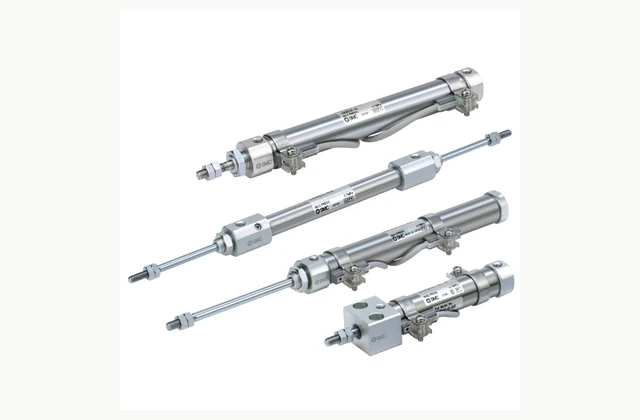
Shown as a configuration reference. Availability and the equipment offered for your project are confirmed separately.
When does air consumption matter to the buyer?
Air consumption determines compressor sizing, energy cost and whether existing plant air can support an added machine. Underestimating total demand leads to pressure drops, slow cycles and unreliable machine behavior. Calculate consumption for the complete machine, including all cylinders, blow-off nozzles and tool changes, then add margin for leakage and simultaneous operation.
Speed directly affects cycle time, throughput and mechanical shock. A cylinder that moves too slowly limits production. One that moves too fast can damage the driven mechanism or create unsafe conditions. Speed depends on the complete pneumatic circuit, not the cylinder bore alone.
How to calculate pneumatic cylinder air consumption
Air consumption equals the cylinder’s swept volume multiplied by the number of full strokes per minute, adjusted to standard atmospheric conditions. Swept volume is the piston area times stroke length. For double-acting cylinders, calculate push and pull volumes separately because the rod reduces the effective area on the return stroke.
Express consumption in standard liters per minute (Nl/min) or standard cubic feet per minute (SCFM) at the supply pressure. Consumption increases with operating pressure; calculate demand at the actual working pressure rather than atmospheric pressure.
The SMC CJ2 series includes various bore sizes and stroke lengths [S1]. Select bore diameter based on required force, then use the swept volume to estimate air demand. Obtain exact consumption figures from the manufacturer’s data for the selected bore, stroke and pressure rather than relying on generic estimates.
What affects pneumatic cylinder speed?
Cylinder speed is governed by the air flow rate into the cylinder, which depends on valve capacity, tubing diameter, tubing length and any flow-control restrictions. A large-bore cylinder with a small valve or long, narrow tubing will move slowly regardless of available pressure. Increasing supply pressure alone does not guarantee faster speed if the circuit restricts flow.
Moving mass, friction and any external load all resist acceleration. Heavier assemblies require more flow to achieve the same speed. End cushioning or external shock absorbers intentionally slow the piston near stroke ends to prevent impacts, extending the total stroke time.
Standard industrial cylinders typically reach speeds between 0.1 and 1.5 meters per second, but the actual speed for a given application must be verified with the selected valve, tubing size and any installed flow controls. Installing adjustable speed controllers in the exhaust line is a common method to set and repeat cycle times reliably.
Pneumatic cylinder consumption and speed decision table
| Decision factor | Impact on air consumption | Impact on speed | Buyer action |
|---|---|---|---|
| Bore diameter | Consumption increases with the square of bore diameter for the same stroke and cycle rate | Larger bores require higher flow to achieve the same speed; small bores fill faster with the same valve | Select bore for required force first, then assess air demand and speed capability with the chosen size |
| Stroke length | Consumption increases linearly with stroke; doubling stroke doubles consumption per cycle | Longer strokes take more time to complete at the same piston velocity | Specify actual required stroke; avoid excess stroke that wastes air and cycle time |
| Supply pressure | Higher pressure increases consumption proportionally when calculated at standard conditions | Higher pressure can increase speed if the circuit is not flow-limited, but excessive pressure wastes energy | Operate at the minimum pressure that delivers required force and acceptable speed |
| Valve flow capacity | Does not change consumption per cycle, but low flow can prevent reaching desired cycle rate | Directly limits maximum speed; undersized valves create bottlenecks | Select valve Cv or flow rating based on required cylinder speed and bore size |
| Tubing size and length | Does not change theoretical consumption, but excessive restriction can reduce effective pressure and cycle rate | Small or long tubes restrict flow and reduce speed significantly | Use short, appropriately sized tubing; avoid long runs of narrow hose |
| Cycle frequency | Consumption per minute increases linearly with cycles per minute | Faster cycling requires faster individual strokes, demanding higher flow capacity | Calculate total air demand at peak cycle rate, not average rate |
Compressor and system capacity boundaries
Size the air compressor to meet peak simultaneous demand from all pneumatic equipment, not just one cylinder’s maximum consumption. Include air blow-off, vacuum generators, tool changes and any intermittent high-demand operations. Add margin for leakage and future equipment additions.
Verify available pressure at the point of use under full production load, not at the compressor outlet. Pressure drops in distribution piping, filters and regulators reduce the effective supply. Insufficient pressure reduces both force and speed. Install pressure gauges at key machine locations and monitor them during commissioning to confirm supply adequacy.
If existing plant air cannot support the added load, options include upgrading the compressor, adding a dedicated compressor for the new machine, or reducing consumption through circuit optimization, lower operating pressure or smaller cylinders where force permits.
Speed control and end-impact management
Install adjustable flow-control valves, typically in the exhaust line, to set repeatable cylinder speed. Meter-out control provides more stable speed under varying loads than meter-in control. Test the adjusted speed with the actual load and verify that end impacts are acceptable.
Built-in air cushions or external shock absorbers are necessary when kinetic energy at stroke end exceeds safe limits. Calculate kinetic energy from moving mass and speed. High-speed, heavy-load applications may require both cushioning and mechanical stops. The SMC CJ2 series offers models with built-in speed controllers [S1], integrating flow adjustment into the cylinder body.
Avoid setting speed so high that the piston impacts the end cap hard enough to damage seals, loosen fasteners or create unacceptable noise. Measure actual deceleration and compare against the cylinder manufacturer’s rated energy absorption. If kinetic energy exceeds the rating, reduce speed, add cushioning or specify a larger bore with higher energy capacity.
Buyer inputs for consumption and speed specification
- Required push and pull force, including friction and any load variation through the stroke
- Actual stroke length and whether shorter stroke is feasible to reduce consumption
- Desired cycle time or piston speed, and whether end-position dwell is acceptable
- Moving mass, including piston, rod, attachment and driven load
- Available supply pressure at point of use under load, not compressor nameplate pressure
- Existing compressor capacity and current plant air demand
- Valve type, flow rating and whether speed control is needed
- Tubing size, length and any fittings or restrictions in the circuit
- Simultaneous operation: how many cylinders and other air consumers run at once
- Acceptable noise level and whether cushioning or external absorbers are required
Request configuration-specific evidence
Obtain the cylinder manufacturer’s consumption data for the exact bore, stroke and operating pressure. Request valve flow curves and tubing pressure-drop tables to estimate circuit performance. Ask the supplier to calculate expected speed and total air demand for the proposed configuration.
If compressor capacity is marginal, request a detailed consumption breakdown for all equipment. Consider a trial installation or simulation to verify that the complete system meets cycle-time and pressure requirements before committing to production quantities.
For OEM or high-volume applications, evaluate energy cost over the equipment’s operating life. Reducing operating pressure or optimizing circuit design can yield significant savings without compromising performance. IndustryApex engineers can review application requirements and propose an optimized pneumatic circuit. Visit the pneumatic cylinder guide for broader selection criteria, or consult the RFQ checklist to prepare a complete project specification.
Define your equipment requirements
Review the Pneumatic cylinder buying guide for the complete equipment scope.
Discuss this equipment project ↗ · OEM requirements · ODM requirements. Configuration and feasibility are reviewed for your application.
Explore the Pneumatic cylinder buying guide and RFQ checklist ↗
Frequently asked questions
How do I calculate air consumption for a double-acting pneumatic cylinder?
Calculate swept volume separately for push and pull strokes. Push volume is piston area times stroke. Pull volume is piston area minus rod area, times stroke. Multiply each by cycles per minute and supply pressure ratio to standard conditions. Add both results for total consumption per minute. Obtain exact piston and rod dimensions from the cylinder data sheet.
Why does my cylinder move slower than expected even with adequate pressure?
Speed is limited by air flow rate, not pressure alone. Check valve flow capacity, tubing diameter and length, and any installed flow controls. Small or long tubing and undersized valves restrict flow. Measure actual pressure at the cylinder port under motion to identify circuit bottlenecks.
What valve flow capacity do I need for a given cylinder speed?
Required flow depends on bore diameter, desired speed and whether the circuit uses meter-in or meter-out control. Consult the valve manufacturer's flow curves at your operating pressure. For accurate sizing, provide the cylinder bore, stroke, speed target and any flow-control method to the valve supplier.
Can I reduce air consumption without slowing the cylinder?
Lower operating pressure reduces consumption but also reduces force and may reduce speed if the circuit becomes flow-limited. Shorter stroke, smaller bore where force permits, or reduced cycle frequency cut consumption directly. Fixing leaks and optimizing simultaneous operation lower total plant demand without affecting individual cylinder performance.
How do I prevent end impacts when increasing cylinder speed?
Use built-in air cushions, install external shock absorbers, or add adjustable flow controls to decelerate the piston before impact. Calculate kinetic energy from moving mass and speed. Compare against the cylinder's rated energy absorption. If kinetic energy exceeds the rating, add cushioning or reduce speed.
What margin should I add for leakage when sizing a compressor?
Add margin for leakage and future expansion based on measured or estimated system leakage. Measure actual system leakage by isolating equipment and monitoring compressor load time. Persistent leaks waste energy and reduce available pressure. Regular inspection and maintenance keep leakage within acceptable limits.
Reference information
- WEB Catalog |SMC CORPORATION
Reference data and images explain equipment configurations. IndustryApex engineers confirm the offered model, specification and commercial scope in your project quotation.