
Process chiller sizing requires actual heat load, supply and return temperatures, flow and circuit resistance. Catalog capacity belongs to stated conditions; request cooling performance at your setpoint and ambient. Match pump capacity to the complete circuit and verify the connected equipment's temperature tolerance before ordering.
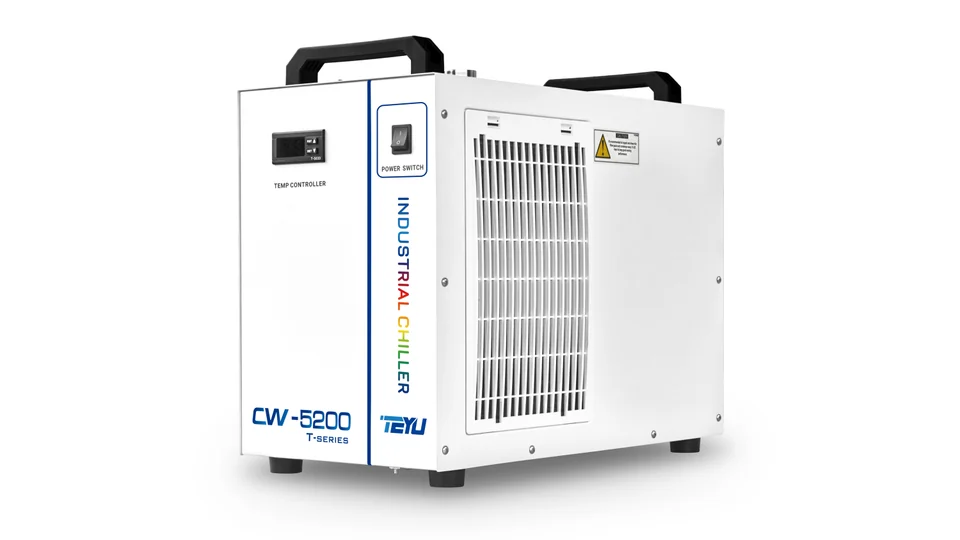
Shown as a configuration reference. Availability and the equipment offered for your project are confirmed separately.
Defining Heat Load and Temperature Requirements
Process chiller selection starts with the connected equipment’s cooling specification. Obtain the heat load that must be rejected under normal and peak duty, the required supply and return temperatures, and the flow and pressure drop through the equipment heat exchanger. Catalog cooling capacity belongs to stated supply temperature, return temperature and ambient conditions; it is not automatically available at every setpoint combination. Refrigeration efficiency falls as the temperature lift increases, so a chiller may deliver its nominal capacity at one condition but provide significantly less cooling at a different supply temperature or when the temperature differential changes.
Distinguish continuous from intermittent loads. If several machines share one chiller, state whether they run simultaneously or in sequence. Mark the normal job mix and the difficult exceptions separately. Explain which operating cases the supplier must review before proposing a configuration, and provide the coolant composition and material compatibility requirements with the inquiry.
Supply and Return Temperature Strategy
Supply temperature is the chilled fluid temperature delivered to the process. Return temperature is the warmed fluid temperature coming back from the process. The difference between return and supply—the temperature differential—determines how much heat is carried per unit of flow. A larger differential reduces the required flow rate for a given heat load, but the process equipment must tolerate the resulting supply temperature and the return temperature must remain within the chiller’s design range.
Some processes require tight supply temperature control to maintain product quality or dimensional stability. Others can accept a wider range. State the supply temperature setpoint, its tolerance and any return temperature limit in the inquiry. If the connected equipment specifies only an acceptable coolant range without distinguishing supply from return, ask the equipment manufacturer to clarify the cooling requirement and confirm whether that range applies to supply, return or both.
Flow, Pressure Drop and Pump Matching
Chiller catalogs specify pump flow at zero head and maximum pressure with no flow. Actual delivered flow depends on the total circuit resistance: hose length, fittings, elevation changes, heat exchangers and any inline filters or valves. Calculate or measure pressure drop through the complete circuit, then compare it against the pump curve to confirm adequate flow at the required pressure. Undersized pumps produce insufficient flow and reduce effective cooling capacity. Oversized pumps waste energy and may generate excessive turbulence or noise.
Long hose runs, multiple elevation changes and narrow or complex heat exchanger passages increase resistance. Provide a circuit diagram showing hose lengths, diameters, fittings, elevation changes and connected equipment with the inquiry. If the circuit has not been finalized, state the expected maximum hose length and elevation difference, and request pump options or an external pump recommendation.
Ambient Conditions and Condenser Capacity
Air-cooled chillers reject heat through a condenser fan and coil. Cooling capacity falls as ambient temperature rises, because the refrigeration system must work harder to move heat from the coolant to warmer surrounding air. If the installation site experiences high ambient temperatures, request cooling capacity at the actual maximum ambient and confirm that the compressor and condenser remain within safe operating limits.
Ensure adequate ventilation and prevent hot exhaust air from recirculating into the chiller intake. Provide the ambient temperature range, available clearances and any restrictions on exhaust direction with the inquiry. If the chiller will be installed in an enclosure or near heat-generating equipment, state that condition and ask the supplier to confirm suitable operation or recommend ventilation improvements.
Temperature Control Modes and Setpoint Stability
The TEYU S&A CW-5200 industrial chiller offers constant temperature mode and intelligent control mode, switchable for different needs [S1]. Constant mode maintains a fixed setpoint. Intelligent mode may adjust the setpoint or compressor duty based on load or return temperature to save energy when full cooling is not required. Confirm which mode suits the process tolerance and whether mode selection, setpoint limits and alarm thresholds can be configured on site or require factory programming.
The CW-5200 provides temperature stability of ±0.3°C [S1]. If the process requires tighter control, state the required stability and ask the supplier to confirm capability at the operating setpoint and load, or recommend a precision chiller model. Stability worsens when the chiller is undersized, the circuit has high thermal mass, or load changes are large and sudden.
Coolant Composition and System Compatibility
Deionized, distilled or purified water is recommended for most industrial chillers to reduce scaling, corrosion and biological growth. If the coolant must include glycol for freeze protection or corrosion inhibitors for specific materials, state the composition and concentration with the inquiry. Glycol reduces heat capacity and increases viscosity, which affects both cooling performance and required pump power. Request cooling capacity and flow ratings for the actual coolant, not just water.
Verify material compatibility between the coolant, the chiller’s wetted components (tank, pump, heat exchanger, hoses) and the connected equipment. If the process equipment manufacturer specifies acceptable coolant types, forward that specification to the chiller supplier and ask for written confirmation of compatibility. Mixing incompatible materials or coolants can cause leaks, blockages or accelerated corrosion.
Sizing Decision Table
| Buyer Input | Required Evidence | Rejection Condition |
|---|---|---|
| Peak heat load, continuous or intermittent | Connected equipment cooling specification; chiller cooling capacity at operating setpoint and ambient | Chiller capacity below peak load at stated conditions; supplier assumes nominal capacity without confirming setpoint and ambient |
| Supply temperature setpoint and tolerance | Chiller temperature range and stability at operating load; refrigerant and control method | Setpoint outside chiller range; stability exceeds process tolerance; unconfirmed at actual load |
| Return temperature limit or expected differential | Chiller acceptable return range; impact on capacity and compressor safety | Return exceeds chiller limit; no confirmation of capacity at stated differential |
| Flow requirement | Pump curve; delivered flow at total circuit pressure drop | Flow insufficient at calculated circuit resistance; pressure drop not reviewed |
| Circuit hose lengths, elevations, fittings, heat exchanger | Calculated or measured pressure drop; pump selection confirmation | Circuit resistance unknown; pump rated only at zero head; elevation or length not considered |
| Coolant type and concentration | Cooling capacity and pump power at actual coolant; material compatibility confirmation | Ratings given for water only; glycol impact not stated; incompatible materials |
| Ambient temperature range | Cooling capacity and safe operation limits at maximum ambient | Capacity not confirmed at site ambient; ventilation or clearance not reviewed |
| Voltage, frequency, refrigerant service availability | Electrical specification match; refrigerant type; local service capability | Voltage or frequency mismatch; refrigerant unavailable or restricted at destination |
Installation Scope and Interface Responsibilities
Request the quotation to identify supplied hoses, fittings, coolant, filtration and electrical connections. Clarify which items remain the responsibility of the installation site. Long or custom hose assemblies, elevated or remote mounting, insulation and drain provisions may require separate supply or modification. Assign responsibilities for ambient ventilation, condenser clearance, electrical installation and commissioning before approving the order.
Show the installer a dimensioned layout including the chiller location, connected equipment, hose routing, elevation changes and accessible fill and drain points. Resolve interfaces while changes can still be engineered. The layout should allow tank cleaning and maintenance without interrupting unrelated equipment.
Acceptance Testing and Documented Baselines
Run the intended process load and record supply and return temperatures, flow, ambient conditions and operating mode. Verify that cooling capacity, temperature stability and alarms meet the agreed specification under the actual circuit and load. Include startup, stable production and an idle-to-load transition if the process cycles. Keep the circuit sketch, coolant specification, hose lengths, elevations and acceptance readings together so later maintenance or modifications do not quietly change the conditions under which the system was approved.
Agree the test inputs, inspection method and responsibilities in writing before the trial. A catalog specification or supplier demonstration is not the same as acceptance under the project’s operating conditions. Repeat relevant checks if a later modification changes the process heat load, circuit configuration or installation assumptions.
IndustryApex Engineering and Supply Service
IndustryApex is a quality industrial equipment supplier and a China sourcing agent for premium machinery and complete production systems. Its professional engineers work directly with customers on cooling requirement assessment, chiller configuration, circuit design and a project-specific supply proposal. Discuss your connected equipment cooling specifications, heat load, supply and return temperature limits and circuit layout with IndustryApex engineers to obtain a complete equipment solution and quotation.
Process Chiller Sizing Checklist
- Connected equipment cooling specification with heat load, supply and return temperature
- Normal and peak duty; continuous or intermittent; shared or dedicated load
- Required flow and total circuit pressure drop (hose lengths, elevations, fittings, heat exchanger)
- Coolant type, concentration and material compatibility requirements
- Ambient temperature range, ventilation and condenser clearances
- Voltage, frequency and destination refrigerant service availability
- Temperature control mode, setpoint stability and alarm requirements
- Installation scope: supplied hoses, fittings, coolant, filtration, electrical connections
- Acceptance test plan with load conditions, measurement points and approval criteria
For product context and general selection guidance, see the industrial water chiller product guide.
Define your equipment requirements
Review the Industrial water chiller buying guide for the complete equipment scope.
Discuss this equipment project ↗ · OEM requirements · ODM requirements. Configuration and feasibility are reviewed for your application.
Explore the Industrial water chiller buying guide and RFQ checklist ↗
Frequently asked questions
Why does chiller cooling capacity depend on supply and return temperature?
Refrigeration efficiency falls as the temperature lift increases. A chiller delivers less cooling at lower supply temperatures or higher return temperatures because the compressor must work harder to move heat. Request capacity at your actual setpoint and return temperature, not just the nominal catalog rating.
How do I confirm adequate pump flow for my circuit?
Calculate or measure total pressure drop through hoses, fittings, elevations and heat exchangers, then compare it against the pump curve. Provide a circuit diagram showing hose lengths, diameters, elevations and connected equipment with your inquiry. Request pump selection confirmation at the calculated resistance.
What coolant information should I provide in a chiller inquiry?
State coolant type, concentration and any additives. If using glycol or inhibitors, request cooling capacity and flow ratings for that coolant, not just water. Confirm material compatibility between the coolant, chiller wetted components and connected equipment. Forward the equipment manufacturer's coolant specification to the chiller supplier for written confirmation.
How does ambient temperature affect chiller performance?
Air-cooled chiller capacity falls as ambient temperature rises. Provide your site's ambient temperature range and ask for cooling capacity at the maximum ambient. Ensure adequate ventilation and prevent hot exhaust recirculation into the chiller intake.
What should I include in a chiller acceptance test?
Run the intended process load and record supply and return temperatures, flow, ambient conditions and operating mode. Verify cooling capacity, temperature stability and alarms under actual circuit and load conditions. Include startup, stable production and load transitions. Keep circuit details, coolant specification and readings with acceptance records for future reference.
Can I size a chiller from electrical power alone?
No. Electrical input is not the same as heat transferred to coolant. Request the connected equipment's cooling requirement and confirm the chiller's capacity at your operating temperature and ambient conditions. Verify pump flow against circuit resistance and run an acceptance test under representative load.
Reference information
- Industrial Chiller CW-5200 - Hot-selling Water Chiller Unit of TEYU Chiller Manufacturer | TEYU S&a Chiller
Reference data and images explain equipment configurations. IndustryApex engineers confirm the offered model, specification and commercial scope in your project quotation.