
Plan a textile coating line from the coating chemistry, fabric and required functional layer. Define application, drying or curing and web handling as one process, keeping a reference coating module distinct from a complete supplied line with all utility and environmental equipment. Coat representative substrate and formulation combinations using the complete agreed process route. Measure add-on uniformity and test adhesion or the specified functional property after cure and conditioning. Include a formulation change and stable restart, recording good coated length, waste and actual contact-part cleaning rather than accepting applicator movement alone. Submit the intended configuration and any OEM/ODM changes for project-specific feasibility review.
Plan a textile coating line from the coating chemistry, fabric and required functional layer. Define application, drying or curing and web handling as one process, keeping a reference coating module distinct from a complete supplied line with all utility and environmental equipment.
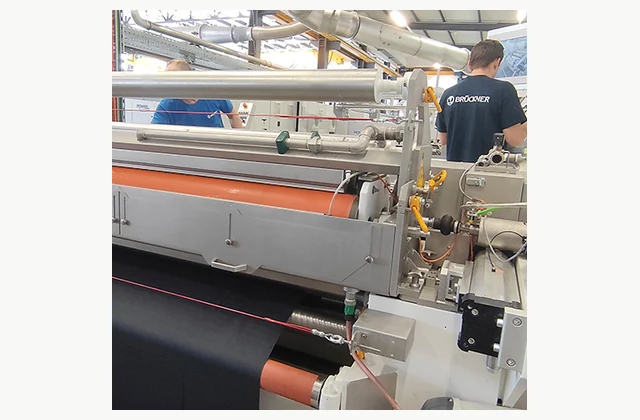
Shown as a configuration reference. Availability and the equipment offered for your project are confirmed separately.
Define fabric and coating function
Provide substrate fiber, construction, width, porosity and dimensional stability, with approved coated samples. State whether the layer targets adhesion, barrier, surface or another function. A coating weight alone cannot establish useful performance because penetration, surface coverage and the substrate's condition can change the finished behavior.
Qualify chemistry and rheology
Supply coating instructions, viscosity or flow behavior, solids, pot life and cleaning requirements. Include water or solvent content for site assessment. The process specialist must confirm compatibility with the selected application mechanism; a general low-add-on or coating label does not establish suitability for every dispersion, paste or reactive system.
Choose the actual application configuration
Identify the offered application module, metering arrangement and operating width, using the supplier's exact configuration. Define whether the duty is low-add-on treatment, a continuous surface layer or another process. A module image should not imply all coating methods or a turnkey drying range, so document the included mechanism and accessories.
Control coat weight and web tension
Agree wet or dry add-on measurement and across-width and lengthwise tolerances on the actual fabric. Review guiding, tension and edge behavior. A commanded gap or pump value is not proof of coat weight when substrate absorbency, line speed and rheology change, so retain measured samples alongside the operating recipe.
Match drying curing and site systems
Define the required cure or drying route, thermal limits, exhaust and downstream cooling. Qualified site specialists should assess emissions and chemical hazards for the actual formulation. A coating applicator's offer does not automatically include an adequate oven, treatment system or verified environmental performance at the buyer's site.
Plan cleanout recipes and contact parts
List formulation changes, contamination limits and approved cleaning procedures. Identify seals, rolls or metering parts in contact with the coating and obtain replacement support. Evaluate restart quality after a realistic cleanout, because cured residues and formulation carryover can affect performance before a visible machine fault appears.
Compare a complete textile coating line scope
| Decision | Information to compare |
|---|---|
| Define fabric and coating function | Substrate properties, functional target, approved samples and dimensional limits |
| Qualify chemistry and rheology | Coating rheology/solids, pot life, cleaners and compatibility assessment |
| Choose the actual application configuration | Application mechanism, working width, metering and module/accessory list |
| Control coat weight and web tension | Wet/dry add-on method, uniformity, guiding, tension and retained trial samples |
| Match drying curing and site systems | Cure/dry route, temperature limits, exhaust/treatment and supply responsibility |
| Plan cleanout recipes and contact parts | Formulation changes, cleanout, carryover limits and coating-contact spare parts |
Plan installation and access
Qualified process, mechanical and site utility specialists should coordinate substrate entry, application, drying or curing and winding. Confirm chemical preparation, ventilation, treatment and safe cleaning access for the actual formulation. Retain the final module list and interface drawings so a reference application unit is not mistaken for an unspecified complete plant.
Agree acceptance evidence before ordering
Coat representative substrate and formulation combinations using the complete agreed process route. Measure add-on uniformity and test adhesion or the specified functional property after cure and conditioning. Include a formulation change and stable restart, recording good coated length, waste and actual contact-part cleaning rather than accepting applicator movement alone.
Define OEM/ODM engineering boundaries
OEM widths, metering packages and approved web interfaces can be reviewed. ODM coating heads, chemistry-contact parts or drying controls require engineering and trials. Reference module imagery establishes neither agency nor an included turnkey line or guaranteed function with untested substrates and formulations.
What should your textile coating line RFQ include?
- Substrate properties, functional target, approved samples and dimensional limits
- Coating rheology/solids, pot life, cleaners and compatibility assessment
- Application mechanism, working width, metering and module/accessory list
- Wet/dry add-on method, uniformity, guiding, tension and retained trial samples
- Cure/dry route, temperature limits, exhaust/treatment and supply responsibility
- Formulation changes, cleanout, carryover limits and coating-contact spare parts
- Destination, working environment, access and delivery constraints
- Installation responsibility, utilities and connection drawings
- Acceptance samples, documented test method, operator training and maintenance scope
- OEM/ODM changes requested: identification, tooling, interfaces or new design; engineering feasibility to be confirmed
Need OEM / ODM customization?
Submit branding, packaging, configuration or engineering requirements for this equipment. Include the target market, initial and annual quantities, required changes and acceptance criteria.
Customization feasibility, permitted branding, development responsibilities, minimum quantity, cost and lead time are reviewed for the proposed supplier and configuration before a quotation is confirmed.
Frequently asked questions
How do I define fabric and coating function?
Provide substrate fiber, construction, width, porosity and dimensional stability, with approved coated samples. State whether the layer targets adhesion, barrier, surface or another function. A coating weight alone cannot establish useful performance because penetration, surface coverage and the substrate's condition can change the finished behavior.
How do I qualify chemistry and rheology?
Supply coating instructions, viscosity or flow behavior, solids, pot life and cleaning requirements. Include water or solvent content for site assessment. The process specialist must confirm compatibility with the selected application mechanism; a general low-add-on or coating label does not establish suitability for every dispersion, paste or reactive system.
How do I choose the actual application configuration?
Identify the offered application module, metering arrangement and operating width, using the supplier's exact configuration. Define whether the duty is low-add-on treatment, a continuous surface layer or another process. A module image should not imply all coating methods or a turnkey drying range, so document the included mechanism and accessories.
How do I control coat weight and web tension?
Agree wet or dry add-on measurement and across-width and lengthwise tolerances on the actual fabric. Review guiding, tension and edge behavior. A commanded gap or pump value is not proof of coat weight when substrate absorbency, line speed and rheology change, so retain measured samples alongside the operating recipe.
How do I match drying curing and site systems?
Define the required cure or drying route, thermal limits, exhaust and downstream cooling. Qualified site specialists should assess emissions and chemical hazards for the actual formulation. A coating applicator's offer does not automatically include an adequate oven, treatment system or verified environmental performance at the buyer's site.
How do I plan cleanout recipes and contact parts?
List formulation changes, contamination limits and approved cleaning procedures. Identify seals, rolls or metering parts in contact with the coating and obtain replacement support. Evaluate restart quality after a realistic cleanout, because cured residues and formulation carryover can affect performance before a visible machine fault appears.
Reference information
- BRÜCKNER ECO-COAT official product reference
- BRÜCKNER textile coating line official family or technical reference
Reference data and images explain equipment configurations. IndustryApex engineers confirm the offered model, specification and commercial scope in your project quotation.