
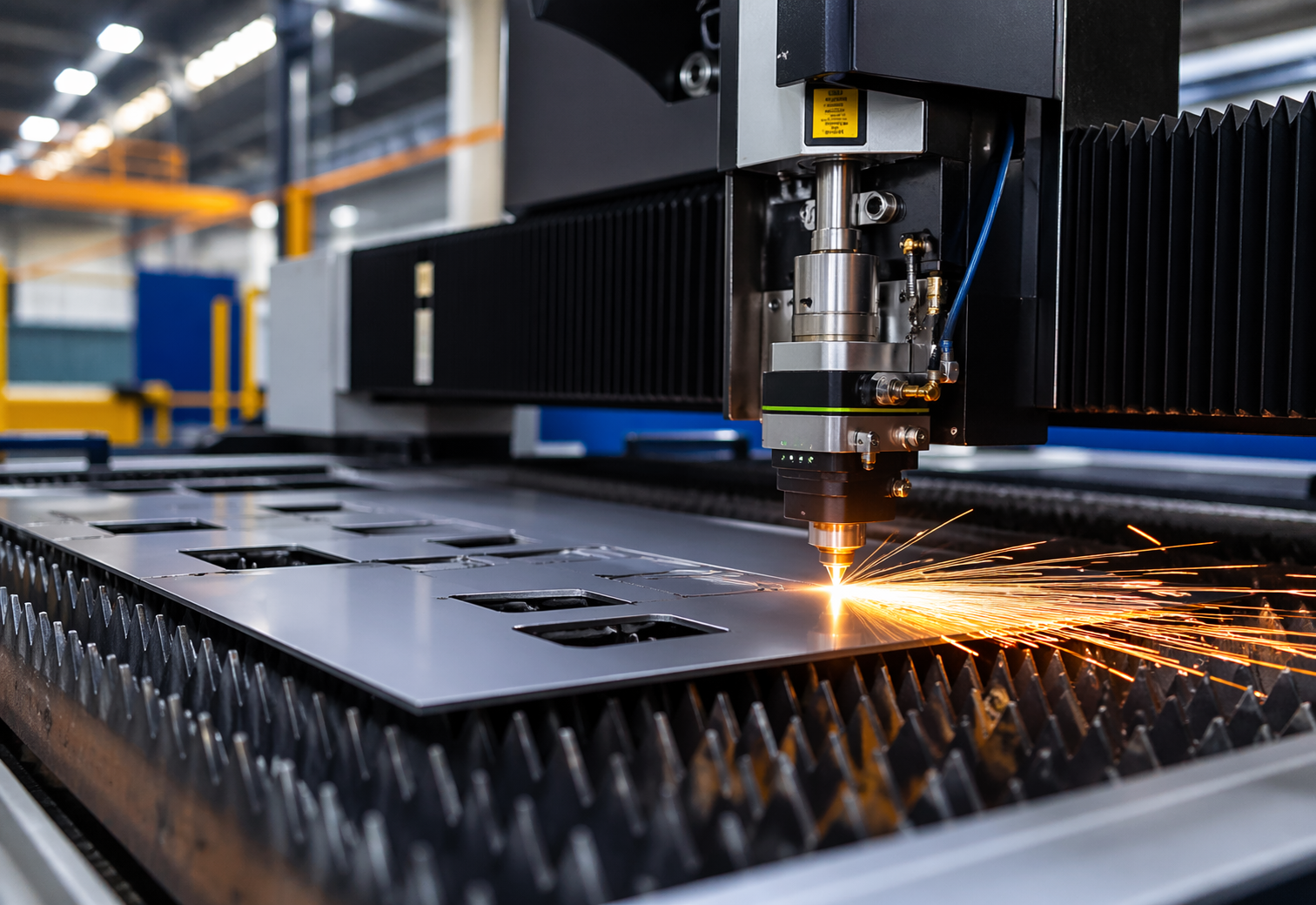
Translate industrial laser system specifications into practical capacity, quality, and integration criteria. Technical evaluation guide for buyers.
Specifying an industrial laser system requires translating application requirements into measurable performance parameters. Buyers evaluating sheet metal cutting, tube processing, or laser welding systems face dozens of technical claims, but specifications only matter when they directly predict throughput, quality consistency, integration effort, and total cost of ownership. This guide connects specification sheets to real-world acceptance criteria.
Quick answer: Industrial laser system specifications must cover source parameters (power, wavelength, beam quality), machine capacity (work envelope, positioning accuracy, axis speed), control architecture (real-time protocols, I/O mapping), and acceptance test procedures. Translate each spec into a verifiable capacity metric: cutting speed at target thickness, weld penetration depth, mark contrast on actual substrates, and integration time with existing automation.
Why Standard Specification Sheets Leave Gaps
Most laser systems arrive with detailed datasheets listing power output, wavelength, beam diameter, and maximum axis velocity. These numbers describe the hardware, but they do not predict whether the system will maintain kerf width tolerance across an eight-hour shift or synchronize correctly with upstream material handling. Procurement conflicts typically arise from three gaps:
- Source specifications describe ideal laboratory conditions rather than thermal drift over production cycles
- Machine capacity metrics omit acceleration limits, corner velocity, and toolpath interpreter response time
- Integration parameters assume generic industrial protocols without mapping specific fieldbus registers or interlock logic
A complete specification set must connect component-level parameters to application-level results. This requires defining not just what the laser can emit, but what the complete system can reliably produce under factory conditions.
Laser Source Parameters That Define Process Capability
The laser source determines energy delivery to the workpiece. For industrial systems, three parameters govern process windows and material compatibility.
Power and Wavelength Selection
Continuous wave power (measured in watts or kilowatts) controls processing speed for cutting and welding. A fiber laser operating at 1,064 nm wavelength offers high absorption in metals and simplifies fiber delivery, making it dominant in sheet metal and tube cutting applications. Ultraviolet or CO₂ sources address different material absorption curves but require different beam delivery infrastructure.
Power stability over time matters more than peak rating. Specify maximum power drift over an eight-hour period (typically ±3% for industrial fiber lasers) and warm-up time to rated output. Systems that cannot maintain power within tolerance produce inconsistent cut edge quality and require frequent parameter adjustment.
Beam Quality and Focal Characteristics
Beam quality, expressed as M² (M-squared), predicts how tightly the beam can be focused. An M² value near 1.0 produces a smaller focal spot, increasing power density for thick-section cutting or precision welding. Practical fiber lasers range from M² 1.05 to 1.30 for high-quality sources.
Focal spot size and depth of focus interact with cutting head design to define the usable tolerance for standoff height and part flatness. A system cutting 12 mm steel requires deeper focus and larger spot diameter than one optimized for 1 mm stainless sheet, even at the same nominal power.
Pulse Control for Marking and Welding
Pulsed operation allows peak power to exceed average power, essential for laser marking systems and seam welding. Specify pulse duration (nanoseconds to milliseconds), repetition rate (kHz to MHz), and pulse energy. For marking applications, shorter pulses reduce heat-affected zones and improve mark contrast on reflective surfaces. Welding applications trade pulse shape against penetration depth and spatter control.
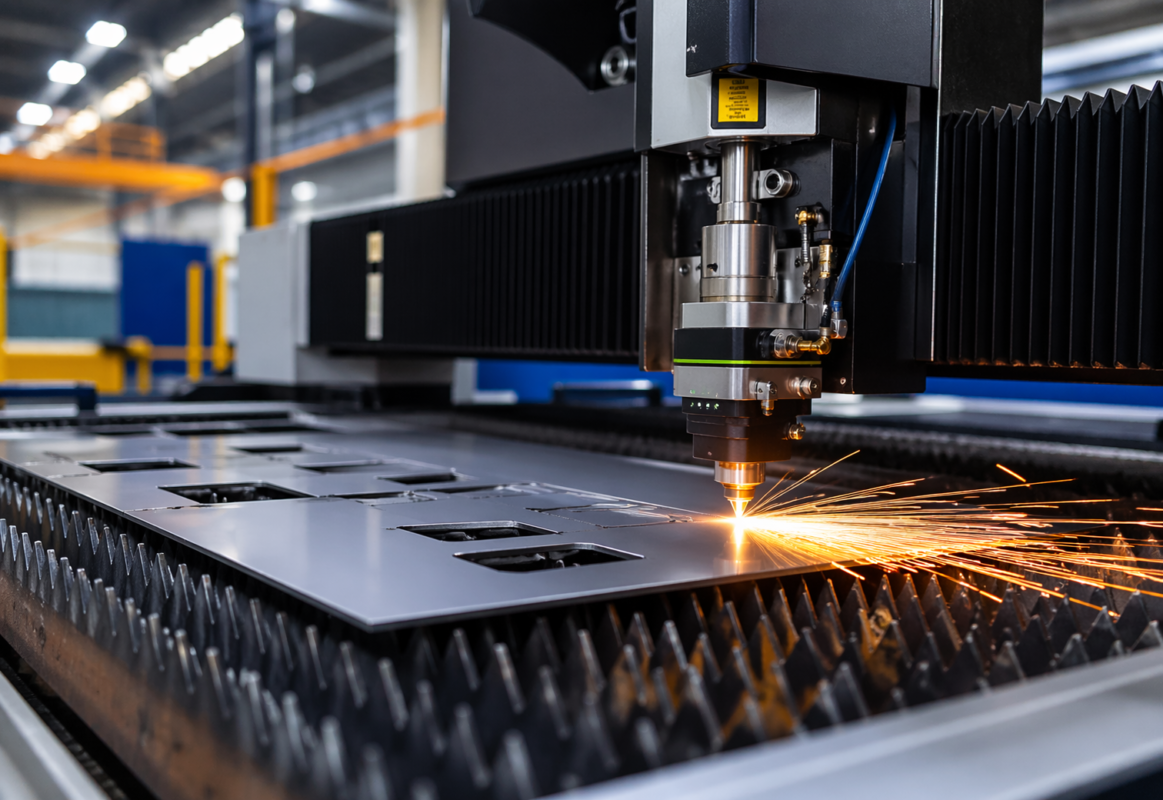
Machine Specifications That Determine Throughput and Quality
The motion system, work envelope, and positioning accuracy translate laser capability into production capacity. These parameters interact; evaluating them in isolation produces misleading conclusions.
Work Envelope and Material Handling
Work envelope dimensions (X, Y, Z travel) must accommodate not just part size but fixture clearance, nozzle access, and tool change zones. A system with 3,000 × 1,500 mm nominal bed may only handle 2,800 × 1,400 mm sheets after accounting for clamping and edge detection. For tube cutting systems, specify maximum tube diameter, length, and wall thickness range rather than just chuck capacity.
Material loading and unloading time often dominates cycle time for small parts. Automated sheet loading, pallet shuttles, and integrated part sorting become capacity-defining features, not optional accessories.
Positioning Accuracy and Repeatability
Positioning accuracy describes how closely the machine reaches a commanded coordinate; repeatability describes how consistently it returns to the same point. ISO 230-2 testing protocols define measurement methods, but practical acceptance requires testing with actual parts under thermal load.
For sheet metal cutting, ±0.05 mm repeatability maintains kerf alignment on contour cuts. Tube cutting demands rotary axis repeatability within ±0.02° to align seam welds. Specify accuracy across the full work envelope, not just at calibration points, and define warm-up period required to achieve rated performance.
Axis Speed, Acceleration, and Cornering Behavior
Maximum traverse speed (meters per minute) appears prominent in marketing literature but rarely limits production. Acceleration and corner velocity define real throughput for parts with complex geometries. A system rated at 120 m/min that decelerates to 15 m/min on tight radii produces slower cycle times than a 90 m/min system with better acceleration and lookaround algorithms.
Demand toolpath simulation with representative part geometry and measure actual cut time, including pierce delays and corner slowdown. This single test reveals more about productivity than any datasheet claim.
Control Architecture and Integration Requirements
Industrial laser systems must communicate with factory automation, exchange production data, and respond to interlock signals. Control specifications determine integration effort and operational flexibility.
Real-Time Communication Protocols
Modern systems support EtherCAT, PROFINET, or Ethernet/IP for deterministic motion control and I/O. Verify protocol version, cycle time (typically 1-4 ms for laser systems), and maximum network load. Non-real-time protocols like Modbus TCP suffice for supervisory data but cannot synchronize motion and laser pulsing.
For systems integrated into automated cells, map all required I/O before procurement: material present sensors, safety curtain inputs, extract system interlocks, and upstream/downstream handshake signals. A system with 32 digital I/O points may require expander modules to interface with a complete cell, adding cost and panel space.
Programming Environment and Data Exchange
CNC-style G-code systems offer familiarity but limited access to laser-specific parameters. Dedicated laser control platforms provide process databases, automatic parameter lookup by material and thickness, and closed-loop quality monitoring, but require operator training.
Specify CAD/CAM compatibility, nesting software integration, and production data export formats (OPC UA, CSV, database connections). Systems that cannot report actual cut time, gas consumption, and reject rates per job prevent effective production scheduling and cost tracking.
Safety and Access Control
Industrial laser systems operate as Class 4 or Class 1 enclosed systems under OSHA and IEC 60825 classifications. Verify that enclosure design, interlock architecture, and beam delivery shielding meet the requirements of your facility and local authority. Retrofitting safety features after delivery is expensive and delays commissioning.
User access control, audit logging, and parameter lockout prevent unauthorized process changes. Specify how the system authenticates users, logs parameter edits, and restricts access to calibration and maintenance functions.

Acceptance Testing and Performance Verification
A detailed acceptance test procedure, agreed before purchase, protects both buyer and supplier. The procedure must define test methods, measurement equipment, pass/fail criteria, and remediation process.
| Test Category | Measured Parameter | Typical Acceptance Criterion |
|---|---|---|
| Laser source | Output power stability | ±3% over 8 hours at rated power |
| Positioning | Repeatability (ISO 230-2) | ±0.05 mm across work envelope |
| Process capability | Cut edge roughness (Ra) | ≤10 µm on specified material/thickness |
| Throughput | Cycle time on reference part | Within 10% of simulation |
| Integration | I/O response time | ≤100 ms for safety interlocks |
Reference parts for process testing should represent actual production: material grade, thickness range, geometry complexity, and required edge quality. Testing on ideal samples conceals problems that appear in daily operation. Conduct acceptance under realistic conditions: after thermal stabilization, using production assist gas, and including loading/unloading cycles.
Auxiliary Systems That Affect Total Cost and Uptime
The laser and motion platform receive most specification attention, but auxiliary systems determine operational cost and reliability.
Assist Gas Supply and Consumption
Cutting and welding consume nitrogen, oxygen, or compressed air at rates from 5 to 50 cubic meters per hour depending on nozzle size and pressure. Calculate daily consumption based on expected duty cycle and verify that facility supply capacity and purity meet system requirements. On-site nitrogen generation may offer lower operating cost than cylinder supply for high-volume operations.
Cooling and Environmental Control
Fiber lasers generate heat that must be removed to maintain beam stability. Chiller capacity (kilowatts), coolant flow rate, and temperature setpoint (typically ±1°C) affect system reliability. Verify chiller redundancy, alarm outputs, and coolant quality monitoring. Ambient temperature and humidity limits define where the system can operate; some fiber sources require air conditioning even in climate-controlled facilities.
Fume Extraction and Filtration
Laser cutting and welding produce particulate and vapor that must be captured and filtered to protect optics and meet workplace air quality standards. Extraction system capacity (cubic meters per hour), filter type (HEPA, activated carbon), and ductwork pressure drop must match system requirements. Undersized extraction degrades cut quality and accelerates lens contamination.
Documentation and Training Requirements
Complete industrial laser system specifications include documentation, training, and post-delivery support. Request electrical schematics, pneumatic diagrams, PLC program source code, and calibration procedures in editable formats. Proprietary control systems that withhold documentation create long-term dependency on the original supplier for troubleshooting and modification.
Operator training should cover daily setup, parameter adjustment within approved limits, and first-level troubleshooting. Maintenance training must address lens cleaning, beam alignment verification, calibration procedures, and safety system testing. Specify training duration, location (factory or supplier facility), number of participants, and language.
For international procurement, clarify responsibility for installation supervision, commissioning, and acceptance testing. A system delivered ex-works requires buyer-arranged rigging, electrical connection, and initial startup, adding time and risk compared to a turnkey installation contract.

Buyer Checklist: Specifications to Verify Before Purchase
- Laser source: Power, wavelength, beam quality (M²), power stability (±%), pulse parameters if applicable
- Work envelope: X/Y/Z travel, rotary axis range, maximum part weight, actual usable area after fixturing
- Positioning: Accuracy and repeatability per ISO 230-2, tested across full envelope after warm-up
- Motion: Maximum speed, acceleration, corner velocity on test geometry, pierce time
- Control: Real-time protocol (EtherCAT, PROFINET, Ethernet/IP), cycle time, I/O count, CAD/CAM compatibility
- Safety: Class rating per IEC 60825, interlock architecture, enclosure certification, local compliance verification
- Auxiliary systems: Chiller capacity, gas consumption rate, extraction volume, facility requirements
- Acceptance test: Defined procedure with reference parts, measurement methods, pass/fail criteria, remediation process
- Documentation: Electrical/pneumatic diagrams, PLC source code, calibration procedures, user/maintenance manuals in required language
- Training: Operator and maintenance courses, duration, location, participant count, language, post-training support
- After-sales: Spare parts availability, response time for technical support, field service coverage, software update policy
Connecting Specifications to Total Cost of Ownership
Procurement decisions based on lowest capital cost often produce higher total cost when specification gaps emerge during commissioning. A system that requires three months of parameter tuning to achieve acceptable cut quality costs more in delayed production than the price difference to a better-specified machine.
Evaluating industrial machinery across borders introduces logistics, installation, training, and support variables. Systems sourced from experienced manufacturers with documented integration history carry less risk than lowest-cost alternatives with incomplete specifications. China-based platforms now offer engineering support, compliance documentation, and structured commissioning that narrows the risk gap, but buyers must verify these capabilities during specification review rather than assuming them.
When working with turnkey solution providers, request detailed scope documents that allocate responsibility for every specification item: who provides chiller, extraction, gas supply, electrical installation, programming, training, and acceptance testing. Ambiguity in scope produces schedule delays and cost overruns.
Frequently Asked Questions
What laser power do I need for cutting 10 mm steel sheet?
Cutting 10 mm carbon steel at production speeds (1.5-2.5 meters per minute) typically requires 4-6 kW fiber laser power with oxygen assist gas. Higher power (8-12 kW) increases speed or enables nitrogen cutting for oxide-free edges. Power requirements vary with material grade, required edge quality, and acceptable cycle time. Request cut samples on your actual material before finalizing power specification.
How do I verify positioning accuracy claims before purchase?
Require factory acceptance testing per ISO 230-2 using laser interferometer or ballbar measurement across the full work envelope. Testing should occur after thermal stabilization (minimum two hours at operating power) and include diagonal measurements and repeatability checks at multiple points. Request test certificates and raw data, not just summary statements. Independent third-party measurement provides additional assurance for high-value systems.
Can I integrate a laser system into an existing automation cell?
Yes, but successful integration requires detailed I/O mapping, protocol compatibility verification, and safety circuit integration. Specify all required interlock signals, material present sensors, and handshake logic during procurement. Systems with open control architectures (EtherCAT, PROFINET) integrate more easily than proprietary platforms. Budget 15-25% of system cost for integration engineering, programming, and commissioning when adding a laser to an existing cell.
What documentation should I request to support long-term maintenance?
Request electrical schematics in editable format (AutoCAD Electrical, EPLAN), PLC program source code with comments, pneumatic and hydraulic diagrams, mechanical assembly drawings, and calibration procedures. Documentation should include spare parts lists with manufacturer part numbers, recommended maintenance schedules, and troubleshooting flowcharts. Systems that provide only PDF manuals without source files limit your ability to modify or troubleshoot independently.
How do fiber laser specifications differ from CO₂ systems for the same application?
Fiber lasers operate at 1,064 nm wavelength with higher electrical efficiency (25-35% vs. 10-15% for CO₂), simpler beam delivery (fiber cable vs. mirror system), and better absorption in metals. CO₂ lasers at 10,600 nm wavelength offer advantages for thick acrylic, wood, and some plastics. For sheet metal cutting below 25 mm, fiber systems deliver lower operating cost and reduced maintenance. Specify based on material absorption, required edge quality, and infrastructure constraints (three-phase power, cooling water, gas supply).
What acceptance criteria should I set for laser welding systems?
Define weld penetration depth, bead width, porosity limits, and tensile strength on representative joint configurations and materials. Acceptance testing should include metallographic cross-sections, dye penetrant or X-ray inspection, and mechanical testing per applicable welding standards (AWS, ISO, or industry-specific codes). Specify minimum and maximum travel speed, acceptable spatter levels, and cosmetic appearance criteria. Laser welding acceptance is more complex than cutting due to the number of variables affecting joint quality.
Moving from Specifications to Confident Procurement
Industrial laser system specifications serve as a contract between application requirements and delivered capability. Effective specifications describe not just component ratings but verifiable system performance under production conditions. Buyers who invest time in detailed specification development, reference part testing, and structured acceptance procedures reduce commissioning risk and achieve faster return on investment.
Translation errors between application language and laser parameters remain the most common source of procurement failure. Work with suppliers who ask detailed questions about workpiece material, quality requirements, cycle time targets, and integration constraints. Suppliers who offer immediate quotations without investigating your application likely rely on standard configurations that may not match your needs.
Contact industrial solution specialists early in the specification process to review application requirements, discuss acceptance test procedures, and clarify scope boundaries. Clear specifications protect both buyer and supplier by establishing shared performance expectations before contract signature.
Sources
- RP Photonics Encyclopedia: Laser Specifications – referência técnica
- S-Laser: How to Define Your Laser System Requirements – referência técnica
- Laser Marking Technologies: Mastering Laser Marker Integration Technical Guide – referência técnica
- IEEE Xplore: IEEE Guide for Safety Specification of Laser Transmission in High-Power Industrial Laser Systems – referência técnica