
A wood planer should be selected from the timber condition and the surface or thickness result required. Distinguish flattening a face from thicknessing stock against an existing reference face. Provide wood species, widths, lengths, moisture condition and removal per pass. Compare cutterhead, feed, support and extraction arrangements, then test difficult boards. Include tooling, sharpening, chip removal and operator training when comparing the complete installed project.
Applications and production fit
First decide whether the operation must establish a flat reference face, produce parallel thickness, or perform both through separate stages. A thicknesser alone should not be expected to remove every form of bow from unsupported stock. Collect examples of the timber that causes difficulty, including short pieces, wide hardwood boards and uneven incoming thickness. Selection should follow the material preparation route and final assembly requirements.
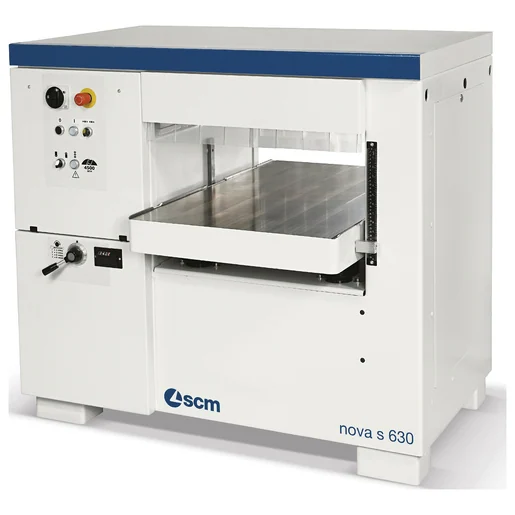
Shown as a configuration reference. Availability and the equipment offered for your project are confirmed separately.
Configuration choices to compare
Compare usable width and thickness opening with your stock, then review cutterhead design, insert or knife replacement and feed control. Straight knives and segmented cutting systems create different maintenance and tooling requirements. State the acceptable surface before sanding, the planned removal per pass and the grain conditions encountered. Include the handling of long boards and the smallest permitted workpieces in the supplier’s proposed configuration.
Utilities, layout and site compatibility
Plan an infeed and outfeed path that keeps long stock supported without forcing it through a doorway at an angle. Verify floor stability, chip-extraction airflow and the electrical connection for the offered machine. Timber storage condition also belongs in the project review; wet or changing stock can undermine consistent dimensions after machining. Ask for a connection drawing and a clear list of utility requirements.
Delivered project cost and scope
Price comparisons should include the cutterhead supplied, spare knives or inserts, sharpening access, extraction changes and supports. Consider the time required to rotate inserts or set replacement knives, not only their unit price. Budget for initial setup and training on feed, depth and material orientation. Establish who supplies replacement tooling locally and whether common consumables can be sourced without extended machine downtime.
Representative acceptance testing
A useful trial includes the species, grain and moisture condition used in production. Check thickness at several points, the surface under consistent light and any end snipe using agreed criteria. Repeat passes across the intended range and observe how boards feed. Record cutter condition and settings. Testing a single clear softwood board does not establish performance on difficult hardwood or short furniture components.
Maintenance and operating handover
Arrange a handover that explains routine table cleaning, lubrication where specified, cutter service and feed-component inspection. Keep thickness checks tied to a calibrated measuring tool and retain accepted reference samples. Explain how contaminated reclaimed timber is screened before machining. Wear, resin accumulation and unsuitable stock can change results, so the operating method and material checks deserve the same attention as the original machine order.
OEM/ODM and project customization
Define customization as a separate scope in the quotation. Configuration choices concern the equipment arrangement and operating requirements; OEM requests can include permitted branding, labels, manuals and packaging; ODM requests may involve engineering changes. Identify the party responsible for design, documentation and verification before agreeing to a change. A manufacturer reference photograph demonstrates a category or model family and does not establish that IndustryApex represents that brand or can relabel its product. Ask which changes are feasible for the proposed supplier, what sample or drawing approval is needed and how the change affects service parts, testing and delivery.
RFQ checklist for a comparable proposal
Send a concise project brief with the specific items below and attach drawings, samples or site information where available. Distinguish essential requirements from preferences so alternative offers remain comparable. Ask each bidder to return a configuration list, utility and installation boundary, relevant model documentation, acceptance plan and an itemized quotation. State the destination and who will review applicable local requirements for the exact offered configuration. Identify exclusions, recurring consumables, training, warranty conditions and after-sales responsibilities before comparing totals. If important data is unavailable, mark it as an assumption to verify instead of allowing different bidders to silently solve different projects.
- Flattening or thicknessing operation required
- Wood species and grain examples
- Incoming moisture and thickness condition
- Maximum stock width and thickness
- Shortest and longest board lengths
- Removal per pass and final thickness range
- Required surface quality before sanding
- Preferred cutterhead and tooling arrangement
- Boards per shift and batch variety
- Electrical supply and chip extraction capacity
- Long-board support and handling sketch
- Destination and service arrangements
Manufacturer configuration references
Review the linked manufacturer information as configuration references. Request the current sheet, included scope and relevant evidence for the exact proposed equipment; these references do not establish an IndustryApex supply relationship.
What should you include in your RFQ?
- Flattening or thicknessing operation required
- Wood species and grain examples
- Incoming moisture and thickness condition
- Maximum stock width and thickness
- Shortest and longest board lengths
- Removal per pass and final thickness range
- Required surface quality before sanding
- Preferred cutterhead and tooling arrangement
- Boards per shift and batch variety
- Electrical supply and chip extraction capacity
- Long-board support and handling sketch
- Destination and service arrangements
For OEM / ODM requests, include the branding, packaging, configuration or engineering changes you need, initial and annual quantities, target market, sample approval and acceptance requirements. Feasibility and commercial scope are confirmed for the specific project.
Need OEM / ODM customization?
Submit branding, packaging, configuration or engineering requirements for this equipment. Include the target market, initial and annual quantities, required changes and acceptance criteria.
Customization feasibility, permitted branding, development responsibilities, minimum quantity, cost and lead time are reviewed for the proposed supplier and configuration before a quotation is confirmed.
Frequently asked questions
Can a thickness planer flatten a twisted board?
Thicknessing references a supported face and does not automatically establish a flat datum. Review the preparation method, stock condition and any preceding jointing operation. Send difficult samples and judge final geometry as well as the thickness reading.
Is a spiral cutterhead always the better choice?
It depends on timber, finish requirements and maintenance habits. Compare insert changes, noise conditions, cutting results and tooling availability with the alternative cutterhead. Require a representative trial and a clear tooling bill rather than choosing by the cutterhead label alone.
What causes snipe at the ends of planed boards?
Support, stock geometry, feed components and adjustment can influence end results. Agree an inspection method and test long and short stock on the exact setup. Ask the supplier to show the handling and adjustments needed for your accepted result.
What timber samples should be sent for a planer trial?
Use normal production species plus boards with difficult grain, width, length and moisture conditions. Explain the target thickness and subsequent sanding or assembly. Mark incoming condition so the trial can be repeated and its limitations understood.
Can I request OEM or ODM customization for a wood planer?
Yes, include the requested configuration, branding or engineering changes in your project inquiry. Feasibility, ownership of the design, validation, documentation, minimum quantities and delivery terms need confirmation with the proposed supplier. The referenced manufacturer model is an example, not an OEM commitment from that brand.
What information is needed to request a wood planer quotation?
Send the category-specific checklist on this page, the destination, your operating conditions and available drawings or samples. Ask for an itemized complete project scope and a representative acceptance plan. Flag missing input data so quotations state the same assumptions rather than appearing comparable while covering different configurations.
Reference information
- SCM nova s 630 thicknessing planer
Reference data and images explain equipment configurations. IndustryApex engineers confirm the offered model, specification and commercial scope in your project quotation.