
A pallet stretch wrapping machine should create a defined, repeatable wrapped load for the actual shipping route. Record the pallet size, mass, height, overhang and center of gravity together with product sensitivity to compression. Stable carton loads and tall irregular assemblies can demand different wrapping methods. Identify sharp corners, soft packages and slippery layers before selecting film tension. Decide whether a top sheet or corner protection is required and who supplies it.
Start with load containment and transport conditions
A pallet stretch wrapping machine should create a defined, repeatable wrapped load for the actual shipping route. Record the pallet size, mass, height, overhang and center of gravity together with product sensitivity to compression. Stable carton loads and tall irregular assemblies can demand different wrapping methods. Identify sharp corners, soft packages and slippery layers before selecting film tension. Decide whether a top sheet or corner protection is required and who supplies it. The procurement objective is an accepted unit load after handling, not a visually tight wrap immediately after the machine finishes its cycle.
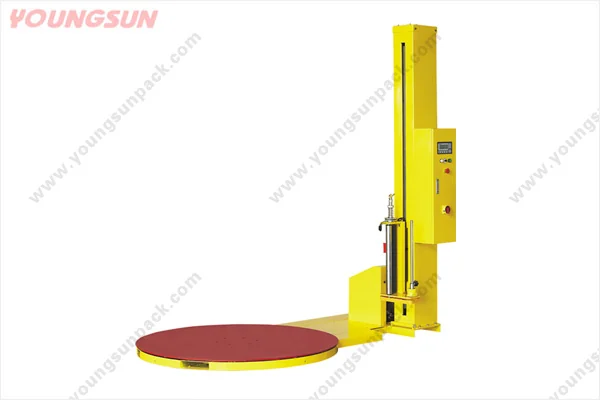
Shown as a configuration reference. Availability and the equipment offered for your project are confirmed separately.
Compare turntable, rotary arm and film delivery
A turntable rotates the pallet, while a rotary-arm system carries film around a stationary load. Assess which movement is acceptable for the heaviest or least stable product and reserve the required guarded area. Mechanical film stretch and powered pre-stretch should be compared with the actual film grade, carriage settings and load profile. Specify wrap programs, bottom reinforcement, top reinforcement and the treatment of the pallet base. Confirm how load height is detected and how dark or reflective packs behave. Automatic film attachment and cutting should be stated explicitly; they are not implied by an automatic wrapping cycle.
Plan loading access and line interlocks
Show whether a forklift, pallet truck or conveyor delivers the load to the wrapper. Include ramp gradient, turntable height, clearances and the operator’s film-handling position in the site drawing. A conveyor wrapper needs defined pallet stops, transfer geometry and signals for blocked downstream equipment. Review the floor, anchoring and supply connection with the responsible installer. Reserve room for film-roll changes and recovery of a torn film without entering moving equipment. Document entry control and the site’s handling rules before layout approval, particularly where forklifts and people share the surrounding palletizing area.
Compare cost per accepted wrapped load
Include the wrapper, carriage, ramps or conveyors, automatic cut-and-clamp devices, top-sheet equipment and guarding in each quote. Measure film consumed per accepted load rather than using pre-stretch percentage as a saving claim. Add labor for load placement, film attachment, roll changes and recovery. Request wear-part costs for rollers, chains, belts and film clamps along with maintenance intervals for the quoted duty. Freight, installation and training belong in the installed budget. Any transport-damage comparison needs an agreed test and representative loads; the equipment photograph cannot establish how a new packaging pattern will perform in distribution.
Agree a repeatable wrapping and handling trial
Acceptance should use the pallet and film versions identified in the RFQ and cover both a typical load and the difficult edge cases. Record film usage, cycle time, completed loads, carriage behavior, tears and recovery time. Inspect containment at the top, middle and bottom where the chosen test procedure requires it. Include forklift pickup and the agreed transport simulation or handling route, followed by inspection of shifted layers and damaged goods. Test recipe change, film-end handling and restart. Keep the approved wrap settings with the acceptance record so future product or film changes can be controlled.
State OEM and ODM handling requirements
An RFQ should include pallet drawings, load photographs, sample film and the proposed test criteria. OEM requests can cover branding, documentation and interface language. ODM work may include a special load envelope, modified conveyors, automatic film handling or integration with palletizing and warehouse systems. Ask for an engineered layout, responsibility matrix and a versioned control description before approving that scope. Identify film supply and local service arrangements. The referenced manufacturer model illustrates one wrapper arrangement; the final configuration, available options and achieved containment must be verified for the offered project.
Manufacturer configuration references
Review the linked manufacturer information as configuration references. Request the current sheet, included scope and relevant evidence for the exact proposed equipment; these references do not establish an IndustryApex supply relationship.
What should you include in your RFQ?
- Pallet dimensions and entry arrangement
- Load height mass and center of gravity
- Unstable fragile or sharp products
- Loads per shift and arrival pattern
- Forklift or conveyor loading
- Film roll specification
- Required wrap and top cover pattern
- Containment and transport test criteria
- Floor space turntable and ramp
- Power air and environmental conditions
- Maintenance film and wear parts
- OEM automation and destination
For OEM / ODM requests, include the branding, packaging, configuration or engineering changes you need, initial and annual quantities, target market, sample approval and acceptance requirements. Feasibility and commercial scope are confirmed for the specific project.
Need OEM / ODM customization?
Submit branding, packaging, configuration or engineering requirements for this equipment. Include the target market, initial and annual quantities, required changes and acceptance criteria.
Customization feasibility, permitted branding, development responsibilities, minimum quantity, cost and lead time are reviewed for the proposed supplier and configuration before a quotation is confirmed.
Frequently asked questions
When is a rotary-arm wrapper preferable to a turntable?
Consider a rotary arm when keeping the load stationary is valuable for the reviewed heavy or unstable pallet. Compare it with a turntable through actual loads, available floor space, loading access and the required containment test.
How should pre-stretch be evaluated?
Evaluate pre-stretch with the actual film grade, carriage settings and load profile. Measure film consumed per accepted load and inspect containment and damage; a percentage on its own does not establish savings or transport performance.
What loading access does a pallet wrapper need?
The wrapper needs access matched to forklift, pallet-truck or conveyor loading. Show ramp and turntable geometry, pallet clearances, guarded space and film-changing access, and confirm compatibility with the load and site's handling rules.
Does higher pre-stretch always lower packaging cost?
No. Excessive or unsuitable film stretching can cause tears, poor containment or product damage. Compare total film use and completed loads under an agreed handling test, including bottom reinforcement, top wraps and recovery losses.
How do I accept a wrapping machine?
Run typical and difficult pallets with approved film. Record cycle time, film use, tears, interventions and containment, then perform the agreed handling or transport test. Include recipe changes, film-end recovery and restart in the acceptance record.
Can wrapping patterns and handling be customized?
Yes. Request wrap recipes, load envelopes, automatic film handling, conveyors and OEM presentation through the inquiry. Engineered changes require reviewed layouts, load trials and clear responsibility for guarding, controls and accepted wrapped-load performance.
Reference information
- YOUNGSUN: MH-FG-1000A pallet stretch wrapper
Reference data and images explain equipment configurations. IndustryApex engineers confirm the offered model, specification and commercial scope in your project quotation.