
Choose seal-band protection based on contaminant type, deposition rate and duty cycle. Request protective-cover options, wiper compatibility and documented cleaning intervals for the quoted mechanically jointed or magnetically coupled configuration. Test representative samples at the intended stroke contamination level and record carriage motion, air leakage and position accuracy before and after the contamination exposure period.
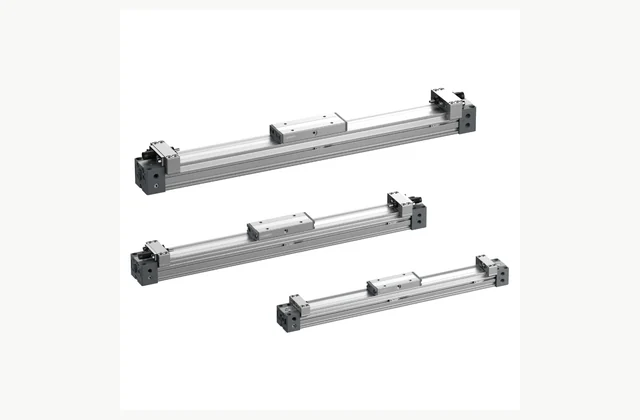
Shown as a configuration reference. Availability and the equipment offered for your project are confirmed separately.
Rodless pneumatic actuators use a flexible sealing band that runs the full stroke length to contain pressurized air and keep contaminants outside the cylinder. Dust, metal chips, coolant mist or sticky residues along the travel path can damage this band, increase friction and cause air leaks. The sealing arrangement differs between mechanically jointed and magnetically coupled designs, and protection requirements depend on contaminant type, deposition rate and duty cycle.
When does seal band contamination require additional protection?
Assess the contamination exposure for your specific application environment. Occasional fine dust in a clean assembly area may not need extra covers, while continuous metal-cutting chips, abrasive grit or sticky oils usually require mechanical barriers. The decision depends on particle size, deposition rate, chemical compatibility with elastomer seals and the consequences of gradual seal wear or sudden leakage.
Mechanically jointed rodless cylinders use an external carriage that passes through a longitudinal slot sealed by inner and outer bands; contaminants can enter at this opening during every stroke. Magnetically coupled designs avoid the external slot but may still need covers if magnetic dust or ferrous particles accumulate on the cylinder body and interfere with force transmission.
Compare seal band protection methods
| Protection method | Contamination addressed | Application boundary | Evidence to request |
|---|---|---|---|
| Integral protective cover (bellows or fixed shield) | Chips, coolant spray, coarse particles along stroke | Adds envelope width and weight; may limit sensor access or intermediate carriage positions | Cover material, installed dimension, sensor mounting options, cleaning access and cover replacement procedure |
| External wipers or scrapers at carriage entry | Fine dust, dry powder, loose debris that can be swept away | Does not seal against pressurized liquid jets or sticky contaminants; wiper wear adds a maintenance item | Wiper material, retention method, expected service interval and compatibility with the quoted carriage design |
| Purge air curtain or positive enclosure pressure | Airborne dust, mist or fume that settles during idle periods | Requires continuous clean air supply, added piping and flow monitoring; does not remove deposited material | Purge flow rate, supply pressure, enclosure sealing, flow verification method and effect on cylinder speed |
| Scheduled manual cleaning and seal inspection | Low deposition rate or intermittent exposure where mechanical barriers are impractical | Depends on operator discipline and access; does not prevent contamination entry between cleaning cycles | Cleaning interval recommendation, approved cleaning agent, seal inspection criteria and wear indicators |
Define the contamination exposure and protection requirement
Provide the following application details so the supplier can recommend a suitable configuration:
- Contaminant description: particle size, chemical composition, magnetic properties, whether dry or mixed with liquid, and whether abrasive or sticky
- Deposition rate and coverage: continuous heavy exposure, intermittent light dust or occasional splash; whether contamination covers the full stroke or only specific zones
- Carriage duty cycle: strokes per hour, dwell time at contaminated positions and total operating hours between scheduled maintenance
- Temperature and humidity: conditions that may cause condensation, hardening or chemical interaction with seal materials
- Installed orientation: horizontal travel allows settled debris to remain on the band; vertical or inverted installations may allow gravity-assisted cleaning or accelerated buildup
- Cleaning access: whether the actuator can be isolated, whether covers must be removable without disassembly, and available utilities for cleaning
Request configuration-specific seal protection evidence
Ask the supplier for written confirmation of the following:
- Seal band material specification and chemical compatibility with the identified contaminants
- Protective cover availability, material, installed dimensions and effect on sensor mounting or intermediate stops
- External wiper or scraper options, retention method and expected service life in the described environment
- Recommended cleaning interval, approved cleaning agents, inspection procedure and replacement seal part numbers
- Test or field experience with the proposed configuration in a comparable contamination environment, including documented stroke count, observed wear and any recorded seal failures
Mechanically jointed rodless cylinder families include protective cover variants [S2], but availability, dimensions and integration with the selected bore size, stroke and sensor arrangement must be confirmed for your quoted configuration.
Agree contamination acceptance criteria before ordering
Run representative stroke cycles at the intended contamination exposure level. Measure and record:
- Carriage motion smoothness and friction changes over the test duration
- Air leakage rate or pressure drop before, during and after contamination exposure
- Position signal accuracy and repeatability at critical stops
- Visible seal wear, debris accumulation or cover damage at the end of the test period
Define acceptable limits for each measurement, the test duration or stroke count, responsibility for sample contamination and witness, and the corrective action if results fall outside the agreed range. Document whether protective covers, wipers or cleaning intervals form part of the acceptance configuration or remain a recommended option.
Buyer decision checklist: seal band contamination protection
- Describe contaminant type, size, deposition rate and chemical properties
- State carriage duty cycle, dwell time and total operating hours between maintenance
- Identify installed orientation, temperature, humidity and cleaning access
- Request protective cover options, dimensions, material and sensor compatibility
- Request external wiper or purge-air suitability and integration details
- Obtain seal material specification and chemical compatibility confirmation
- Agree cleaning interval, approved agents, inspection criteria and seal replacement procedure
- Define contamination test sample, duration, measurements and acceptance limits
- Record which protection features are included in the quoted configuration and which are optional
IndustryApex engineers assess the contamination environment, recommend a suitable seal protection method and confirm the supplied configuration, cleaning support and acceptance test scope in your rodless pneumatic actuator project quotation. Review the complete equipment selection process in the product guide, and compare rodless pneumatic actuator RFQ requirements to prepare a defined project brief.
Define your equipment requirements
Review the Rodless pneumatic actuator buying guide for the complete equipment scope.
Discuss this equipment project ↗ · OEM requirements · ODM requirements. Configuration and feasibility are reviewed for your application.
Explore the Rodless pneumatic actuator buying guide and RFQ checklist ↗
Frequently asked questions
How do I decide whether my rodless actuator needs a protective cover?
Assess contaminant type, particle size, deposition rate and duty cycle. Continuous metal chips, abrasive grit or sticky oils usually require mechanical covers or wipers. Occasional fine dust in a clean area may not. Request the supplier's recommendation based on your specific contamination description, stroke frequency and maintenance interval, and ask for test or field evidence in a comparable environment.
What is the difference between seal protection for mechanically jointed and magnetically coupled rodless cylinders?
Mechanically jointed designs have an external slot and carriage that exposes the sealing band along the full stroke; covers or wipers are often retrofitted to shield this opening. Magnetically coupled cylinders have a closed tube, but ferrous contaminants or magnetic dust may still interfere with force transmission. Confirm the coupling concept and request configuration-specific protection options for your quoted model.
Can I add external wipers to an existing rodless actuator?
Wiper compatibility depends on the carriage design, mounting features and clearance. Request the wiper retention method, material specification and installation procedure for your exact model and bore size. Some configurations require factory-fitted wipers; field-added scrapers may not seal effectively or may interfere with position sensors.
How do I determine the cleaning interval for seal bands?
Run a contamination exposure test with representative stroke cycles, monitor friction, air leakage and position accuracy, and inspect the seal band at intervals. Agree acceptable wear limits and the test duration with the supplier. The cleaning interval depends on your actual deposition rate, not a universal recommendation. Document the interval, approved cleaning agents and inspection criteria in the acceptance record.
What seal band contamination evidence should I request before ordering?
Ask for seal material specification and chemical compatibility with your identified contaminants, protective cover or wiper availability and installed dimensions, recommended cleaning interval and procedure, replacement seal part numbers, and any documented test or field experience in a comparable contamination environment. Confirm which protection features are included in the quoted price and which are optional.
Does a protective cover affect sensor mounting or intermediate carriage stops?
Yes, covers add envelope width and may block sensor access or limit switch adjustment. Request the installed dimension, sensor mounting options and any restrictions on intermediate stop positions for the proposed cover configuration. Compare the protected envelope with your machine layout and verify that cleaning access remains practical.
Reference information
- WEB Catalog |SMC CORPORATION
Reference data and images explain equipment configurations. IndustryApex engineers confirm the offered model, specification and commercial scope in your project quotation.