
Pre-bending capacity and rolling capacity are separate duties. Submit plate grade, yield strength, width, thickness, target diameter range and allowed flat ends. Request written confirmation that the proposed four-roll machine handles both the pre-bending operation and the final rolling duty for your smallest and largest shells.
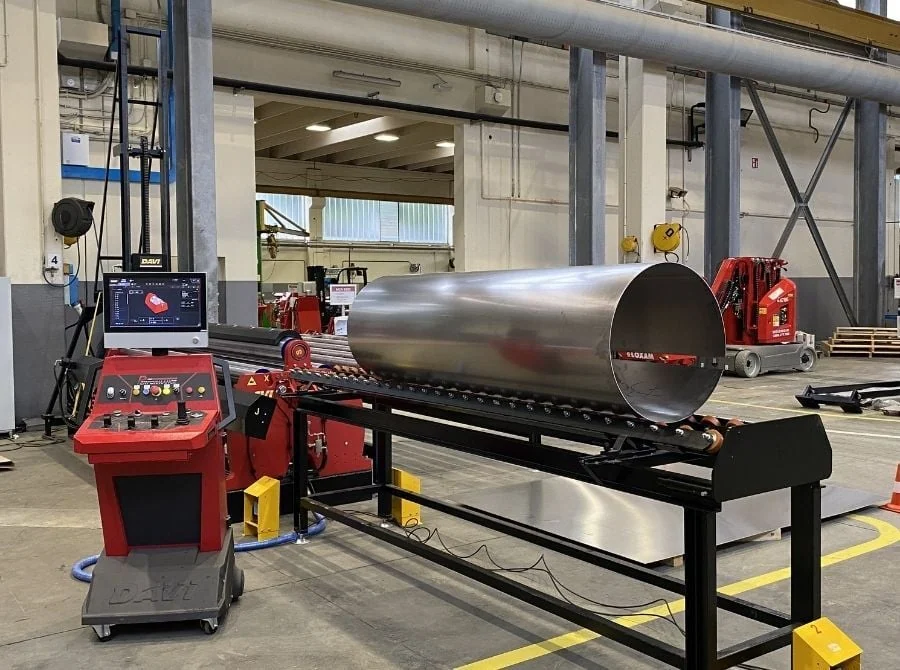
Shown as a configuration reference. Availability and the equipment offered for your project are confirmed separately.
Pre-bending and rolling as distinct duties
A four-roll plate roller typically incorporates pre-bending into the rolling process, reducing or eliminating separate end-forming steps. The DAVI MCA four-roll design “ensures the shortest possible flat end, eliminating manual pre-bending” [S1]. However, pre-bending capacity and full-thickness rolling capacity may not be identical for every machine configuration. The pre-bending operation forms the leading and trailing plate edges before the main rolling pass, and its success depends on roll diameter, hydraulic force, plate yield strength and target shell diameter.
Provide the actual plate grades and their yield strengths, not only mild-steel ratings. Higher-strength materials require greater roll force and may limit the minimum diameter or maximum thickness the machine can pre-bend in one pass. Confirm that the proposed configuration handles both the pre-bending duty and the final rolling duty for the specified plate width, thickness and smallest required diameter.
Buyer inputs for capacity confirmation
Build a capacity inquiry around the following project-specific data:
| Input category | Required detail | Why it matters |
|---|---|---|
| Plate material | Grade designation, yield strength | Determines roll force and springback behavior |
| Dimensions | Width range, thickness range, combinations of width and thickness | Machine rating applies to specific width-thickness pairs, not independent maximums |
| Shell geometry | Minimum cylinder diameter, maximum cylinder diameter, cone angles if applicable | Small diameters and cones increase roll loading; confirm both limits are covered |
| Flat ends | Maximum permitted straight length at each plate edge after pre-bending | Defines whether the machine’s integrated pre-bending meets your quality requirement |
| Surface finish | Coated, polished or cosmetic plates; marking restrictions | Influences roll surface material and support arrangement |
Request a written capacity review covering the hardest combinations: thickest high-strength plate at minimum diameter, widest plate at maximum thickness, and any cone work with its required taper. A favorable rating on mild steel at a large diameter does not prove the machine will pre-bend high-strength plate at a small diameter.
Configuration features affecting pre-bending performance
Four-roll machines position a top roll and a bottom roll as the main bending pair, with two side rolls that provide support and influence the plate path. Planetary guides or servo-controlled positioning systems adjust roll parallelism and help maintain uniform pressure across the plate width. Hydraulic cylinders apply force to the top roll, and their capacity, together with roll diameter, determines the maximum bending moment.
Ask which roll movements are hydraulic, which are manual, and whether the control system coordinates pre-bending force with rolling force automatically or requires operator adjustment between passes. CNC control can store recipes for different plate grades and diameters, reducing setup time and improving repeatability. Confirm whether the proposed machine includes those controls or treats them as optional features.
Roll diameter and minimum shell diameter
Larger roll diameters allow tighter minimum shell diameters for a given plate thickness, but they also increase machine size and cost. Compare the machine’s roll diameter and stated minimum diameter capability against your smallest required shell. If the supplier lists only a maximum thickness without a corresponding minimum diameter, request clarification for each thickness you intend to run.
Side supports and plate handling
Long or heavy plates may need additional side supports to prevent sagging during loading and rolling. Specify the longest plate length and its mass, and confirm whether the machine base includes integrated supports or whether external stands are required. Agree on who supplies supports, how they are positioned, and whether they must be adjustable for different plate widths.
Evidence to request before ordering
Require the supplier to provide:
- Written confirmation that the proposed model and configuration handle all specified plate grades, widths, thicknesses and minimum diameters, with pre-bending included.
- A process sequence showing plate loading, pre-bending of leading and trailing edges, rolling passes and shell removal, with roll positions and forces identified.
- Dimensional drawing showing roll diameters, roll length, machine footprint, headroom and maintenance clearance.
- Control system description: manual, semi-automatic or CNC, and whether recipes can be stored and recalled.
- Hydraulic power unit specification: integrated or separate, pressure rating, reservoir capacity and cooling method.
- Itemized quotation distinguishing the base machine from optional side supports, cone attachments, roll surfacing, CNC upgrade and commissioning.
Request a demonstration or sample trial using representative plate material, thickness and target diameter if the application is critical or if the specified combination approaches the machine’s stated limits. Record the settings, sequence and results, including measured flat ends and shell roundness, so acceptance criteria are clear.
Rejection conditions and alternatives
Reject a proposed machine if:
- The supplier cannot confirm in writing that the configuration handles your smallest required diameter at the specified plate thickness and yield strength.
- Pre-bending force or roll diameter is inadequate for the material strength and target geometry.
- The quotation omits required side supports, cone accessories or control functions, and adding them later would exceed your budget or delivery window.
- No demonstration or trial is offered for a combination near the machine’s limits, and the application is production-critical.
Alternative approaches include:
- A larger four-roll machine with greater roll diameter and hydraulic capacity, accepting higher cost and larger footprint.
- A three-roll machine with separate pre-bending dies or presses, adding process steps but offering flexibility for very thick or high-strength plates.
- Segmented rolling for extremely large diameters or unusual geometries, requiring specialized tooling and setup.
Compare alternatives by total installed cost, floor space, operator skill requirements and the actual cycle time for your most common and most difficult shells, not only the machine’s maximum rating.
Preparing a comparable inquiry
Send each potential supplier the same set of inputs: plate grades and yield strengths, width and thickness combinations, minimum and maximum shell diameter, allowed flat ends, and any cone or special-shape requirements. Attach drawings or samples showing the finished shell geometry and surface finish. Specify your destination, installation window and decision timeline.
Ask each bidder to return a line-by-line response confirming which requirements are met by the base configuration, which require optional equipment, and which cannot be met. Request a dimensioned layout, a process sequence, a controls description and an itemized quotation with delivery terms and commissioning responsibilities identified. This approach makes differences visible and provides a factual basis for comparing machines with different roll arrangements, hydraulic systems and control features.
Discuss your plate rolling requirements and request a configuration review and equipment proposal fromIndustryApex engineering.
Define your equipment requirements
Review the Plate rolling machine buying guide for the complete equipment scope.
Discuss this equipment project ↗ · OEM requirements · ODM requirements. Configuration and feasibility are reviewed for your application.
Explore the Plate rolling machine buying guide and RFQ checklist ↗
Frequently asked questions
What is the difference between pre-bending capacity and rolling capacity?
Pre-bending capacity describes the machine's ability to form the leading and trailing plate edges before the main rolling pass, while rolling capacity covers the full-thickness bending operation across the plate width. Submit grade, yield strength, width, thickness and target diameter for both duties. Request written confirmation that the proposed machine handles your smallest diameter and highest-strength material in a complete process.
Which project data should I send with a four-roll plate roller inquiry?
Send plate grades and yield strengths, width and thickness combinations, minimum and maximum shell diameter, and allowed flat ends. Include cylinder, cone or special-shape requirements, and specify surface finish if cosmetic or coated plates are involved. Attach drawings showing the finished geometry so the supplier can review the actual operating duty.
How do I confirm that a four-roll machine will pre-bend high-strength plate?
Request a written capacity review covering your highest yield strength, thickest plate and smallest diameter combination. Ask for roll diameter, hydraulic force and a process sequence showing the pre-bending step. If the application is critical, require a demonstration using representative material and measure the resulting flat ends against your specification.
What configuration details affect pre-bending performance?
Roll diameter, hydraulic cylinder capacity, side-roll positioning and control system coordination all influence pre-bending. Larger roll diameters and higher hydraulic force enable tighter minimum diameters and higher-strength materials. Ask which features are included in the base machine and which are optional.
When should I reject a proposed four-roll plate roller?
Reject the machine if the supplier cannot confirm in writing that it handles your smallest required diameter, highest yield strength and specified flat-end limit. Also reject if required side supports, cone accessories or control functions are omitted from the quotation and adding them exceeds your budget. Request a demonstration for combinations near the machine's limits before committing to production-critical work.
What evidence should I request before ordering a four-roll plate roller?
Request written capacity confirmation for all specified materials and geometries, a process sequence with roll positions and forces, a dimensional drawing, control system description, hydraulic specification and an itemized quotation. Require the supplier to identify which items are included, which are optional and which remain the buyer's responsibility.
Reference information
- MCA 4-Roll Plate Roll series | Davi
Reference data and images explain equipment configurations. IndustryApex engineers confirm the offered model, specification and commercial scope in your project quotation.