
Select between refrigerated and desiccant air dryers by comparing the achievable pressure dew point against your lowest downstream temperature and end-use moisture requirement. Request configuration-specific performance evidence at your actual flow, pressure and inlet conditions.
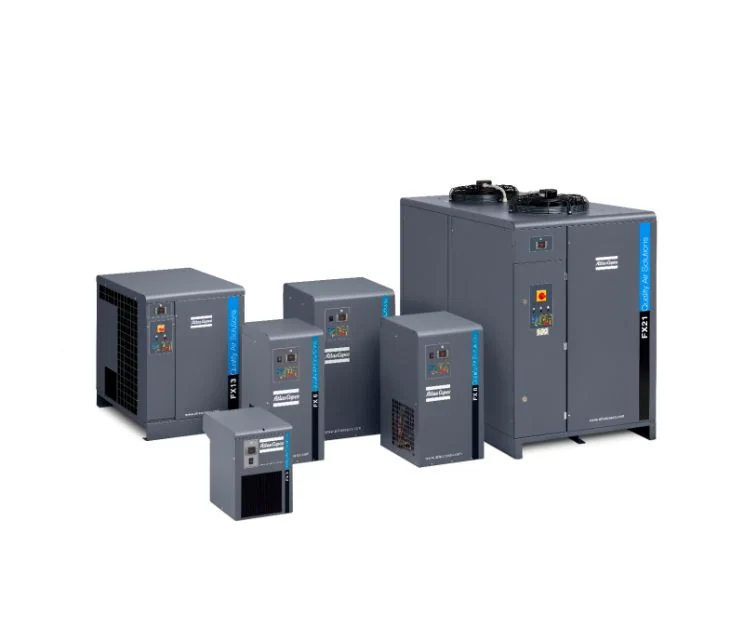
Shown as a configuration reference. Availability and the equipment offered for your project are confirmed separately.
Match pressure dew point to downstream temperature
The selection between refrigerated and desiccant air dryers depends on the lowest temperature your compressed air system will encounter and the moisture sensitivity of the end use. Refrigerated dryers remove moisture by cooling the air stream and condensing water vapor, then reheating to prevent downstream condensation under normal conditions. Desiccant dryers use anadsorbent material to capture water vapor and can achieve significantly lower dew points for applications exposed to freezing conditions or requiring extremely dry air.
Atlas Copco describes refrigerant dryers as reliable solutions that deliver “a pressure dew point as low as +3 °C/+37.4 °F” [S1]. This performance suits general factory air where downstream piping remains above freezing and processes tolerate moderate residual moisture. When air lines run through unheated areas, when the process demands moisture levels below what a refrigerated dryer can deliver, or when equipment manufacturers specify sub-zero dew points, a desiccant dryer becomes necessary. Do not assume that one technology fits every application; instead, define the required dew point from the downstream duty, then select the dryer type that meets it.
Establish the complete moisture requirement
Identify every location where compressed air temperature could drop below the dryer outlet dew point. External pipe runs, poorly insulated compressor rooms, seasonal ambient swings and process cooling all create condensation risk. Record the coldest expected temperature at each use point, not just the average or the compressor-room condition. A refrigerated dryer outlet dew point will not prevent moisture formation in a pipe section exposed to colder ambient conditions, even though it protects warmer areas.
State the end-use sensitivity separately. Pneumatic controls, spray painting, pharmaceutical packaging and food contact air may carry moisture limits stricter than simple condensation prevention. Obtain those limits in writing from the equipment maker or process standard, then add a margin for installation pressure drop, measurement uncertainty and load variation. Use that combined requirement—lowest temperature and process moisture limit—as the selection criterion, and request written confirmation that the proposed dryer configuration meets it at the specified flow, pressure and inlet conditions.
Decision factors beyond dew point capability
Refrigerated dryers generally involve lower initial cost, simpler maintenance and no consumable desiccant replacement. They operate continuously with modest power consumption and require straightforward condensate drainage. Desiccant dryers consume a portion of the dried air for regeneration, add capital and desiccant replacement expense, and need more complex control and maintenance procedures. These differences matter when the application permits either technology.
When the required dew point falls near the boundary between the two technologies, compare the complete operating cost, including compressed air purge loss, desiccant service, energy and the consequence of a dew point excursion. A refrigerated dryer may suit the base load while a smaller desiccant unit protects critical circuits. Alternatively, improved insulation or heat tracing might raise the minimum downstream temperature enough to allow a refrigerated solution. Evaluate these trade-offs with actual cost and risk data rather than generic preference.
Configuration and sizing confirmation
Request the dryer’s rated dew point at your actual operating pressure, inlet temperature and flow. Manufacturers rate equipment at reference conditions; deviations reduce capacity or raise the outlet dew point. High inlet temperature, low pressure or peak flow above the nominal rating all degrade performance. Ask the supplier to apply corrections and state the guaranteed dew point under the worst credible combination of pressure, temperature and flow your system will experience.
For a refrigerated dryer, confirm condenser cooling arrangement, ambient limits and cycling or continuous control. For a desiccant dryer, specify regeneration type—heatless, heated or blower purge—and the corresponding air consumption, utility requirements and desiccant service interval. Both types need upstream filtration to protect internal components; define filter grade, differential pressure allowance and change intervals as part of the complete moisture-removal system, not just the dryer alone.
Buyer input worksheet
| Required Input | Buyer Data | Rejection Condition | Evidence to Request |
|---|---|---|---|
| Lowest downstream air temperature | [State coldest pipe/use-point temperature] | Proposed dew point at or above this temperature | Rated dew point at actual pressure, flow, inlet temp; written confirmation of suitability |
| End-use moisture limit | [Specify process or equipment requirement, ppm or dew point] | Dryer cannot meet stated limit | Test certificate or third-party validation showing compliance at operating condition |
| Actual flow and load profile | [Peak, average, minimum flow; duty cycle] | Dryer sized for nameplate flow only, ignoring peaks or inlet-temp derating | Sizing calculation with corrections; guaranteed dew point at stated flow/temp/pressure combination |
| Working and minimum pressure | [Operating pressure range] | Rating assumes higher pressure than actual system delivers | Capacity curve or correction factor for actual pressure; pressure-loss specification |
| Maximum air inlet temperature | [Highest compressed air temp entering dryer] | Inlet temp exceeds dryer’s rated limit or requires unconfirmed aftercooler | Rated inlet-temp range; proposed precooling if needed; effect on dew point and capacity |
| Ambient and installation conditions | [Compressor-room temp range, ventilation, outdoor/indoor] | Ambient exceeds dryer’s cooling capacity or freezing risk not addressed | Ambient rating; condenser clearance and ventilation requirement; cold-start protection if applicable |
| Desiccant purge and utility cost | [If desiccant: compressed air cost, electricity cost, acceptable purge loss] | Purge loss or energy cost not disclosed; operating expense exceeds budget | Purge air consumption as percentage of rated flow or actual volume; heater power if heated regen; annual desiccant replacement cost |
| Filtration and condensate scope | [Existing filters, drain type, condensate disposal method] | Dryer quote assumes filters/drains supplied separately without stating so | Itemized scope: inlet filter grade and included/excluded; drain type and supply responsibility; outlet filter if required |
| Monitoring and acceptance test | [Required dew-point indication, alarm, test procedure] | No dew-point verification method included; acceptance criteria not defined | Dew-point display or sensor specification; proposed test conditions and acceptance limits matching the required dew point |
Compare complete system cost and risk
Assess the installed cost including filters, drains, bypass piping, electrical connection, condensate treatment and commissioning. Add annual expense for energy, purge air loss, desiccant or refrigerant service, and filter replacement. Compare these figures at the same delivery term, currency and support arrangement. A lower dryer purchase price is false economy if it omits necessary components, requires expensive purge air, or lacks local service for the supplied configuration.
Evaluate the consequence of a dew-point excursion. If moisture damages product, corrodes tooling, or creates a safety hazard, the investment in redundant capacity, backup systems, or a lower-dew-point design may be justified. If occasional condensation is merely inconvenient and temporary, a simpler configuration with routine monitoring suffices. Align the system’s complexity and cost with the actual risk and the downstream impact of a moisture event.
Acceptance and ongoing verification
Agree on a written acceptance procedure that measures pressure dew point, flow, pressure and inlet temperature simultaneously under representative production conditions. Record ambient temperature and verify that condensate drains operate correctly. Check dew point at the critical use point, not only at the dryer outlet, to confirm that downstream piping and any additional coolers do not introduce condensation. Repeat this verification after any system modification, seasonal ambient change, or capacity addition that alters the original assumptions.
Establish a monitoring and maintenance schedule. Refrigerated dryers need periodic condenser cleaning, refrigerant checks and drain inspection. Desiccant dryers require desiccant replacement, filter changes and purge-valve service. Assign responsibility for each task, obtain the manufacturer’s service intervals for the specific model, and keep maintenance records linked to the commissioning baseline. Treat dew-point drift or condensate appearance as a signal to inspect the system before process damage occurs.
IndustryApex engineers assess application requirements, compare refrigerated and desiccant configurations, and prepare equipment proposals with complete scope and acceptance criteria. Discuss your moisture requirement, downstream temperatures and operating conditions to receive a detailed quotation matching your compressed-air system. Visit the refrigerated air dryer guide for broader product selection information.
Define your equipment requirements
Review the Refrigerated air dryer buying guide for the complete equipment scope.
Discuss this equipment project ↗ · OEM requirements · ODM requirements. Configuration and feasibility are reviewed for your application.
Explore the Refrigerated air dryer buying guide and RFQ checklist ↗
Frequently asked questions
When does a desiccant dryer become necessary instead of a refrigerated type?
A desiccant dryer is required when the lowest downstream air temperature falls below the refrigerated dryer's achievable dew point, typically when pipes are exposed to freezing conditions, or when the end-use process specifies a sub-zero or very low moisture limit that a refrigerated unit cannot deliver. Define both the coldest temperature and the process requirement, then select the technology that meets the stricter of the two.
What buyer inputs determine whether a refrigerated dryer will prevent condensation?
Provide the lowest downstream air temperature at any use point or pipe section, the end-use moisture requirement, actual flow and load profile, working and minimum pressure, and maximum air inlet temperature. The supplier must confirm that the proposed dryer delivers the required dew point under all these conditions, not just at rated reference conditions.
How should I compare the operating cost of refrigerated versus desiccant dryers?
Request itemized annual costs for energy consumption, compressed-air purge loss for desiccant types, desiccant or refrigerant service, filter and drain maintenance, and any required utility connections. Include the cost of omitted scope such as filters, condensate treatment and monitoring, so comparisons reflect the complete installed system at your actual operating conditions and electricity rates.
What configuration details must the dryer quotation specify?
The quotation must state rated and guaranteed dew point at your actual pressure, flow and inlet temperature; ambient and inlet-temperature limits; included and excluded filtration, drains and bypass components; pressure-loss allowance; electrical and condensate-disposal requirements; and the acceptance test procedure with defined pass criteria. Request corrections for any deviation from the manufacturer's reference rating condition.
Can I verify dryer performance after installation?
Yes, measure pressure dew point, flow, pressure and inlet temperature simultaneously under representative production load and ambient conditions. Check dew point at the critical downstream use point, verify drain operation, and compare results against the agreed acceptance criteria. Repeat verification after system changes or seasonal ambient shifts that alter the original operating assumptions.
What evidence should I request to confirm the dryer meets my moisture requirement?
Request the rated dew point with sizing corrections applied to your flow, pressure and inlet temperature; written confirmation that this dew point satisfies your lowest downstream temperature and end-use moisture limit; a capacity curve or correction factors; the proposed acceptance test conditions; and documentation of filtration, drain and monitoring scope. Ensure the supplier states what is included and what remains your responsibility.
Reference information
- FX industrial refrigerant air dryers - Atlas Copco USA
Reference data and images explain equipment configurations. IndustryApex engineers confirm the offered model, specification and commercial scope in your project quotation.