
Servo hydraulic press control converts force and position signals into programmed motion profiles with monitored verification. Specify force-displacement curves, approach and working speeds, dwell conditions and acceptance boundaries. Request cycle records, configuration drawings and commissioning evidence tied to your actual forming sequence and part drawings.
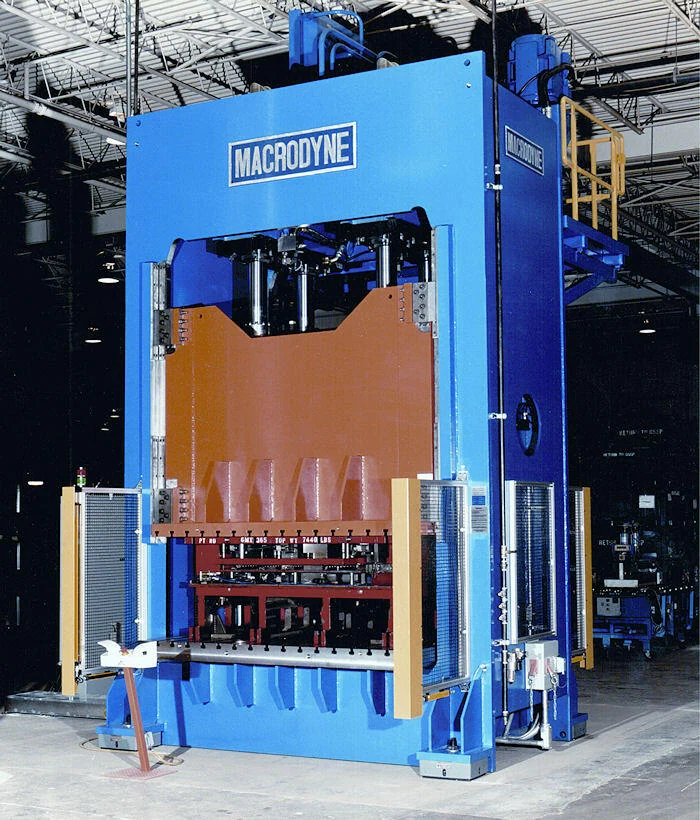
Shown as a configuration reference. Availability and the equipment offered for your project are confirmed separately.
Control modes and selection criteria
Servo hydraulic press systems apply closed-loop control to ram position, velocity and force throughout the stroke. The servo valve or proportional valve responds to programmed motion profiles rather than operating at fixed speed. This control architecture enables custom force-displacement curves, variable approach and forming speeds, programmable dwell and monitored acceptance limits for each production cycle.
Traditional hydraulic presses regulate pump flow and pressure with mechanical or fixed-speed valves. Servo control adds programmable motion segments, real-time force and position feedback and recorded cycle evidence. Macrodyne Technologies offers servo-controlled programmable motion as optional equipment on their metalforming press family [S1]. That reference does not establish universal servo applicability or guarantee the same configuration from another supplier. Compare the offered control capability against your documented force-displacement requirement.
Buyer application inputs
Define the complete forming process before evaluating servo control options. Submit part and process drawings, material properties, force-displacement requirement and tooling envelope. Identify which motion segments need independent speed control, where dwell is required and what force tolerance the part will accept. Mark critical forming zones where force or position monitoring must trigger an alarm or stop. Request the supplier to confirm which process stages the proposed control system will execute and monitor.
Distinguish approach, working stroke, bottom dwell and return as separate motion segments. State target speeds, force ramp rates and position windows for each segment. If the process includes cushion or ejector motion, describe their timing and force relationship to the main ram. Provide representative force-stroke curves from trial or simulation work when available. Ask the supplier to show how the proposed system will reproduce that profile and what deviation the controller can detect.
Force and displacement monitoring requirements
Servo hydraulic systems measure ram position with linear transducers and force with load cells or pressure transducers. The controller compares measured values against programmed limits throughout the cycle. Specify which parameters must be recorded, displayed in real time and archived for quality traceability. Define acceptable force and position windows at key process points rather than assuming the supplier’s default monitoring will suit your part acceptance.
Request sample force-displacement plots from the proposed system operating at relevant speeds and forces. Verify sampling rate, resolution and alarm response time against your part tolerance and cycle duration. Ask how recorded data will be stored, exported and linked to part serial numbers or batch identifiers. Confirm whether monitoring is passive (recording only) or active (stops the press on deviation). Require written commissioning evidence showing that alarm thresholds and stop functions operate as agreed.
Motion profile configuration and limits
Programmable servo control allows multi-segment motion with independent speed, acceleration and force limits in each segment. Define how many motion segments your process needs and what transitions occur between them. Typical segments include rapid approach to near-contact, controlled forming at programmed force or displacement rate, dwell at bottom position and variable-speed return. State maximum and minimum speeds, ramp rates and dwell duration for each segment.
Ask the supplier to provide the controller’s motion programming interface, whether that is graphical touch-screen entry, parameter files or integration with your existing production management system. Request training and editable documentation for the exact supplied controller. Confirm what happens when a programmed profile exceeds the press’s hydraulic flow, force or structural capacity. Require commissioning to include running your representative part through the agreed motion profile and verifying force, position and timing against the submitted process requirement.
Decision table: control mode selection
| Control mode | Suitable applications | Required buyer inputs | Reject if | Evidence to request |
|---|---|---|---|---|
| Fixed hydraulic | Constant-force operations, simple press-to-stop cycles | Maximum force, stroke, speed; basic sequence description | Process needs variable speed, force ramping or dwell control | Cycle time at rated conditions; pressure and flow ratings |
| Proportional valve | Adjustable speed and force; limited motion segments | Speed range, force-displacement zones, basic motion profile | Multi-segment motion, tight force tolerance or cycle recording needed | Valve response time; pressure and position feedback specifications |
| Servo hydraulic | Complex force-displacement curves, variable dwell, monitored cycles | Detailed force-displacement curves, motion segments, monitoring points, acceptance windows | Process fits fixed control at lower cost; monitoring infrastructure absent | Sample force-displacement plots; controller documentation; commissioning plan; cycle data format |
Integration and commissioning scope
Servo hydraulic control requires integration between the press controller, servo valve, transducers and plant systems. Define communication protocols, data formats and network security requirements in the inquiry. Ask the supplier to identify which integration tasks are included, which require your site resources and which are optional services. Obtain wiring diagrams, I/O lists and software configuration files before installation begins.
Commissioning must include motion profile verification, alarm function testing and representative part trials with recorded results. Agree the acceptance criteria in writing before commissioning starts. Require the commissioning report to document programmed parameters, measured performance and deviations from the target profile. Retain configuration backups and parameter records with the acceptance documentation so future changes have a known baseline.
Comparison with alternative control methods
Fixed-speed hydraulic presses cost less and suit operations where force and speed are constant. Proportional valve systems add adjustable speed and force without full programmable motion. Mechanical servo presses provide programmable motion but with different force-stroke characteristics and higher structural loads during rapid deceleration. Evaluate each control type against your documented process requirement rather than selecting based on technology category.
Servo hydraulic systems offer variable force-displacement profiles within the hydraulic force capacity and available flow. Mechanical presses generate force through crank or eccentric linkage, creating a fixed relationship between slide position and available force. If your process needs high force near bottom dead center with minimal force during approach, hydraulic force generation may better suit the forming operation. If the process benefits from stored flywheel energy and very short contact time, a mechanical press may be preferable. Compare the proposed system’s force-stroke capability against your process data rather than assuming one control method is universally superior.
Quotation and acceptance boundaries
Request itemized pricing for the base press, servo control package, transducers, monitoring software and commissioning services. Ask the supplier to state what motion capabilities, force and position resolution and data recording are included versus optional. Obtain separate prices for training, spare controller modules and software updates. Align delivery terms, payment milestones and acceptance test responsibilities across all bidders.
Define the acceptance test using your actual part, die and motion profile. Specify force and position tolerances, cycle time and repeatability over a documented sample size. Require recorded force-displacement plots for the acceptance sample. Agree what constitutes a deviation requiring rework versus normal variation. Link payment milestones to completed acceptance rather than equipment arrival. Require the supplier to deliver final configuration files, parameter records and as-built drawings before the final payment is released.
Safety and operational limits
Programmable motion does not eliminate the need for guarding, interlocks and operator protection. Review the complete operation including setup, die changes and maintenance access. Confirm that programmed motion profiles respect the press’s structural, hydraulic and thermal limits. Ask how the controller prevents motion commands that exceed safe operating boundaries. Require the supplier to provide a safety review covering the exact installation arrangement and operating procedures.
Do not assume that servo control provides automatic safe operation or eliminates operator training. The controller executes programmed motion; it does not assess whether that motion is safe for the actual die, part or operating condition. Establish clear procedures for motion profile changes, alarm response and emergency stops. Train operators and setup personnel on the specific controller interface and require documented competency before unsupervised operation begins.
IndustryApex engineering and supply support
IndustryApex professional engineers work directly with customers on application assessment, servo hydraulic press configuration and integration requirements. Discuss your force-displacement profile, motion segments and monitoring needs with IndustryApex engineers to obtain a project-specific equipment solution. The company supplies quality industrial equipment and provides China sourcing for premium machinery with configuration, commissioning and acceptance support tailored to your documented process requirement. Visit the hydraulic press product guide for broader selection and RFQ guidance.
Procurement checklist
- Part and process drawings with material properties
- Force-displacement curves for critical forming stages
- Required motion segments: approach, working, dwell, return
- Speed, acceleration and force limits for each segment
- Monitoring points, acceptance windows and alarm conditions
- Data recording, storage and export requirements
- Integration with plant systems: protocols, I/O, security
- Commissioning scope: profile verification, alarm testing, representative part trials
- Configuration documentation: parameters, backups, as-built drawings
- Training plan and documented competency requirements
- Spare modules, software updates and support route
- Acceptance test inputs, tolerances and recorded evidence
Define your equipment requirements
Review the Hydraulic press buying guide for the complete equipment scope.
Discuss this equipment project ↗ · OEM requirements · ODM requirements. Configuration and feasibility are reviewed for your application.
Explore the Hydraulic press buying guide and RFQ checklist ↗
Frequently asked questions
When should I choose servo hydraulic control over fixed-speed operation?
Choose servo control when your process needs variable force-displacement profiles, independent speed control in multiple motion segments, programmable dwell or monitored cycle verification. Fixed hydraulic control suits operations where force and speed remain constant. Submit your force-displacement curves and motion requirements for a configuration recommendation rather than selecting by technology category.
What process information must I provide to evaluate servo hydraulic press control?
Provide part and process drawings, material properties, force-displacement curves and required motion segments with speed, force and dwell specifications for each. Identify monitoring points, acceptance windows and data recording needs. Ask the supplier to confirm which process stages the proposed system executes and what configuration evidence will be delivered.
How do I verify that the servo control system meets my forming requirements?
Require commissioning to include running your representative part through the programmed motion profile with recorded force-displacement plots. Define acceptance criteria covering force and position tolerances, cycle time and repeatability over a documented sample. Request configuration files, parameter records and as-built drawings before final payment.
What integration and commissioning tasks should the supplier include?
Ask the supplier to identify included integration tasks, required site resources and optional services. Obtain wiring diagrams, I/O lists and software configuration files before installation. Commissioning must document motion profile verification, alarm function testing and acceptance results against agreed criteria. Agree responsibilities in writing before work begins.
Can I request servo hydraulic control as an OEM or ODM customization?
Yes. Describe changes affecting motion profile capability, monitoring integration and control interface. State destination, intended production volume and required documentation. Feasibility, development responsibilities, configuration drawings and acceptance scope must be agreed before an offer is finalized. Request a written review rather than assuming any manufacturer reference configuration is available for customization.
Reference information
- Metalforming Presses | Blanking Press | Macrodyne Technologies
Reference data and images explain equipment configurations. IndustryApex engineers confirm the offered model, specification and commercial scope in your project quotation.